
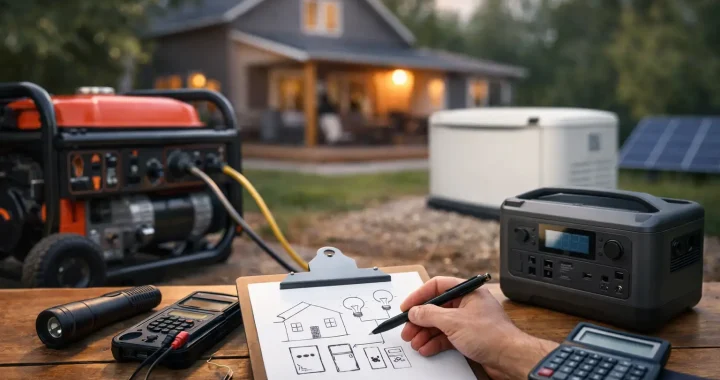
A refrigerator full of food, a CPAP machine at bedtime, a phone at 12% battery – these are the moments when backup power stops being a nice extra and becomes a practical need. This backup power wattage planning guide helps you choose a battery system based on what you truly need to run, how long you need to run it, and the startup demands of the equipment you cannot afford to lose.
The goal is not to power every outlet in the house. It is to build a dependable plan for essential loads, then leave enough operating margin for real-world conditions. A properly sized portable power station delivers quiet, clean electricity without gasoline, exhaust, or the constant attention of a conventional generator.
Start With the Loads That Matter Most
Before looking at power station specifications, decide what stays on during an outage. For many households, that means refrigeration, lights, communication, internet equipment, medical devices, and a way to charge phones. RV users may prioritize a water pump, vent fan, coffee maker, and laptop. A contractor may need battery chargers, work lights, and compact tools.
Make a short list of priority devices, then separate them into two groups: equipment that must run continuously and equipment used only occasionally. A refrigerator may cycle throughout the day, while a microwave or coffee maker runs for only a few minutes. That difference has a major effect on battery capacity.
Avoid planning around appliance labels alone when possible. A label may show maximum input power rather than typical operating consumption. A plug-in watt meter provides the most accurate answer for standard wall-powered devices. If you do not have one, use the manufacturer rating as a conservative starting point.
Backup Power Wattage Planning Guide: Know the Numbers
Two specifications determine whether a backup system can handle your plan: watts and watt-hours.
Watts (W) measure the power a device needs at a particular moment. This tells you whether the power station’s inverter can run the device.
Watt-hours (Wh) measure stored energy. This tells you roughly how long the battery can support your devices.
Think of watts as the size of the pipe and watt-hours as the amount of water in the tank. A large battery with a small inverter may run lights for a long time but still fail to start a high-wattage appliance. A high-output inverter with a small battery may start that appliance but run it only briefly.
For example, a 1,000W power station may have enough continuous output for a refrigerator, router, several lights, and phone chargers operating together. Whether it can support them overnight or for multiple days depends on its usable watt-hour capacity and the refrigerator’s actual duty cycle.
Common Power Ranges
These ranges are planning estimates, not guarantees. Appliance age, operating mode, temperature, and model can change actual consumption.
| Device | Typical Running Watts | Possible Startup Watts | |—|—:|—:| | LED light bulb | 8-15W | None significant | | Phone charger | 5-30W | None significant | | Wi-Fi router and modem | 15-40W | None significant | | Laptop | 45-100W | None significant | | CPAP machine | 30-90W | None significant | | Full-size refrigerator | 100-250W | 600-1,200W+ | | Sump pump | 800-1,500W | 2,000-4,500W+ | | Microwave | 1,000-1,500W | Near running wattage | | Window air conditioner | 500-1,500W | 1,500-3,500W+ |
Motors and compressors deserve special attention. Refrigerators, freezers, pumps, power tools, and air conditioners can draw a short but substantial startup surge. A power station needs adequate surge capability, not just enough continuous wattage, to start them reliably.
Add Running Watts, Then Plan for Surge
Start by adding the running watts of devices you expect to operate at the same time. This is your continuous load estimate.
Consider a basic outage setup: a refrigerator at 180W, internet equipment at 25W, four LED lights at 40W total, two phone chargers at 40W total, and a CPAP at 60W. The estimated continuous load is 345W. In that case, a 500W inverter may appear sufficient, but the refrigerator’s compressor surge could exceed its limit. A system with higher surge capacity and at least 1,000W of continuous AC output offers more practical breathing room.
Do not stack every appliance into one simultaneous-load calculation if you will use them one at a time. A 1,200W microwave and a 900W coffee maker do not require a 2,100W inverter if you will never operate them together. They do require an inverter that can handle the larger device individually, plus any essential loads that remain on in the background.
A useful rule is to add 20% to 30% above your expected continuous load. This reserve helps account for device variation, conversion losses, and the extra loads that appear during a long outage. For motor-driven appliances, verify the listed surge rating rather than assuming reserve alone will solve a startup problem.
Calculate How Much Battery Capacity You Need
Once you know the load, estimate energy use with a simple formula:
Watts × hours of use = watt-hours needed
If a 60W CPAP runs for eight hours, it uses approximately 480Wh. A 30W router operating for 24 hours uses 720Wh. The calculation is straightforward, but intermittent appliances need a better estimate of how long they actually run.
A refrigerator may draw 180W when its compressor is active, but it does not run nonstop. If it runs about one-third of the time over 24 hours, its estimated consumption is 180W × 8 hours, or 1,440Wh. Opening the door frequently, placing it in a hot garage, or storing warm food can increase that number.
Add each device’s estimated daily watt-hours. Then account for inverter and charging losses by adding roughly 10% to 15%. A 2,000Wh battery does not always deliver a full 2,000Wh through its AC outlets. DC-powered devices can often operate more efficiently through USB, USB-C, or 12V outputs when compatible.
For a one-night medical-device plan, a compact power station may be enough. For refrigeration, communications, lighting, and multiple days of uncertainty, larger LiFePO4 power stations and expansion batteries give you a more realistic reserve. Capacity is especially valuable when bad weather limits solar charging.
Match the System to Your Outage Plan
The right size depends on what “prepared” means in your household.
A small essentials plan may cover phones, lights, a router, and a CPAP. This often calls for modest inverter output but enough battery capacity for overnight operation. A home-food-and-communications plan adds refrigerator or freezer support and usually requires stronger surge capability.
A comfort-focused plan might include a window air conditioner, sump pump, microwave, or portable heater. These loads demand careful calculations. Electric resistance heaters consume substantial power continuously, so they can drain even a large battery quickly. Window AC can be workable with the right inverter and battery capacity, but runtime depends heavily on the unit’s efficiency, thermostat setting, and outdoor temperature.
For extended outages, charging strategy matters as much as the battery itself. Solar panels can replenish energy quietly during daylight, but output changes with season, weather, panel angle, shade, and available sun hours. Vehicle charging can help while traveling, though it is typically slower. AC recharging is useful when grid power is restored or when a compatible fuel generator is available as a charging source.
Check the Details That Cause Avoidable Problems
Wattage is the foundation, but a few practical checks prevent a good plan from failing when you need it.
First, confirm the power station has the outlet types and number of ports your setup requires. A device may be within the wattage limit but still need an AC receptacle, regulated 12V output, USB-C PD port, or a specific medical-device adapter.
Second, check whether your essential device requires pure sine wave AC power. Most quality portable power stations provide it, and it is the right choice for sensitive electronics, medical equipment, and many motor-driven appliances.
Third, understand whether a device should be powered directly from the station or through a transfer arrangement. Never connect a portable power station to home wiring or a wall outlet without properly installed, code-compliant equipment. Backfeeding can injure utility workers, damage equipment, and create a fire risk. For whole-circuit backup, work with a qualified electrician.
Finally, test your plan before storm season. Run the refrigerator, charge the devices, check cable lengths, and confirm that everyone in the household knows what stays connected. A backup system is most valuable when it is ready before the lights go out.
Preparedness does not require powering the entire house. It requires knowing your essential loads, choosing enough inverter power to start them, and carrying enough stored energy to keep them running. Build from the equipment you rely on most, leave room for uncertainty, and you will have stable power when the grid is not stable.
