
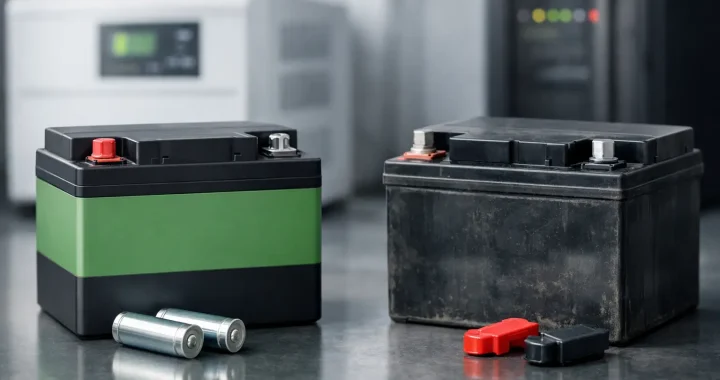
A battery that looks affordable on the shelf can become expensive when an outage lasts through the night, an RV trip runs longer than planned, or a solar setup must recharge before the next storm. In the choice of LiFePO4 versus lead acid batteries, the real question is not simply which battery costs less today. It is which one provides dependable, usable power when you need it.
For most portable power, solar, RV, and emergency-backup applications, LiFePO4 batteries offer longer service life, more usable capacity, faster charging, and much lower weight. Lead acid batteries still have a place, especially for engine starting and basic low-budget setups, but their limits matter when readiness is the priority.
LiFePO4 Versus Lead Acid Batteries at a Glance
LiFePO4 stands for lithium iron phosphate, a lithium battery chemistry widely used in modern portable power stations, expansion batteries, and solar energy storage. It is known for long cycle life, stable performance, and a lower risk of thermal problems than many other lithium-ion chemistries.
Lead acid is the older battery family found in car batteries, many traditional RV house batteries, alarm systems, and entry-level backup banks. Flooded lead acid batteries use liquid electrolyte and require more attention. Sealed AGM and gel batteries reduce maintenance, but they still carry the same fundamental limitations in weight, usable capacity, and cycle life.
The practical difference is easy to see in a common 12V example. A 100Ah lead acid battery may be rated for roughly 1,200 watt-hours, but regularly using more than about half of that capacity can shorten its life. A comparable 100Ah LiFePO4 battery usually delivers far more of its rated capacity without the same penalty. That can mean longer runtime from a battery bank with a similar amp-hour label.
Usable Capacity Matters More Than the Label
Battery ratings can be misleading if you only compare amp-hours. What matters during an outage is the energy you can safely use before recharging.
Most lead acid batteries perform best when discharged to around 50% of their capacity. Going deeper occasionally is possible, but repeated deep discharges accelerate wear. A 100Ah lead acid battery may therefore provide only about 600 watt-hours of practical energy if you want a reasonable service life.
LiFePO4 batteries can typically be discharged much more deeply. Many systems allow 80% to 100% depth of discharge, managed by a built-in battery management system, or BMS. As a result, a 100Ah LiFePO4 battery can often provide roughly 1,000 watt-hours or more of usable energy. Exact output depends on battery voltage, inverter losses, temperature, and the protection settings of the system.
This difference is especially valuable for essentials such as a refrigerator, CPAP machine, modem, lights, laptops, or a small fan. More usable capacity means fewer compromises when grid power is not stable.
Lifespan Changes the True Cost
Lead acid has a lower upfront price, which is its primary advantage. For a rarely used accessory battery or a simple project with a tight budget, that initial savings can be reasonable.
But a battery is a consumable component, not a one-time purchase. A typical deep-cycle lead acid battery may deliver a few hundred cycles when used properly. LiFePO4 batteries commonly provide several thousand cycles, depending on the model, discharge depth, charging conditions, and how the manufacturer defines end of life.
That gap changes the long-term math for anyone who uses solar power regularly, lives in an RV, camps often, or wants to test and rotate backup equipment. Replacing lead acid batteries every few years can cost more over time than buying LiFePO4 once and using it for many seasons.
Cycle life is not the only durability factor. Lead acid batteries gradually lose capacity when left partially charged and can be damaged by sulfation, a condition that develops when the battery remains undercharged. LiFePO4 batteries are generally more forgiving during storage, although every battery should be stored according to its manufacturer’s guidance and checked periodically.
Weight and Charging Speed Affect Real-World Readiness
Moving batteries is not a minor detail when you are loading an RV, carrying equipment to a campsite, or setting up backup power after severe weather. A 100Ah lead acid battery often weighs 60 pounds or more. A LiFePO4 battery with similar nominal capacity may weigh closer to 25 pounds.
Less weight makes portable energy storage easier to deploy and gives RV owners more flexibility with payload limits. It also makes expansion more realistic. Adding several lead acid batteries can quickly become a heavy, space-consuming project.
Charging is another major difference. Lead acid batteries charge slowly, particularly during the final phase of charging. They also become less efficient as they approach full capacity. LiFePO4 batteries can usually accept a higher charging current and maintain that acceptance longer, provided the charger, solar controller, and battery are properly matched.
For solar users, faster charging can be the difference between restoring a battery bank during a short clear-weather window and entering the evening with limited power. For portable power stations, fast AC or solar recharging helps keep essential devices available between outages or travel days.
Performance Under Heavy Loads
Lead acid voltage drops more noticeably under high demand. This effect, sometimes called voltage sag, can reduce the effective capacity available to an inverter powering a refrigerator compressor, power tool, microwave, or other demanding load.
LiFePO4 batteries generally hold voltage more consistently during discharge. That supports steadier inverter operation and allows more of the stored energy to reach your devices. It does not eliminate the need to size a system correctly. A battery’s watt-hours determine runtime, while the inverter’s rated watts and surge capacity determine what it can start and run.
For example, a large battery may have enough energy to run a window air conditioner for a period of time, but the power station or inverter must also have enough continuous and surge output for the unit’s startup demand. Check both numbers before building an emergency plan around a particular appliance.
Safety, Temperature, and System Compatibility
LiFePO4 is often chosen for its stable chemistry, but safe operation still depends on quality design. A well-built LiFePO4 battery or portable power station uses a BMS to monitor voltage, current, and temperature. It should protect against overcharging, over-discharging, short circuits, and charging outside permitted temperature ranges.
Cold weather is the most important trade-off to understand. LiFePO4 batteries should generally not be charged below freezing unless the system has low-temperature charging protection or an integrated heating feature. Discharging in cold weather is usually possible, though available capacity and output can decline. This matters for garages, sheds, RV compartments, and winter camping.
Lead acid batteries also lose performance in cold temperatures, and a discharged lead acid battery can freeze. However, they are less restricted when it comes to cold-weather charging. If your backup battery must remain outside in freezing conditions, confirm its temperature specifications before choosing either chemistry.
Compatibility also matters. A charger designed only for lead acid may not use the right voltage profile for LiFePO4. The same is true for solar charge controllers, RV converters, and older battery monitors. Many newer systems have lithium settings, but assumptions can shorten battery life or trigger protection shutoffs. Portable power stations avoid much of this setup work because the battery, charging system, BMS, and inverter are designed to work together.
When Lead Acid Still Makes Sense
Lead acid is not obsolete. It remains a practical choice for engine starting, where high cranking current and familiar automotive charging systems are the priority. It can also suit a simple standby application where usage is infrequent, weight is irrelevant, and replacement cost matters more than long-term cycling.
AGM lead acid batteries may be useful where a system was built specifically around that chemistry and changing chargers or wiring would add unnecessary expense. They are also widely available, which can help in a repair situation.
Still, for energy storage that will be cycled regularly or relied on during a prolonged outage, the lower purchase price is rarely the whole story. Less usable capacity, slower recharging, heavy weight, and earlier replacement are meaningful costs when power is essential.
Choose the Battery Around the Job
A LiFePO4 power solution is usually the stronger fit for home backup, solar charging, RV living, remote work, camping, and emergency readiness. Look beyond the battery chemistry and confirm the complete system: watt-hour capacity, inverter output, solar input, expansion capability, recharge time, and low-temperature protection.
At Thundervolt Power, that practical approach is central to choosing portable energy storage. A phone and laptop need a very different plan than a refrigerator, medical device, sump pump, or air conditioner. Start with the appliances that cannot wait, estimate how long they need to run, and choose capacity with room for real conditions rather than best-case assumptions.
The right battery is the one that is charged, correctly sized, and ready before the weather changes. Build your power plan while the grid is stable, then you will have a quieter, cleaner option when it is not.
