
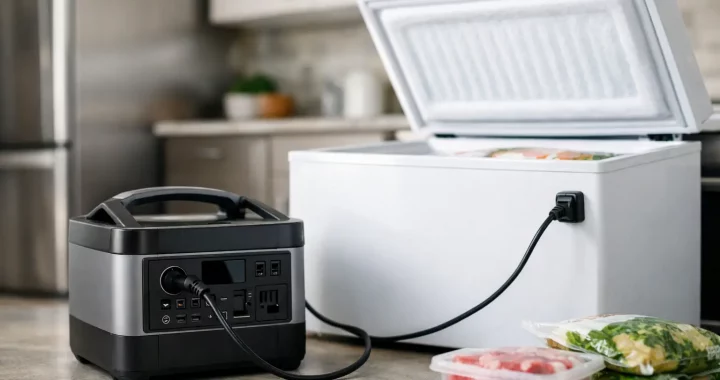
A freezer full of meat, frozen meals, and bulk groceries can turn into a costly loss in a single long outage. If you are shopping for the best emergency battery for freezer backup, the real question is not just what battery is biggest. It is what system can start your freezer, run it safely for the outage you expect, and recharge fast enough to stay useful if the grid stays down.
For most homes, a portable power station with a lithium battery, pure sine wave inverter, and enough surge capacity to handle compressor startup is the right fit. It is cleaner and quieter than a gas generator, easier to keep ready, and practical for overnight outages, storm-related blackouts, and short-term food protection. But freezer backup is one of those jobs where sizing matters. Buy too small, and the unit may never start the appliance. Buy far larger than you need, and you can overspend without gaining much real-world value.
What actually makes the best emergency battery for freezer use?
A freezer is not a constant-load appliance. It cycles on and off as the thermostat calls for cooling. That is good news for runtime, because the compressor does not run every minute. The catch is startup power. A chest freezer or upright freezer may only use around 100 to 300 watts while running, but compressor startup can briefly surge much higher.
That means the best emergency battery for freezer applications needs two things at the same time. First, it needs enough battery capacity, measured in watt-hours, to cover the appliance over time. Second, it needs enough inverter output and surge handling, measured in watts, to start the compressor without tripping.
In plain terms, battery capacity determines how long the freezer can keep going. Inverter power determines whether it can run at all.
Start with your freezer’s real power needs
The label on the appliance is a starting point, but it does not always tell the whole story. Some freezer labels list amps instead of watts. If that is the case, multiply amps by 120 volts to estimate running watts. A freezer drawing 2 amps would be around 240 watts while running.
Still, running watts are only half the picture. Compressor-driven appliances can pull 2 to 3 times their running power for a brief moment at startup. Some freezers surge even higher depending on age, temperature, and compressor condition. If your freezer runs at 200 watts, a safe target is often an inverter that can handle at least 600 watts of surge, and ideally more.
This is why compact battery packs made for phones, lights, or CPAP machines are not enough. You need an emergency power station built for appliance loads.
Battery size matters more than most buyers expect
A lot of people assume they can match a 200-watt freezer with a 200-watt battery system. That is not how backup runtime works. A 200-watt freezer does not use 200 watt-hours every hour unless it runs nonstop. Most freezers cycle, so actual consumption over time is lower.
A good planning range for many residential freezers is roughly 1 to 2 kilowatt-hours per day, though efficient models may use less and older units may use more. Ambient temperature, how often the door opens, and how full the freezer is all affect this. A packed freezer in a cool basement generally performs better than an older upright in a hot garage.
If your freezer averages 1.2 kWh per day, a 1000Wh power station will not usually give you a full 24 hours once inverter losses are included. In real use, it may cover part of a day. A 2000Wh class unit is often a more realistic starting point for meaningful freezer backup, especially if you want margin for startup surges and less-than-perfect conditions.
For outages that may stretch beyond a day, expansion batteries or solar charging become much more relevant. Without a way to recharge, even a large battery is still finite.
LiFePO4 is usually the smart choice
For emergency home backup, LiFePO4 battery chemistry makes sense. It offers long cycle life, strong thermal stability, and dependable performance for repeat use. If you are buying a unit for outages, storm season, and occasional household backup, LiFePO4 generally gives better long-term value than older lithium chemistries built around shorter lifespan expectations.
That does not mean chemistry is the only factor. Battery management, inverter quality, recharge speed, and warranty support matter too. But if you are comparing systems for freezer backup, LiFePO4 is a strong baseline.
Features worth paying for – and features you can skip
For this use case, pure sine wave output is not optional. Your freezer’s compressor is an inductive motor load, and pure sine wave power is the safer, more appliance-friendly choice.
Fast AC recharging is also important. If the power comes back for a few hours and goes out again, you want to refill the battery quickly. A slow-charging unit can leave you exposed during unstable grid conditions.
An expandable system can be worth the extra cost if freezer backup is part of a broader emergency plan. The same battery that protects food can also support lights, routers, phone charging, and a few essentials. If you know you may eventually want longer runtimes, it is often smarter to buy into a platform that can grow.
On the other hand, you do not need to overvalue features that do not help your appliance run. Fancy app controls are convenient, but they should not take priority over inverter headroom, usable capacity, and recharge speed.
How to size the best emergency battery for freezer backup
A practical approach is to work backward from the outage you want to cover.
If your goal is short protection during common outages, such as 4 to 12 hours, a quality power station in the 1000Wh to 2000Wh range may be enough for many efficient freezers. If your goal is full-day coverage, especially in summer or with an older freezer, 2000Wh or more is usually the safer target. If your region sees multi-day outages, look at high-capacity systems with expansion batteries or pair the unit with solar input for daytime recovery.
It also helps to leave headroom. Do not size a system right at the freezer’s minimum requirement. Compressor loads are not perfectly predictable, and emergency backup is one place where extra margin pays off.
As a rule of thumb, many homeowners shopping for freezer backup should look for:
- Pure sine wave AC output
- At least 1000 watts of inverter power, with higher surge capability
- 1000Wh minimum for short outages, with 2000Wh or more preferred for longer coverage
- LiFePO4 battery chemistry
- Fast wall charging and, ideally, solar charging capability
That does not mean every freezer needs the same setup. A small chest freezer in a cool room is different from a large upright opened frequently by a family during an outage.
Battery backup versus gas generator
For freezer protection, batteries solve several problems gas generators create. They start instantly, run quietly, and can be used indoors because they do not produce exhaust. There is no fuel storage, no carburetor maintenance, and no late-night noise issue in a neighborhood after a storm.
The trade-off is runtime. A gas generator can keep going as long as you have fuel. A battery system gives you limited stored energy unless you can recharge it. That is why batteries are especially strong for short and medium outages, apartment living, overnight use, and situations where quiet indoor operation matters. For long outages in rural areas, some households still prefer a layered approach – battery first, then generator or solar support if needed.
When solar charging makes sense
Solar is not required to back up a freezer, but it can extend usefulness during prolonged outages. If you lose power for two or three days after a storm, recharging from portable solar panels can help offset freezer consumption during daylight hours.
The limitation is weather and panel size. Cloud cover, winter sun angle, and shading can reduce production. Solar should be viewed as a recharge strategy, not a promise of unlimited freezer runtime under all conditions. Still, for people building a more resilient home backup setup, it is one of the most practical add-ons.
Who should buy bigger than they think they need?
If your freezer is in a garage, if you live in a hot climate, if your appliance is older, or if your outages regularly last more than half a day, sizing up is usually the safer move. The same goes for households that want one battery to handle more than the freezer. Once you add a refrigerator, internet equipment, lights, or medical devices, small units get stretched quickly.
This is where a curated portable power system from a backup-focused retailer can make the buying process easier. Brands carried by companies like Thundervolt Power often include higher-capacity LiFePO4 platforms designed for real appliance loads, not just weekend gadget charging.
The best setup is the one you will actually have ready before the outage starts. For freezer backup, that usually means a battery system with enough surge capacity to start the compressor, enough stored energy to protect food for the outage window you expect, and enough recharge flexibility to stay useful if conditions get worse. If you plan around those three factors, you are much more likely to keep your freezer cold when the grid does not cooperate.
