
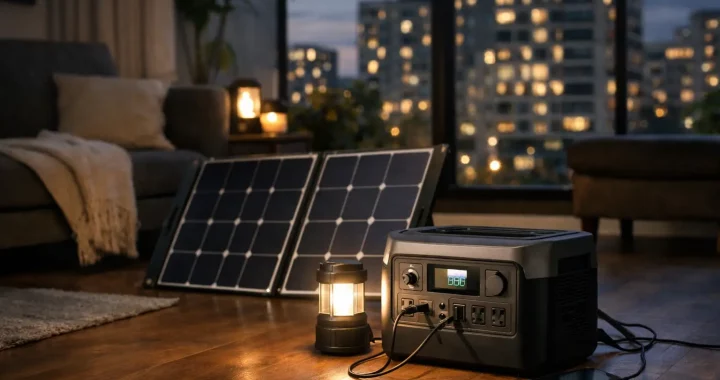
When the lights go out in an apartment, the problem is rarely just darkness. Your phone battery starts dropping, the router dies, refrigerated food becomes a countdown, and if you rely on a CPAP machine, work equipment, or small medical devices, an outage gets serious fast. A solar generator for apartment blackout situations gives you a quiet, indoor-safe backup power option without storing gas, running extension cords from a car, or dealing with the noise and fumes of a fuel generator.
Why a solar generator makes sense in an apartment blackout
Apartment living changes the backup power equation. You usually do not have a garage, backyard, or legal place to run a gas generator safely. Building rules, shared walls, limited storage, and indoor air safety all matter more in a multi-unit space than they do in a detached house.
That is why battery-based solar generators are such a practical fit. They store power in a portable battery station and deliver electricity through AC outlets, USB ports, and DC outputs. You can charge them from the wall before a storm, top them off from your car when needed, and in some cases recharge them with portable solar panels when sunlight is available.
For apartment residents, the biggest advantages are simple: they are quiet, they produce no exhaust, and they can be used indoors. That makes them useful not just for emergencies, but also for everyday readiness.
What a solar generator for apartment blackout use can actually power
This is where expectations matter. A solar generator can be an excellent apartment backup, but the right unit depends on what you need to keep running.
A smaller power station is often enough for phones, tablets, laptops, Wi-Fi routers, lights, modems, rechargeable fans, and a television for a few hours. A mid-size unit can usually add a mini fridge, CPAP machine, work monitors, and charging for multiple devices. A larger system can support heavier loads such as a full-size refrigerator for a limited period, microwave use in short bursts, or even certain window AC units if the inverter and surge capacity are high enough.
What it usually will not do for long is run your entire apartment like nothing happened. Electric stoves, central air systems, space heaters, and large dryers are high-demand appliances. If those are your priority, you need a much larger backup strategy than most apartment setups allow.
The better question is not, can it run everything? It is, what must stay on during the outage?
The two numbers that matter most
If you are shopping for backup power, ignore marketing claims until you check two specifications: wattage and watt-hours.
Wattage tells you how much power the unit can deliver at one time. That determines what devices it can run. Watt-hours tell you how much energy is stored in the battery. That determines how long it can run them.
For example, if your router uses 10 watts and your laptop uses 60 watts, that is a 70-watt load. If your power station has 700 watt-hours of usable battery capacity, you can estimate around 10 hours of runtime in ideal conditions, though real-world losses will reduce that. Add a mini fridge or medical device, and runtime changes quickly.
For many apartment dwellers, a practical starting range is 500Wh to 1500Wh. That range can cover core communications, lighting, device charging, and a few small appliances. If you want to support refrigeration, longer outages, or higher-draw appliances, moving into 1500Wh to 3000Wh territory makes more sense.
On the inverter side, many people should look for at least 600W to 2000W of AC output depending on the devices involved. Pure sine wave output is especially important for sensitive electronics, medical equipment, and modern appliances.
Battery chemistry matters more than most buyers think
In backup power, battery chemistry is not a minor detail. It affects lifespan, safety, and long-term value.
LiFePO4 batteries are often the better choice for apartment blackout preparedness because they offer longer cycle life, strong thermal stability, and dependable performance over time. If you plan to keep a unit charged, use it during outages, and rely on it season after season, LiFePO4 is the kind of feature worth prioritizing.
A cheaper battery may lower the purchase price, but that trade-off can show up later in shorter service life or reduced performance. For emergency equipment, reliability should carry more weight than a small upfront savings.
How to choose the right size for your apartment
Start with your must-run devices, not the biggest machine you hope to power one day. Most apartment blackout plans are built around a short list.
For basic outage coverage, many people only need to keep a phone charged, maintain internet access, power a lamp, and run a laptop. That is a light-load setup, and a compact unit may be enough.
For a more realistic overnight outage plan, add a CPAP, mini fridge, fan, or several hours of television and work equipment. That usually pushes you toward a mid-capacity station.
For extended outages, especially during summer heat or winter storms, it is worth looking at larger units with expansion battery options. Expandability matters because your needs may change. A system that can grow later is often smarter than buying too small and replacing it.
You should also check the startup surge of appliances with motors or compressors. A fridge may run at a moderate wattage once operating, but it can require much more power for startup. If your station cannot handle surge demand, the appliance may not run even if the battery is large enough.
Charging options during a blackout
A lot of people buy a solar generator and focus only on output. Charging speed and charging flexibility are just as important.
Wall charging is still the fastest and most common way to prepare. If severe weather is coming, a fast-recharging unit is easier to top off before the outage starts. Car charging is useful if grid power is down for longer than expected and you need another source.
Solar charging is valuable, but apartment buyers should think realistically about their setup. If you have a balcony, accessible rooftop space, or a sunny window area where portable panels can be placed safely and legally, solar becomes more practical. If your building has limited sun access or strict restrictions, solar may be more of a supplemental feature than a primary recharge method.
That does not make it a bad investment. It just means your charging plan should match your actual living space.
Features worth paying for
Some features sound impressive but do not matter much in a real outage. Others make a clear difference.
A clear display that shows input, output, and remaining runtime helps you manage power before the battery drops too low. Multiple AC outlets and USB-C ports are useful if several people are sharing one station. Built-in fast charging helps if your household depends on phones for communication and alerts.
If you are buying for apartment emergencies, look closely at portability too. A large-capacity unit is less helpful if it is too heavy to move from a closet to the room where you need it. Wheels or handles can matter more than people expect.
For longer-term value, expansion battery compatibility is a strong advantage. It gives you room to start with a manageable system and add capacity later.
Common mistakes apartment buyers make
The most common mistake is buying by price alone and ending up with a unit that cannot handle the devices that matter. The next mistake is going too large without considering storage, weight, and how often the unit will actually be used.
Another issue is assuming solar panels are always easy to use in an apartment. Sometimes they are. Sometimes they are not. Building layout, sun exposure, HOA or lease rules, and weather all affect whether solar charging is realistic.
People also forget to test their backup setup before an emergency. A power station should be charged, updated if needed, and checked with your actual devices in advance. If you rely on medical equipment or refrigerated medication, that testing is not optional.
A practical apartment blackout setup
For many households, the best setup is not the biggest one. It is the one that covers the essentials with enough runtime to get through a night or a full day. That often means a lithium power station with pure sine wave AC output, enough watt-hours for communications and refrigeration support, and charging options that fit apartment life.
If you expect frequent outages or want a wider safety margin, stepping up to a larger, expandable system is a smart move. Brands and models vary, but the right choice usually comes down to load needs, battery capacity, recharge speed, and whether the system fits your space.
Retailers like Thundervolt Power focus on these practical differences because specs only matter if they solve a real problem. In an apartment, backup power is about staying connected, protecting essentials, and keeping your household stable when the grid is not.
A good solar generator should make a blackout feel manageable, not comfortable in every possible way, but controlled enough that you are not scrambling in the dark the next time the power cuts out.
