
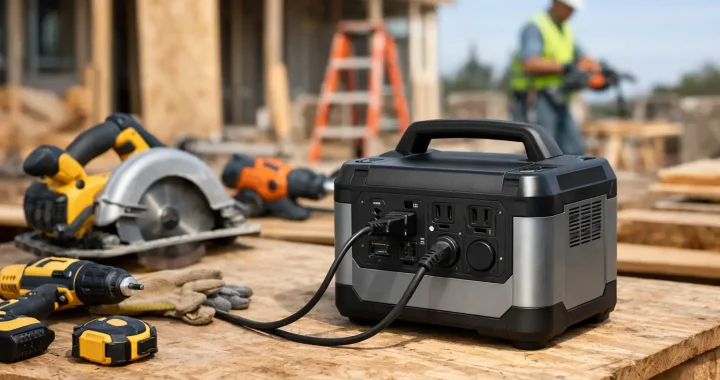
A tripped breaker can slow a crew down. A gas generator that will not start can stop work completely. That is why a portable power station for jobsite tools has become a serious option for contractors, remodelers, mobile service crews, and anyone working where grid power is limited, unreliable, or not available yet.
The appeal is straightforward. You get quiet, instant power without fuel, fumes, or pull-start frustration. But not every battery unit belongs on a jobsite. Some are built for phones and coolers. Others can handle chargers, lights, saws, and short bursts from heavier tools. The difference comes down to power output, battery capacity, surge handling, recharge speed, and how your tools are actually used during the day.
What a portable power station for jobsite tools needs to do
On a jobsite, power demands are not gentle. Even a small circular saw or miter saw can pull a high startup surge before settling into a lower running load. Battery chargers may be easy to run, but they can stay plugged in for hours. Vacuums, compressors, and rotary hammers introduce another layer of demand because they combine startup spikes with sustained draw.
That means a portable power station for jobsite tools should be judged on more than the headline battery size. Watt-hours tell you how much energy is stored, but inverter wattage tells you whether the unit can start and run the tool at all. Surge capacity matters too. A station rated for 2,000 watts with a strong surge buffer may run tools that a lower-quality unit with similar battery capacity cannot.
Battery chemistry also matters. LiFePO4 systems are a strong fit for work use because they offer long cycle life, good thermal stability, and better long-term value than older lithium-ion designs that wear out faster. For buyers who expect regular use rather than occasional emergency backup, that is not a minor detail.
Start with the tools, not the battery
The best buying process starts with your actual load list. Think in terms of three groups: always-on essentials, intermittent tools, and problem tools.
Always-on essentials include work lights, phone charging, tablets, laptops, test equipment, and battery chargers for cordless tools. These loads are usually manageable and predictable. Intermittent tools are things like saws, grinders, nailers with compressors, shop vacs, or mixers that run in short bursts. Problem tools are high-draw items such as large air compressors, heat guns, and some corded demolition tools that may push beyond what a battery station can handle efficiently.
If most of your day revolves around charging cordless batteries and running lights, a mid-size unit can make a lot of sense. If you expect to run corded tools regularly, you need to look harder at inverter rating and surge power, not just watt-hours. In many cases, the smarter setup is to use the power station as the charging hub and reserve direct AC output for selected tools rather than every tool on site.
Wattage, watt-hours, and the runtime question
This is where many buyers get tripped up. A 2,000Wh power station sounds large, and it is, but runtime depends entirely on the load. A 100-watt lighting setup can run for many hours. A 1,500-watt saw used continuously will drain that same battery much faster.
Real jobsite use is usually somewhere in the middle because most tools are not running nonstop. A miter saw may draw heavily for a cut, then sit idle while material is measured and positioned. A vacuum may run in short cleanup cycles. That stop-and-start pattern works in favor of battery power.
Still, there are trade-offs. If your crew relies on long continuous runs from corded equipment, a power station can become undersized quickly. If your workflow is based on intermittent tool use, charging stations, and mobility, the value improves fast. Quiet operation, indoor-safe use, and no fuel handling become practical advantages instead of nice extras.
Where portable power stations fit best on a jobsite
The strongest use case is not replacing every generator in every scenario. It is solving the jobs where clean, quiet, ready-to-use power saves time and reduces hassle.
Interior remodels are a good example. Running lights, chargers, laser levels, vacuums, and occasional saw use indoors without exhaust is a real benefit. Finish crews working in occupied homes, apartment units, offices, schools, or healthcare spaces often need low-noise power that does not disrupt the environment.
Service technicians are another strong fit. Electricians, low-voltage installers, garage door techs, HVAC crews, and mobile repair teams can keep diagnostic tools, laptops, test gear, and battery chargers running from the truck or wherever the job takes them.
Remote punch-list work also fits well. When the panel is not energized yet or temporary power is not in place, a battery station can bridge the gap without bringing a full generator for a light-duty workload.
What to look for before you buy
Output options matter more than many buyers expect. Multiple AC outlets help, but so do regulated USB ports, a 12V output, and clear display data that shows incoming charge, active load, and remaining runtime. On a worksite, visibility matters. You want to know quickly whether the system is keeping up.
Recharge speed is another practical factor. A large battery is useful, but if it takes too long to refill, downtime creeps in. Fast AC charging can be the difference between turning the unit around overnight or being stuck with a half-ready system the next morning. For crews working out of trucks or trailers, solar can help in some conditions, but it is usually best treated as supplemental charging rather than the main refill strategy for tool-heavy use.
Weight and portability deserve honest attention. Higher-capacity stations are heavier. That extra battery and inverter performance comes with a carrying cost. Wheels, handles, and form factor matter if the unit needs to move through houses, up stairs, or around unfinished sites.
Durability also matters, even if these units are not meant to be dropped or left in standing water. A jobsite-ready choice should feel stable, well-built, and easy to store. Dust exposure, temperature swings, and transportation vibration are part of real use.
When a power station beats a gas generator
A gas generator still has a place, especially for high continuous loads and all-day heavy equipment use. But there are clear cases where battery power is the better tool.
If you are working indoors, around customers, or in noise-sensitive settings, the quiet alone changes the experience. If you need instant power with no fuel mixing, no engine maintenance, and no startup effort, a battery station is faster to deploy. If your use is intermittent rather than constant, you may waste less time and deal with fewer work interruptions.
The cost equation also depends on use. A cheaper gas generator can deliver more raw wattage upfront, but ownership includes fuel, maintenance, storage concerns, and the reality that many crews hate using them for small jobs. A quality lithium power station costs more initially, but for the right workload it can be easier to live with and more dependable day to day.
A realistic sizing approach
For light-duty jobsite support, think lights, chargers, electronics, and occasional small-tool use. For mixed-duty work, look for enough inverter capacity to handle common corded tools with startup headroom. For serious use, especially if multiple people may plug in at once, it often makes sense to step up to a larger unit or choose an expandable platform.
That is where curated systems from sellers focused on power resilience can help. At Thundervolt Power, the better options for work use tend to be LiFePO4 stations with pure sine wave output, strong AC inverter ratings, and fast recharge capability. Those are the features that translate into fewer compromises on site.
The key is to buy for your real workday, not the most optimistic spec sheet scenario. Add up the loads you know you have, allow room for startup surges, and be honest about how long you need to stay productive before recharging.
A portable power station for jobsite tools is not a magic box. It is a practical power source that works best when matched to the right tools and the right workflow. If your job depends on quiet operation, indoor-safe power, fast setup, and dependable output for chargers, lights, and selected corded tools, it can be one of the most useful pieces of equipment you bring to the site. The smart move is to size it for the work you actually do, so power stays in the background where it belongs.
