
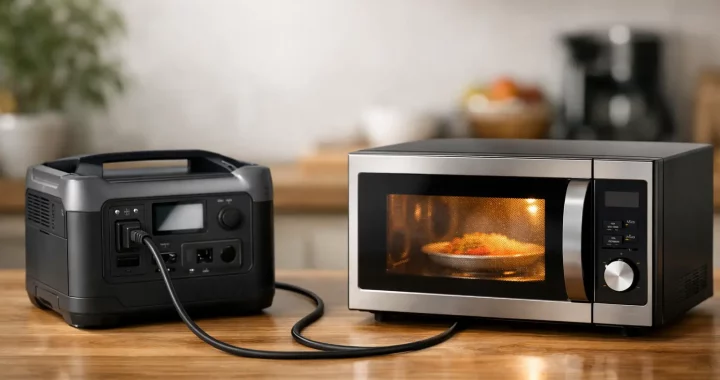
That question usually comes up right after the power goes out or when you’re trying to make an RV kitchen actually useful: can a power station run microwave use without tripping, beeping, or shutting down? The short answer is yes, many can. The catch is that microwaves are one of the more demanding small appliances you can plug into a portable power station, so the inverter size, surge capacity, and battery storage all matter.
If you get the numbers wrong, the microwave may fail to start even though the power station looks large on paper. If you get them right, a quality unit can handle quick reheats, simple meals, and emergency cooking without fuel, noise, or exhaust. That makes this less about guesswork and more about matching the appliance to the right level of backup power.
Can a power station run microwave loads reliably?
Yes, but not every model can do it. A microwave pulls a lot of power in a short burst, and the label on the front does not always tell the whole story.
For example, a microwave advertised as 900 watts of cooking power may actually draw 1300 to 1500 watts from the wall. That difference matters because portable power stations are rated by output wattage, not just battery size. If your unit has a 1000W inverter and your microwave needs 1400W to operate, it will not run, even if the battery is fully charged.
This is why the first number to check is continuous AC output. For most microwaves, a power station with at least 1500W of pure sine wave AC output is a safer starting point. Larger countertop microwaves may need 1800W to 2200W or more, especially at startup.
What makes microwaves harder to run than other appliances?
A microwave is not like charging a laptop or powering a TV. It uses a magnetron and internal electronics that can create a higher startup demand than many people expect. Some units also cycle power in pulses rather than drawing it evenly, which can confuse lower-end power systems.
There are three limits that matter. The first is continuous wattage, which is what the power station can supply steadily. The second is surge capacity, which helps the unit absorb startup demand. The third is battery capacity, measured in watt-hours, which determines how long you can keep using the microwave before the station needs recharging.
In practical terms, this means a power station may be strong enough to start the microwave but not large enough to support repeated use. Or it may have plenty of battery storage but too little inverter output to turn the microwave on in the first place.
How to tell if your microwave and power station are a match
Start with the microwave’s input wattage, not just its cooking wattage. If the label says 1200W input, you need a power station whose AC inverter can comfortably exceed that. If the label only shows cooking power, assume actual draw will be higher.
As a rough guide, a 700W microwave often draws around 1000W to 1100W. A 900W microwave may draw 1300W to 1500W. A 1000W to 1200W microwave can push well into the 1500W to 1800W range. Compact dorm or RV models are usually easier to run than full-size kitchen units.
After that, check the battery size. A microwave uses a lot of energy fast, so runtime disappears quicker than many buyers expect. If you run a 1500W microwave for 10 minutes, that is roughly 250 watt-hours of energy use before inverter losses. Real-world losses mean the power station will likely give up more than that from the battery.
A 1000Wh unit might handle a few short heating cycles. A 2000Wh class system gives you more breathing room, especially if you are also powering lights, a fridge, phones, or a router during an outage.
Can a power station run microwave use during an outage?
Yes, and this is one of the most practical use cases if you size the system correctly. During a blackout, a microwave can help with fast meal prep, boiling water alternatives, reheating shelf-stable food, and warming baby bottles or simple meals without needing propane or a gas generator.
The trade-off is efficiency. A microwave is useful in short bursts, but it is not a low-draw appliance. If your backup plan depends on stretching stored energy over many hours, each minute of microwave use needs to count.
For outage planning, it often makes sense to treat the microwave as a short-duration appliance rather than an always-available kitchen tool. Use it to heat food quickly, then turn it off and reserve the rest of your power for refrigeration, communications, medical devices, or charging.
What size power station is best for a microwave?
For most households, RV users, and emergency setups, the practical floor is around a 1500W inverter with enough battery capacity to make usage worthwhile. That usually means a mid-size to large portable power station rather than an entry-level unit.
If your goal is occasional use with a compact microwave, a unit in the 1000Wh to 1500Wh range with strong AC output may be enough. If you want better runtime, more confidence with startup loads, or the ability to run multiple essentials at once, moving into the 2000Wh class is a better fit.
Expandable systems are especially useful here. They let you start with enough inverter power to run the microwave, then add battery capacity for longer outages, RV travel, or off-grid weekends. That is often a smarter path than buying a small station that can technically run the microwave once or twice but leaves very little energy for anything else.
A few real-world scenarios
At a campsite, a compact microwave in an RV may work well on a properly sized power station, especially if you are charging from solar during the day. The key is timing. Running the microwave when the battery is already low is more likely to trigger shutdowns.
At home, using a power station for microwave duty during storms or grid outages is realistic if the station has enough inverter headroom. If the same unit is also carrying a refrigerator, coffee maker, or space heater, capacity planning becomes more important. You may need to avoid running major appliances at the same time.
On a jobsite or in a mobile setup, microwave use is possible, but it should not be treated as a casual add-on. High-draw appliances quickly expose whether your backup power is truly sized for real work or just light electronics.
Common mistakes that cause microwave failures
The most common problem is relying on the microwave’s cooking wattage instead of its actual input draw. That leads people to buy a station that looks close enough on paper but cannot support the real load.
Another issue is overlooking surge performance. Some power stations advertise a high output number but struggle with startup demands from appliances that do not ramp up gently.
Battery size is the other big miss. A microwave may run for a few minutes on a smaller station, but if your plan includes multiple meal cycles, coffee, lighting, and device charging, that battery will drain faster than expected.
It also matters that the station uses a pure sine wave inverter. Most quality portable power stations in this category do, and that is the safer choice for sensitive electronics and appliance compatibility.
When a microwave is not the best fit
Sometimes the answer is technically yes but practically no. If you have a very large kitchen microwave, a small portable power station, or a backup plan built around conserving every watt-hour, using the microwave may not be the smartest move.
In those cases, lower-draw cooking options may stretch battery power better. But if microwave use is a priority, the better answer is not to compromise around it. It is to choose a power station built for serious appliance loads, ideally with LiFePO4 battery chemistry, strong inverter output, and room to expand.
That is the difference between emergency power that only covers phones and lights and a system that supports real household convenience when the grid is down.
If you are buying with microwave use in mind, think beyond whether it can work once. Think about whether it can work when you need it most, with enough reserve left for everything else that matters. That is the kind of power planning that holds up when conditions are not ideal.
