
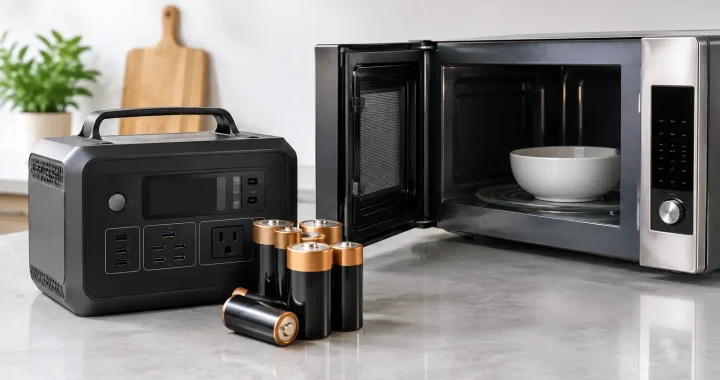
A microwave can turn a cold meal into a hot one in minutes, which makes it one of the first appliances people want available during an outage or off-grid trip. But can batteries power microwaves? Yes, when the battery system includes a properly sized pure sine wave inverter and enough usable battery capacity. The catch is that microwaves draw far more power than their cooking labels often suggest.
A phone charger can run from a small battery bank. A microwave needs a serious portable power station or solar generator setup. Knowing the difference before a storm, campsite stay, or RV trip helps you choose equipment that will work when you need it.
Can Batteries Power Microwaves Safely?
Batteries store direct current, or DC power. Most household microwaves require 120-volt alternating current, or AC power. A portable power station bridges that gap: its battery stores energy, and its built-in inverter converts that energy into household-style AC power through standard outlets.
For a microwave, the inverter should be pure sine wave and rated to supply more continuous wattage than the microwave consumes from the wall. Pure sine wave output is the clean, stable form of AC power that sensitive electronics and appliance motors are designed to use. It is the right choice for dependable appliance operation.
Do not judge a microwave solely by the number on its front panel. A microwave labeled as 700 watts usually delivers 700 watts of cooking power, but it may consume 1,050 to 1,250 watts from the outlet. A 1,000-watt microwave may draw 1,400 to 1,700 watts. The exact input wattage should be listed on the appliance data label, usually inside the door frame, on the back, or in the owner’s manual.
The battery system must also handle the initial demand when the microwave starts. Many modern portable power stations have surge capacity above their continuous inverter rating, but surge capability is not a substitute for adequate continuous output. If a microwave pulls 1,500 watts while heating food, choose a system with at least 1,800 to 2,000 watts of continuous AC output for a practical safety margin.
Start With the Microwave’s Actual Input Watts
The most useful specification is input power, not cooking power. Look for wording such as “input,” “rated input,” or “power consumption.” If the label says 1,450 watts, that is the number your power station must support.
A small 600- to 700-watt countertop microwave may be a workable match for a 1,000- to 1,200-watt inverter, depending on its true input draw. A full-size kitchen microwave generally calls for a 1,800-watt or 2,000-watt inverter. Larger convection microwaves and microwave-air-fryer combinations can require still more power and should be checked carefully before use.
Avoid relying on a vehicle’s 12-volt accessory outlet. These outlets are usually limited to roughly 120 to 180 watts, nowhere near enough for a microwave. Connecting a high-watt appliance to an undersized inverter, overloaded extension setup, or improvised battery wiring can trip protection circuits, damage equipment, or create a safety hazard.
Battery Capacity Determines How Long It Runs
Inverter wattage determines whether the microwave can start and operate. Battery capacity determines how long it can operate. Capacity is measured in watt-hours, abbreviated Wh.
A simple estimate is:
Usable watt-hours ÷ microwave input watts = runtime in hours
Because inverter conversion and battery operation have losses, plan on using about 85% to 90% of a power station’s stated capacity for AC appliances. For example, a 1,000Wh power station may provide approximately 850Wh of usable AC energy. With a microwave drawing 1,400 watts, that works out to about 36 minutes of total microwave runtime.
That may sound limited, but microwave use is usually measured in short heating cycles. Three minutes to heat leftovers at 1,400 watts uses about 70Wh from the battery after allowing for normal losses. A 1,000Wh system can therefore support several quick meal preparations while still preserving power for lights, phones, a refrigerator, or medical equipment.
Here is what common portable power station sizes can realistically mean for a 1,400-watt-input microwave:
- A 500Wh unit may have enough inverter power in rare cases, but it offers limited practical runtime and is better suited to smaller loads.
- A 1,000Wh unit with a 1,800W or 2,000W inverter is a solid starting point for occasional reheating.
- A 2,000Wh unit provides more flexibility for repeated meal use and other household essentials.
- An expandable battery system is the stronger choice for multi-day outages, RV living, or family use where the microwave is only one part of the power plan.
Runtime changes with the microwave’s actual draw, the battery’s state of charge, ambient temperature, and any other devices connected to the station. Keep the power station on a stable, ventilated surface and avoid draining it to zero when critical loads still need support.
Why 12-Volt Battery Math Matters
A microwave’s AC wattage becomes a much heavier demand on the battery side. A 1,400-watt microwave powered through an inverter can draw well over 120 amps from a 12-volt battery system once conversion losses are included. That is far beyond what a small lead-acid battery, thin wiring, or basic car inverter should be expected to deliver.
This is why integrated lithium portable power stations are often the practical answer. They combine a battery management system, correctly matched inverter, internal wiring, cooling, and protective shutoffs in one unit. Many use LiFePO4 battery chemistry, valued for long cycle life, thermal stability, and dependable use in backup-power applications.
For fixed DIY battery banks, the same principles apply, but system design becomes more involved. The battery bank, inverter, fuse protection, cable gauge, ventilation, and charging equipment all need to be sized correctly. For most homeowners, travelers, and campers, an all-in-one system removes much of that complexity.
Choosing a Microwave for Backup Power
If microwave cooking is part of your emergency plan, appliance choice can make the entire setup more efficient. A compact microwave with a lower input draw is easier to support than a large kitchen model. It may take longer to heat food, but it can significantly reduce the inverter size and battery capacity required.
Use the microwave intentionally during an outage. Heat one meal at a time, use shorter intervals, and avoid running high-demand appliances simultaneously. A microwave, electric kettle, space heater, hair dryer, and portable air conditioner can quickly overwhelm even a capable power station if operated together.
Also consider what the microwave replaces. Heating canned soup, warming leftovers, or preparing baby food for a few minutes is a reasonable battery use. Cooking every meal with high-watt electric appliances for days requires a larger energy plan, ideally with solar panels, a vehicle charging option, or grid recharging when available.
Recharge Planning Is Part of Readiness
A battery system that can run a microwave once is useful. A system that can be recharged reliably is resilient. During extended outages, solar charging can restore energy quietly during daylight hours, while AC wall charging and vehicle charging provide additional options before and after travel.
Solar input depends on panel wattage, sun conditions, panel angle, weather, and the power station’s maximum solar charging input. A 2,000Wh battery does not necessarily need 2,000 watts of solar panels, but more charging capacity shortens recovery time and makes repeated appliance use more realistic. For emergency readiness, it is wise to keep the station charged and test the microwave setup before severe weather arrives.
A microwave is not a small load, but it does not have to be out of reach when the grid goes down. Match the microwave’s true input watts to a pure sine wave inverter with adequate headroom, then choose enough watt-hours for the meals and essential devices you expect to support. With that preparation, a portable power station becomes more than a backup battery – it becomes a practical way to keep daily routines moving when power is not stable.
