
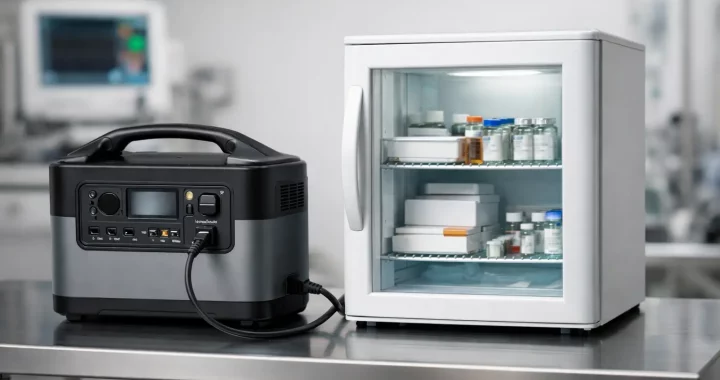
A power outage is not just an inconvenience when a refrigerator holds insulin, vaccines, biologics, or other temperature-sensitive medicine. The question, “can portable batteries power medical fridge” equipment, has a practical answer: often yes, but only when the battery system is correctly sized and the refrigerator’s temperature requirements are protected from the start.
A portable power station can provide quiet, fuel-free backup electricity for many medical refrigerators. But it is not enough to choose a unit based on the refrigerator’s running wattage alone. You need to account for startup power, total energy use, outage duration, recharge options, and the refrigerator manufacturer’s specific instructions. For critical medication storage, dependable planning matters more than an optimistic runtime estimate.
Can Portable Batteries Power a Medical Fridge Safely?
Portable batteries can power many medical refrigerators safely when they deliver the correct AC voltage, sufficient continuous wattage, and a pure sine wave output. Most residential-style and compact medical refrigerators use standard 120V AC power, which makes them compatible with a properly equipped portable power station.
The larger question is whether the system can maintain the storage conditions required for the contents. A refrigerator may run normally for several hours on a battery while its internal temperature still drifts outside an acceptable range because of frequent door openings, a warm room, a poor seal, or an undersized power supply. A battery is part of the plan, not the entire plan.
Start with the refrigerator’s manual and product label. Some purpose-built pharmacy and vaccine refrigerators have strict guidance for backup power, acceptable transfer time, alarm settings, and temperature monitoring. Follow those requirements first. If the medication supplier, pharmacist, or care team has storage instructions, those take priority over a general power calculation.
Size the Battery by Watt-Hours, Not Just Watts
Watts tell you whether a power station can run an appliance at a given moment. Watt-hours tell you how long it can keep running. Both numbers matter.
A refrigerator with a 100-watt compressor does not draw 100 watts every hour of the day. The compressor cycles on and off as it maintains temperature. Its real daily consumption may be 500 watt-hours, 900 watt-hours, or more depending on the unit, room temperature, loading, and how often the door opens. The appliance label may list amps or watts, but the most useful figure is often its annual kWh rating or measured energy use over 24 hours.
Find the refrigerator’s actual energy use
If the refrigerator lists annual energy consumption, divide that number by 365 to estimate daily watt-hours. For example, a unit rated at 365 kWh per year uses about 1 kWh per day, or 1,000 watt-hours daily, under the test conditions used for that rating.
A plug-in power meter can provide a more realistic answer. Measure the refrigerator over at least 24 hours in its normal location with typical contents inside. This captures compressor cycling and gives you a sound basis for backup planning.
Add a margin for real outage conditions
Battery capacity is not fully available at the AC outlet. The inverter uses some energy, and actual refrigerator consumption can rise when the surrounding space is hot. Plan for at least 20% to 30% more capacity than your basic calculation, with a larger buffer for multi-day outages.
For a refrigerator using 800 watt-hours per day, a 1,000Wh power station may cover roughly a day under favorable conditions, but it is not a comfortable two-day solution. A 2,000Wh unit provides more room for inverter losses, warmer weather, and unexpected compressor runtime. An expandable battery system gives families supporting critical equipment a more practical path to longer protection.
Check Compressor Startup Watts
Refrigerator compressors draw a brief surge of power when they start. A medical fridge that runs at 120 watts may need several hundred watts for a fraction of a second at startup. If the power station’s inverter cannot handle that surge, it may shut down or trigger an overload alarm even though its continuous wattage rating appears sufficient.
Choose a power station with a continuous AC output well above the refrigerator’s normal running demand and enough surge capacity for compressor startup. Pure sine wave AC output is also the right choice for compressor-driven appliances and sensitive electronics. It provides power that closely resembles standard household electricity and avoids the compromises associated with modified sine wave inverters.
Do not assume a small power bank, vehicle inverter, or low-capacity camping battery is suitable because it has an AC outlet. Verify the continuous watt rating, surge rating, battery capacity, and waveform before connecting a critical refrigerator.
Plan for Transfer Time and Temperature Monitoring
When grid power fails, a refrigerator must either switch quickly to backup power or remain closed until you connect the power station. A portable power station can be set up as a manual backup source, but that approach depends on someone being home and acting quickly.
For medication that cannot tolerate interruptions, consider a power station with an EPS or UPS-style backup function. These features can keep the unit connected between wall power and the refrigerator, then switch to battery power when utility power drops. Check the stated transfer time against the refrigerator manufacturer’s requirements. Not every EPS function is appropriate for every medical refrigeration application.
Temperature monitoring is equally valuable. Use the refrigerator’s built-in alarm if available, and consider an independent thermometer or data logger with high- and low-temperature alerts. The display on the refrigerator is useful, but an independent record can show whether temperatures stayed within the required range throughout an outage.
Build a Backup Setup That Can Last
A dependable medical refrigerator backup setup starts with a charged power station positioned in a dry, ventilated area near the appliance. Keep its AC cable accessible, avoid extension cords unless they are properly rated, and never operate the unit where vents are blocked. Portable power stations generate no exhaust, so they can be used indoors, unlike gas generators, but they still need airflow to manage heat.
For outages longer than one night, recharge planning becomes essential. Portable solar panels can replenish a compatible power station during daylight hours, reducing dependence on a returning grid. Solar production changes with weather, season, panel angle, and shade, so treat it as a recharge source to calculate carefully, not a guaranteed replacement for utility power.
A dual approach is often strongest: enough battery capacity to cover the overnight period, plus solar charging or another approved charging source for daytime recovery. If the refrigerator uses 1,000Wh daily and solar realistically replaces 700Wh on a cloudy day, the remaining energy must come from stored battery capacity. That gap becomes significant over several days.
Keep refrigerator doors closed as much as possible during an outage. A full refrigerator generally holds temperature better than an empty one, and cold packs can add thermal stability when appropriate for the contents. Do not place medications in a household cooler or add ice without confirming that this will not create an unsafe temperature excursion.
Test Before the Emergency
The best time to learn that a battery is undersized is not during a storm. Run a controlled test when utility power is available. Fully charge the power station, connect only the refrigerator, and observe the input wattage, compressor starts, battery percentage, and interior temperature over several hours.
Repeat the test with the refrigerator in its normal location and normal operating condition. Record the runtime and leave a simple instruction sheet near the equipment so another household member knows what to connect, what alarms to watch for, and who to contact if temperatures move out of range.
A portable battery can give a medical refrigerator valuable protection when it is matched to the appliance and supported by a clear response plan. Build in capacity, monitor the temperature, test the system, and you will have a calmer, more reliable answer ready when the grid is not.
