
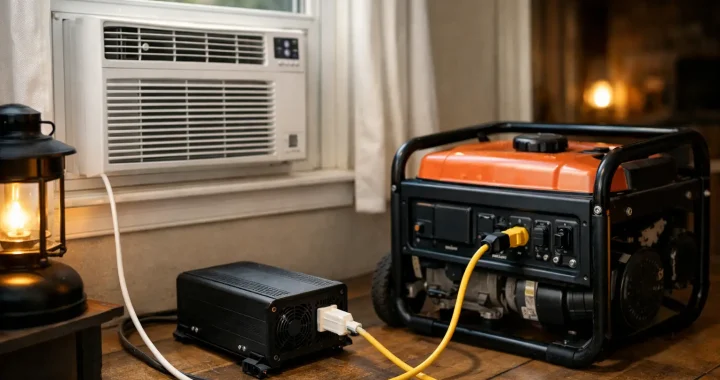
A window air conditioner can turn a dangerous summer outage into a manageable one, but it is one of the most demanding appliances you may connect to backup power. If you are researching how to power window AC equipment from a battery, the answer starts with the unit’s nameplate, not its BTU rating alone. You need enough inverter power to start the compressor and enough stored energy to keep the room cool for a useful amount of time.
A properly sized portable power station can run many small and mid-size window AC units quietly, without gasoline, fumes, or a noisy generator outside the bedroom window. The right system depends on your air conditioner’s running watts, startup surge, how long you need cooling, and whether you can recharge with solar or another source during the outage.
Start With Your Window AC Power Requirements
Look for the manufacturer label on the side, back, or plug cord of the air conditioner. It may list watts, amps, volts, or all three. Watts are the most useful number for matching an AC to a power station. If the label lists only amps, multiply amps by volts. For a standard 120V unit, an air conditioner rated at 5 amps uses roughly 600 watts while running.
Do not size a backup system from cooling capacity alone. BTU is a measure of cooling output, while watts tell you how much electricity the appliance needs. A modern 5,000 BTU window unit may draw roughly 400 to 600 running watts. A 6,000 to 8,000 BTU unit often uses about 500 to 800 watts. Larger 10,000 to 12,000 BTU models can require 900 to 1,300 watts or more.
Those ranges are useful for planning, but the label on your specific unit wins every time. Older units, poorly maintained units, and models with additional features can draw more power than a similar new model.
Running watts and startup watts are different
When the compressor starts, a window AC briefly draws more power than it does during normal operation. This is called startup surge. Some units may need two to three times their listed running wattage for a fraction of a second. A 600-watt AC could therefore need 1,200 to 1,800 watts of surge capacity to start reliably.
Choose a portable power station with an AC inverter that exceeds the air conditioner’s running watts and can handle its startup demand. A 1,000-watt inverter may run a small AC after it starts but still shut down when the compressor cycles on. For a unit that runs at 600 watts, a power station with 1,500 watts or more of continuous AC output and strong surge capability gives you a more dependable margin.
Pure sine wave AC output is also the right choice for compressor-driven appliances. It provides utility-style power that is better suited to the motors and electronics inside modern air conditioners than a low-quality modified-wave inverter.
Calculate How Much Battery Capacity You Need
Inverter wattage determines whether the power station can run the AC. Battery capacity determines how long it can run. Capacity is measured in watt-hours, abbreviated Wh. A 1,000Wh battery can theoretically deliver 1,000 watts for one hour, or 500 watts for two hours. Real-world runtime is lower because the inverter uses energy and the AC’s power draw changes as the compressor cycles.
Use this practical estimate:
Estimated runtime = usable battery watt-hours ÷ average AC watts
For a quick planning figure, assume that about 85% of a power station’s rated capacity is available through its AC outlets. For example, a 1,024Wh power station running a 500-watt window AC has approximately 870Wh of usable energy. That works out to about 1.7 hours if the AC pulls 500 watts continuously.
In a closed, shaded room, the compressor may cycle off after the room reaches the thermostat setting. That can extend runtime. In a sun-facing room during a heat wave, the compressor may run nearly nonstop, and the continuous-use estimate will be closer to reality. Keep expectations conservative when cooling is a health and safety priority.
A 2,000Wh-class power station gives a 500-watt unit roughly 3.4 hours of continuous runtime before accounting for cycling. An expandable system with 4,000Wh or more can support longer overnight cooling, especially when paired with daytime solar recharging. The best capacity is not simply the largest battery available. It is the capacity that matches your outage plan, room size, recharge options, and budget.
How to Power a Window AC With a Portable Power Station
Set up the system before severe weather arrives. Testing your actual AC at home is the only reliable way to confirm that the power station can handle its startup surge and to see how quickly the battery drains.
First, fully charge the power station. Place it indoors on a stable, dry surface with several inches of open space around its ventilation ports. Portable power stations do not produce exhaust, so they are safe for indoor use when operated according to their instructions. They still need airflow to manage heat while supplying a high load.
Next, plug the window AC directly into the power station’s AC outlet. Avoid light-duty extension cords, crowded power strips, and adapters that can overheat under a sustained high load. If an extension cord is necessary, use a short, heavy-duty cord rated for the appliance’s amperage.
Turn on the power station’s AC output, then start the air conditioner. Watch the power display during the first few compressor cycles. If the station alarms, overloads, or shuts down, disconnect the AC. The issue may be insufficient surge capacity, an appliance drawing more than expected, or a battery level too low to support the load.
Once it is running, set the AC for efficient cooling rather than maximum cooling. Close doors, cover sun-facing windows, keep blinds down, and cool one occupied room instead of trying to condition the entire house. A higher thermostat setting, such as 76 to 78 degrees, can reduce compressor runtime while still providing meaningful relief.
Add Solar Charging for Longer Outages
Battery-only operation is often enough to cool a bedroom for part of the night or provide relief during the hottest hours. For a multi-day outage, solar can turn a limited battery into a daily cooling plan.
Solar output changes with panel size, weather, shade, panel angle, and the season. A 400-watt solar array will not deliver a flat 400 watts all day, and it may produce very little during heavy cloud cover. Treat solar as a way to recover energy while the sun is available, not as a guarantee that it will run a high-draw AC continuously.
A practical approach is to charge the power station during the strongest sun, use the window AC selectively in the afternoon and overnight, and reserve part of the battery for phones, lights, medical devices, fans, and refrigeration needs. A fan uses far less energy than an air conditioner, so combining a fan with targeted AC cooling can make every stored watt-hour go further.
If your power station supports solar input and expansion batteries, plan the system around the role cooling plays in your household. A small bedroom AC may be a comfort item for one family and an essential heat-safety tool for an older adult, infant, or person with a medical condition. That distinction should guide how much capacity and solar collection you build into your backup plan.
Common Mistakes That Cut Runtime or Cause Shutdowns
The most common mistake is buying based on battery capacity without checking inverter output. A large battery connected to an undersized inverter still cannot start the compressor. The opposite problem is also common: a high-output inverter with too little battery capacity may start the AC but provide only a short cooling window.
Do not run other high-wattage appliances from the same power station while the AC compressor is active. Microwaves, coffee makers, electric kettles, hair dryers, space heaters, and hot plates can quickly exceed the inverter’s rating. Keep the AC on its own power station whenever possible.
Avoid using a vehicle’s 12V outlet as the primary source for a window air conditioner. Most vehicle outlets cannot supply the required wattage, and idling a vehicle for power creates fuel, ventilation, and wear concerns. Likewise, never operate a gas generator indoors, in a garage, or near open windows. Carbon monoxide can enter the home quickly and without warning.
Choose a Backup Plan That Fits the Room
For a small bedroom, a compact and efficient window AC paired with a high-output portable power station can be a practical outage solution. For extended outages, more battery capacity and solar input matter more than a few extra outlet ports. Systems built with LiFePO4 batteries are especially well suited to preparedness planning because they are designed for long service life and repeated use.
Thundervolt Power focuses on portable stations, solar systems, and expandable battery options that help households prepare for unstable grid conditions without relying solely on fuel-powered equipment. When comparing systems, verify continuous AC output, surge rating, usable watt-hours, solar input limits, recharge time, and expansion capability against your actual air conditioner.
Before the next heat emergency, run a full test in the room you intend to cool. Record the startup behavior, average watt draw, and battery percentage after one hour. That small bit of preparation replaces guesswork with a plan you can rely on when the power is not stable.
