
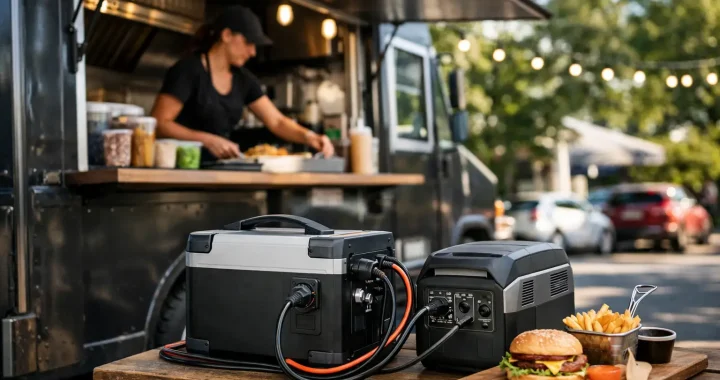
The lunch rush is not the time to discover that the refrigerator is cycling, the point-of-sale system is low, and the generator cannot handle the blender. Reliable food truck power begins before service, with a realistic plan for every appliance, every outlet, and every hour your crew needs to operate. The right system protects more than equipment. It protects your menu, your revenue, and your ability to serve customers without interruption.
For many mobile food businesses, traditional gas generators remain part of the equation. They can deliver substantial output for demanding cooking loads. But they also bring fuel costs, exhaust, noise, maintenance, and restrictions at certain venues. Portable battery power stations and solar charging systems offer a quieter, cleaner option for many essential loads, especially refrigeration, lighting, payment systems, communications, and prep equipment. The best setup depends on how your truck cooks, where it operates, and how long it must run away from shore power.
Start With a Food Truck Power Audit
Do not choose a battery or generator based on a single appliance label. Build a complete power audit first. Walk through a normal service day and write down every device that needs electricity, including equipment that is easy to overlook: ventilation controls, water pumps, fans, chargers, menu displays, and task lighting.
For each item, record its running watts, expected hours of use, and starting or surge watts if it has a motor, compressor, or heating element. Refrigerators and freezers cycle on and off, but their compressor startup draw matters. Blenders, mixers, pumps, and air conditioners can also require a brief surge above their normal running demand.
Your audit should separate equipment into two categories. Continuous loads run for most or all of the shift, such as refrigeration, POS equipment, routers, lights, and fans. Intermittent loads run in short bursts, such as a blender, microwave, coffee maker, water pump, or small prep appliance. This distinction helps you calculate both the inverter size you need at one moment and the battery capacity you need across the day.
A simple estimate starts with watt-hours:
Watts x hours of use = watt-hours required
A 100-watt refrigerator averaging eight hours of active compressor time uses about 800 watt-hours. A 1,000-watt coffee maker used for 20 minutes uses roughly 333 watt-hours. Add every expected load, then allow additional capacity for inverter losses, warm weather, longer service, and changing operating conditions. Planning too close to the limit is how a system that looked sufficient on paper falls short in the field.
Match Output to Your Peak Demand
Battery capacity and inverter output solve different problems. Capacity, measured in watt-hours, tells you how much stored energy is available. Inverter output, measured in watts, tells you how much equipment can run at once.
If your refrigerator, POS system, lights, and blender can overlap during a busy period, their running watts must fit within the power station’s continuous AC output. The unit must also handle any startup surge. A power station with a large battery but a small inverter may run lights for a long time while still being unable to start a compressor or operate a high-wattage appliance.
High-heat commercial equipment changes the calculation quickly. Electric fryers, griddles, ovens, hot plates, and large air conditioners can draw thousands of watts each, often for extended periods. A portable power station can be a practical source for supporting equipment or short-duration use, but a fully electric kitchen may require a large expandable battery bank, shore power, an appropriately sized generator, or a combination of these sources.
That is not a limitation to ignore. It is a reason to design the system around the actual menu. A truck using propane for primary cooking can often shift many supporting electrical needs to quiet battery power. A truck that depends on multiple electric heating appliances needs a more substantial energy plan from the start.
Use Dedicated Circuits and Protect Your Equipment
Food trucks have tight electrical spaces, and overloaded circuits are a real operational risk. Use properly rated cords, connectors, breakers, and distribution equipment. Avoid daisy-chaining power strips or routing cables where staff, customers, or water can create a hazard.
Pure sine wave AC output is a strong choice for sensitive electronics and motor-driven equipment. It delivers cleaner power for laptops, card readers, refrigeration controls, routers, and many modern appliances. Before connecting a power station, confirm the appliance’s rated watts, plug type, voltage, and any manufacturer guidance on mobile or inverter power.
Local health, fire, electrical, and event requirements also matter. Some commissaries and venues have specific rules for generator placement, noise, fuel storage, shore-power connections, and extension cords. A capable power system still needs to meet the rules of the location where you serve.
Size Battery Capacity for the Shift You Actually Work
A short festival lunch service and a 10-hour event day should not use the same assumptions. Start with the hours you need to operate without recharging, then decide what must stay on throughout that period.
For a compact coffee cart, dessert trailer, or truck with propane cooking, a mid-size LiFePO4 power station may cover refrigeration, lights, POS equipment, a router, and occasional small appliances. For longer shifts, multiple refrigerators, or added climate control, expandable battery capacity becomes more valuable. It allows you to increase stored energy without replacing the core power system.
LiFePO4 batteries are especially well suited to frequent mobile use because they are built for long cycle life and stable performance. They also avoid the fumes and fuel handling associated with gas-powered equipment. For food service operators working close to customers, quiet operation can be a business advantage. Staff can take orders without shouting over an engine, and customers can hear the conversation at the window.
Still, battery capacity is not a substitute for daily energy discipline. Keep refrigerator seals in good condition, pre-chill products before loading, use efficient LED lighting, and turn off nonessential equipment between service periods. Small improvements reduce the size and cost of the system required to support your truck.
Plan How You Will Recharge
A food truck power system is only as useful as its recharge plan. Many operators have access to shore power at a commissary, commercial kitchen, storage location, or overnight parking site. Fast AC charging can restore a power station between shifts and make battery power practical for frequent service.
Solar panels can extend runtime and support charging when parked at outdoor events, but they should be treated realistically. Solar output changes with panel size, weather, season, shade, panel angle, and available roof or ground space. Panels may offset daytime loads or replenish battery capacity during slower periods, yet they may not fully recharge a heavily used system during one service day.
A hybrid approach is often the most dependable. Shore power handles predictable overnight charging. Solar contributes when conditions are favorable. A generator remains available for unusual high-demand days, remote locations, or extended bad weather. The goal is not to rely on one source for every situation. The goal is to keep critical operations powered when the plan changes.
Build a Practical Service-Day Routine
Reliable operation comes from repeatable habits. Charge batteries fully before departure, test essential outlets, and confirm that cords and adapters are packed. Check the display for state of charge and estimated runtime before the first customer arrives, not after equipment begins shutting down.
During service, avoid adding a major new load without checking what is already running. If a blender, microwave, or coffee maker is needed, schedule its use around compressor cycles or other high-draw equipment when possible. Keep a simple written load sheet inside the truck so every team member knows which outlets support which equipment.
At the end of the shift, inspect cables, clean dust from ventilation areas, and recharge promptly. If the truck will sit between events, follow the battery manufacturer’s storage guidance rather than leaving the system depleted. A few minutes of routine care can prevent a costly power problem on the next service day.
Thundervolt Power systems can help mobile operators build quieter backup and off-grid capability around the equipment that keeps service organized and customers moving. Start with your critical loads, plan for real operating conditions, and give your truck enough power margin to handle a busy day with confidence.
