
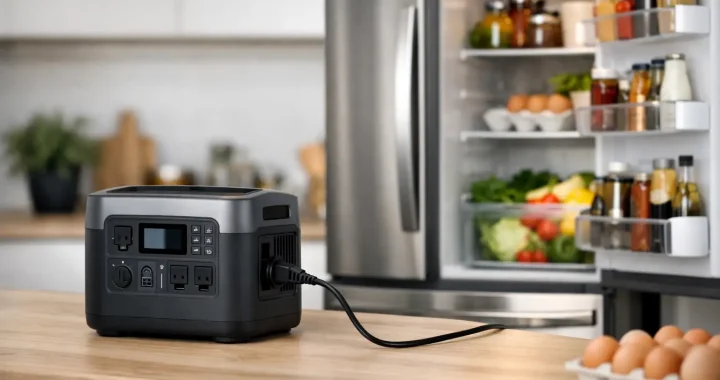
A refrigerator is one of the first appliances that matters when the grid goes down. Food safety has a clock, and a small power bank is not the answer. The best power stations for refrigerators combine enough battery capacity for meaningful runtime with an inverter that can handle the compressor starting load – quietly, indoors, and without fuel storage.
The right choice depends on the refrigerator, how long you expect an outage to last, and how you plan to recharge. A compact unit for a weekend camping fridge has very different needs from a family protecting a full-size kitchen refrigerator through a storm. Start with the appliance, then build the backup plan around it.
What Makes a Power Station Refrigerator-Ready?
A refrigerator does not draw the same amount of power every minute. Its compressor cycles on and off to maintain temperature. That means the running wattage may look modest, while the short burst of power needed to start the compressor can be much higher.
For reliable refrigerator backup, focus on three specifications: battery capacity in watt-hours, continuous AC output in watts, and surge capacity. Battery capacity determines how long the station can run the appliance. Continuous output tells you what it can supply during normal operation. Surge capability helps it absorb the brief startup demand from the compressor.
A pure sine wave inverter is also the right choice for refrigerators and other sensitive household electronics. It delivers cleaner AC power that is better suited to modern compressors, control boards, and appliances than modified sine wave power.
LiFePO4 battery chemistry is especially practical for emergency readiness. These batteries are designed for long cycle life, good thermal stability, and dependable daily use. For a backup system that may sit charged for months and then work hard during an outage, that durability matters.
Best Power Stations for Refrigerators by Use Case
There is no single best battery size for every refrigerator. The best power stations for refrigerators are the ones sized for the job, not simply the largest unit available.
For a Mini Fridge or Small Cooler
A small dorm refrigerator, beverage cooler, or portable compressor fridge may use roughly 40 to 100 watts while the compressor is running. A 500Wh to 1,000Wh portable power station can often cover a day of intermittent use, depending on ambient temperature, how often the door opens, and the appliance’s efficiency.
This range works well for road trips, campsites, tailgates, and short disruptions. Choose a unit with enough AC output to handle the compressor’s startup surge, not just its listed running wattage. If the fridge is traveling with you, consider the station’s weight, charging speed, and 12V output options as well.
For a Standard Kitchen Refrigerator
Most modern full-size refrigerators run at a relatively low wattage once the compressor is operating, often in the 100 to 250 watt range. However, their daily energy use is what determines the battery size you need. Many residential refrigerators consume about 1 to 2 kWh per day, though older, larger, or less efficient models can use more.
A 1,500Wh to 2,000Wh power station is a practical starting point for a standard refrigerator during a short outage. It may provide roughly one day of refrigeration with some reserve, but actual runtime can be shorter or longer. A station with at least 1,500W of continuous AC output gives useful headroom for startup demand and allows limited use of another small essential device.
For overnight outages, this capacity range can be a strong balance of portability and protection. Keep the power station dedicated to the refrigerator rather than sharing it with high-draw appliances such as coffee makers, space heaters, or microwaves.
For Multi-Day Outages
When severe weather, wildfire conditions, or unreliable grid service could keep power out for several days, capacity and recharging become equally important. A 2,000Wh to 3,000Wh station offers more meaningful backup time for a refrigerator, especially when paired with portable solar panels or a fast AC recharge option between outages.
For longer events, an expandable power station is often the more practical investment. Adding expansion batteries can extend runtime without forcing you to run a gas generator around the clock. This approach is especially useful for households that need to keep a refrigerator, freezer, medical device, communications equipment, and a few lights operating on a managed schedule.
A larger battery alone is not a complete plan. Solar input capacity, available sunlight, and recharge speed determine whether the system can keep up after the first day. In cloudy weather or winter conditions, solar production may be lower than expected, so maintain a realistic reserve.
For a Refrigerator and Freezer Together
A refrigerator and a standalone freezer can preserve far more food than either appliance alone, but they substantially increase energy demand. For this job, look toward a 3,000Wh class power station or an expandable system with at least 2,000W of continuous AC output.
Avoid assuming that two appliances will use exactly double the energy. Their compressors may cycle at different times, temperatures in the garage or kitchen can affect runtime, and opening either door adds load. Still, planning for 2 to 4 kWh of daily energy use is a sensible starting point for many households running both units during an outage.
Calculate Runtime Before You Buy
The simplest runtime estimate is battery watt-hours divided by the refrigerator’s average wattage. But refrigerators cycle, and portable power stations lose some energy through inverter conversion. A more realistic calculation uses daily energy consumption.
Check the refrigerator’s EnergyGuide label, owner manual, or manufacturer specifications for annual kWh use. Divide annual kWh by 365 to estimate daily consumption. For example, a refrigerator rated at 600 kWh per year uses about 1.64 kWh, or 1,640Wh, per day under typical conditions.
A 2,000Wh power station will not deliver every stored watt-hour to an AC appliance. Allow for conversion losses and keep a safety margin. If approximately 85% of capacity is usable through the AC outlet, that station may provide around 1,700Wh of usable energy. For a refrigerator using 1,640Wh per day, that is close to one day of backup, not two.
Real conditions can change the result quickly. High room temperatures, direct sunlight on the refrigerator, worn door gaskets, frequent door openings, and ice makers all increase consumption. A newer Energy Star refrigerator in a cool kitchen can run far more efficiently than an older garage fridge during summer.
Do Not Miss the Compressor Startup Load
The running wattage printed on a refrigerator label is only part of the story. When the compressor starts, it may briefly require several times its normal operating power. Some modern inverter-compressor refrigerators have a lower startup spike, while older conventional units may be more demanding.
Choose a station with continuous output comfortably above the refrigerator’s running watts and a surge rating that covers its startup requirement. If the refrigerator runs at 180 watts, a 300W station may seem sufficient on paper, but it may fail when the compressor cycles on. A 1,000W to 1,500W pure sine wave inverter provides more dependable headroom for many household refrigerators.
Before an emergency, test the exact refrigerator with the power station at home. Let it run long enough for the compressor to cycle several times. That one test confirms compatibility, reveals the real power draw, and gives you confidence when conditions are already difficult.
Recharge Strategy Matters as Much as Battery Size
For a short outage, a fully charged power station may be all you need. For anything longer, plan how you will replace the energy your refrigerator uses each day.
Wall charging is the fastest way to prepare before a storm, and many current stations support rapid AC charging. Solar charging adds independence when grid power is unavailable, but panel wattage should match the situation. A small 100W panel may help maintain phones and lights, yet it may not replace a refrigerator’s full daily energy use. Higher-watt portable solar arrays and favorable sunlight give you a much stronger recovery plan.
Vehicle charging can provide another option while traveling or during limited use, although it is typically slower. Never run a vehicle in a garage or enclosed area to charge a power station. If you have access to a traditional generator, use it outdoors to recharge the station periodically while keeping refrigerator power quiet and fuel-free inside the home.
Set Up Refrigerator Backup the Right Way
Place the power station on a stable, dry surface with open airflow around its vents. Use a properly rated AC cord if an extension is necessary, and keep cords out of walkways. Do not place the station inside a cabinet, under blankets, or in direct rain.
During an outage, reduce unnecessary door openings. A closed refrigerator can hold a safe temperature for roughly four hours without power, while a full freezer can hold temperature much longer when left closed. Once the station is connected, let the refrigerator run normally rather than repeatedly switching it on and off. The appliance is designed to manage its own temperature cycles.
Turn off optional loads where possible. Disabling an ice maker, avoiding the through-door water dispenser, and keeping the refrigerator away from heat sources can stretch available battery power. If you are using an expandable system, reserve enough capacity for the appliances that protect health, food, communication, and safety first.
For dependable home backup, Thundervolt Power recommends choosing capacity with room to spare and testing your setup before storm season. The time to learn whether a station starts your refrigerator is not after the freezer begins thawing.
A prepared household does not need to power everything at once. It needs a clear plan for what cannot wait. Size your power station around the refrigerator you rely on, keep it charged, and make recharging part of the plan so your food stays protected when utility power does not.
