
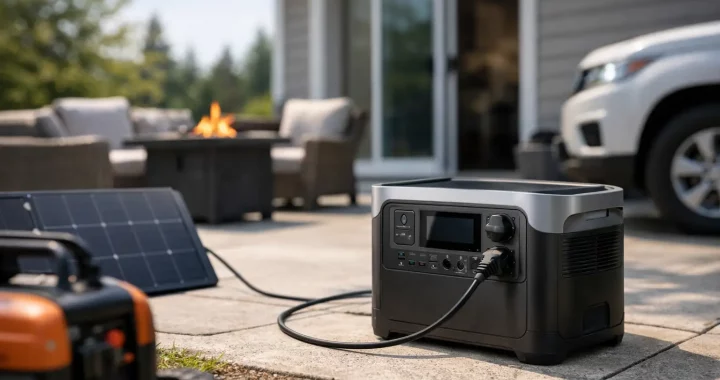
Power usually fails at the worst possible moment – during a storm, in the middle of the night, or right when you need to keep a fridge cold, a CPAP running, or a phone charged. That is why more households and mobile users are looking at a backup battery generator instead of relying only on gas. The appeal is simple: quiet operation, instant power, no fuel storage, and a much easier setup when time matters.
A backup battery generator is not the same thing as a traditional generator, even though people often use the terms interchangeably. In most cases, it refers to a portable power station or battery-based power system that stores electricity and delivers AC and DC output when the grid goes down or when you are away from an outlet. Some systems can also recharge from solar panels, wall power, or a vehicle, which makes them useful for both emergency backup and everyday portable power.
What a backup battery generator actually does
At its core, a battery backup system stores energy in lithium battery cells and sends that energy through an inverter so you can power common devices and appliances. Better systems use pure sine wave inverters, which provide stable output for sensitive electronics like laptops, routers, monitors, and medical devices.
The practical advantage is speed and simplicity. You do not need to pull-start an engine, keep gasoline on hand, or deal with fumes in a garage. When the power goes out, you press a button and start powering what matters. For apartment residents, homeowners, RV users, and anyone who needs indoor-safe backup power, that difference is significant.
Still, battery systems have limits. Runtime depends on battery capacity, and output depends on inverter size. A compact unit can keep small electronics running for hours, but it will not handle a full house. A larger high-capacity system may support refrigerators, freezers, power tools, and even some air conditioning loads, but only if the wattage and surge ratings line up with what those devices actually need.
Backup battery generator vs gas generator
The right choice depends on how you plan to use it.
If your priority is quiet, indoor-safe power with minimal maintenance, a backup battery generator is usually the better fit. It is especially practical for overnight outages, suburban neighborhoods, campsites, tailgates, RV travel, and any setting where noise and fumes are a problem. It also makes sense for people who want power ready at a moment’s notice without worrying about stale fuel or engine upkeep.
A gas generator still has an edge in long-duration, high-draw situations if you have enough fuel and a safe place to run it outdoors. That matters for extended outages where you need to keep larger loads running continuously. But fuel availability, noise, emissions, and maintenance are real trade-offs. Many buyers now prefer battery systems because they cover the most common outage needs with far less hassle.
For some households, the smartest answer is not either-or. It is matching the system to the risk. A battery unit can handle immediate essentials cleanly and quietly, while a larger fuel-based setup may serve as a secondary option for major outages.
How to size a backup battery generator
This is where many people either overspend or buy too small.
Start with what you need to power, not the biggest number on the product page. A phone, modem, lights, and laptop require very little compared with a refrigerator, microwave, sump pump, or portable AC. You need to check two numbers: running watts and starting watts. Running watts are what a device uses during normal operation. Starting watts matter for anything with a motor or compressor, because the initial surge can be much higher.
Battery capacity is measured in watt-hours. This tells you how long the system can run your devices. Inverter output is measured in watts. This tells you how much it can power at one time. Both matter.
For light essentials during an outage, a smaller unit may be enough to cover phones, routers, LED lights, a TV, and laptop charging. For more serious backup, especially if you want to support a refrigerator or multiple appliances, you will need more battery capacity and a stronger inverter. If your goal is to run high-demand equipment or maintain comfort during a longer outage, expandable battery capacity becomes much more valuable.
A simple way to think about it is this: output handles the moment, capacity handles the duration. If either one is too small, the setup falls short.
Features that matter more than marketing
Not every portable power system is built for real backup use. Some are designed mainly for charging electronics on the go. Others are much better suited for emergencies, job sites, or off-grid setups.
Battery chemistry is one of the first things to check. LiFePO4 batteries are popular for good reason. They offer long cycle life, better thermal stability, and dependable performance for repeat use. If you plan to use your system often, not just store it for emergencies, this matters.
Recharging speed also deserves attention. A unit that takes all day to recharge may be frustrating during repeated outages. Fast AC charging helps you get back to full capacity quickly, and solar charging support adds another layer of resilience when the grid stays down.
Output options should match your real devices. AC outlets matter for appliances and household electronics, but DC ports, USB-A, USB-C, and even RV-ready outputs may be equally important depending on how you travel or work. If you plan to keep a system in an RV or use it for mobile work, flexibility matters.
Expandability is another major factor. A fixed-capacity unit can be perfect for short outages or weekend trips. But if you want a system that can grow with your needs, expansion batteries give you a more practical path than replacing the whole unit later.
Best use cases for a backup battery generator
For home backup, these systems are often used to keep essentials online and preserve food. That usually means the fridge, freezer, internet, phones, lights, and a few medical or comfort devices. For many families, that is enough to turn a stressful outage into a manageable inconvenience.
For RV travel and camping, battery generators solve a different problem. You get quiet power without campground noise complaints or generator restrictions. You can charge devices, run small appliances, and pair the system with solar panels for longer stays off-grid.
For job sites and mobile work, battery-based systems are useful when you need clean, dependable power without hauling fuel. Contractors, event crews, and remote workers often value the portability and simplicity more than raw maximum output.
For emergency preparedness, they are one of the easiest backup tools to own because they do not require the same maintenance routine as a gas generator. Keep the unit charged, test it periodically, and store it where you can reach it fast.
Common mistakes buyers make
The biggest mistake is shopping by battery size alone. A large battery does not help if the inverter cannot start your appliance. The second mistake is focusing only on wattage and ignoring runtime. A unit may technically run a device, but only for a short period.
Another issue is assuming solar charging will solve every outage scenario. Solar can be a major advantage, but recharge speed depends on panel size, sun conditions, season, and weather. It works best when the system and panels are matched properly.
Some buyers also underestimate how their needs change over time. What starts as storm backup for phones and lights often grows into a need for refrigeration, workspace power, or off-grid flexibility. That is where a well-built, expandable system often proves its value.
What to look for before you buy
A good buying decision comes down to a few practical questions. What must stay on when the power goes out? How long do you need it to run? Will you use the system only for emergencies, or also for travel, outdoor use, and everyday convenience? Do you want something compact and portable, or something larger that can serve as a serious household backup asset?
If you answer those questions honestly, the field narrows quickly. You can then compare units based on usable capacity, inverter strength, recharge speed, battery chemistry, number of outputs, and whether expansion is available. That is a much better approach than buying the cheapest option or chasing a single oversized spec.
For buyers who want clean, quiet, practical backup power, a well-matched battery system is often the most useful solution. The best one is not the biggest unit on the market. It is the one that keeps your critical devices running, fits how you actually live, and is ready before the next outage tests it.
