
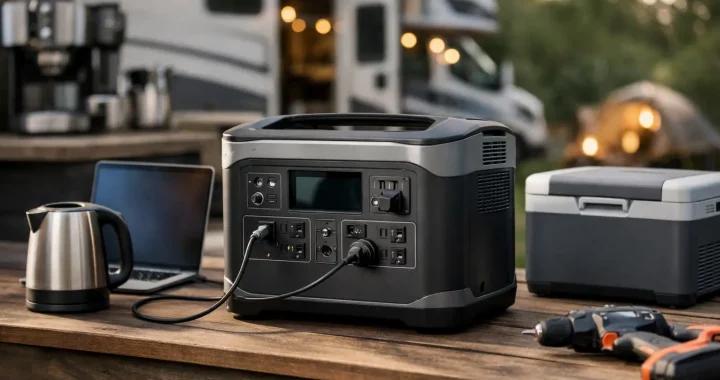
When the grid drops, the real question is not whether you have backup power. It is what can a 2000 watt power station run when you need it most. For many households, campers, RV owners, and jobsite users, 2000 watts is the range where portable power starts covering more than phones and lights. It can support serious everyday equipment – but only if you understand the limits.
A 2000 watt power station is often strong enough to run a refrigerator, microwave, coffee maker, TV, router, CPAP machine, power tools, and many other common devices. That said, the exact answer depends on three things: the running wattage of the device, the startup surge, and the battery capacity of the unit itself. Two power stations can both have 2000 watts of inverter output and still deliver very different runtimes.
What can a 2000 watt power station run in real life?
The easiest way to think about it is this: a 2000 watt power station tells you how much power can be delivered at one time, not how long it will last. If your appliance needs 1500 watts to operate, a properly designed 2000 watt unit can usually run it. If that same appliance runs for an hour, your battery needs enough stored energy to keep up.
In practical terms, a 2000 watt power station can usually handle low-draw essentials all at once, or one larger appliance plus a few smaller items. That makes it a strong fit for outage readiness, RV use, van travel, tailgating, and off-grid work where quiet power matters.
Devices it commonly runs well
Most 2000 watt models can easily support phones, tablets, laptops, Wi-Fi routers, modems, LED lights, fans, portable monitors, and camera gear. These are light loads, so the bigger concern is runtime rather than whether the unit can power them.
It is also a good match for TVs, gaming consoles, desktop computers, and many home office setups. If your goal during an outage is to keep communications, work, and lighting online, 2000 watts is usually more than enough.
Appliances it can often handle
A 2000 watt power station can often run a full-size refrigerator, a microwave, a coffee maker, an electric griddle, a blender, or a toaster – but not always all at the same time. A refrigerator may only draw 100 to 800 watts while running, but the compressor can spike higher at startup. A microwave may run around 1000 to 1500 watts. A coffee maker can sit in a similar range.
This is where quality matters. A unit with a pure sine wave inverter and strong surge capability is much better positioned to start compressor-based appliances and sensitive electronics safely.
Tools and outdoor equipment
For contractors, DIY users, and mobile crews, 2000 watts is often enough for many saws, drills, battery chargers, work lights, and smaller air compressors. It can also run some electric coolers, pellet grills, and portable cooking gear at campsites or tailgates.
Still, motor-driven tools can be tricky. A circular saw may have acceptable running wattage but pull much more at startup. The same applies to certain pumps and compressors. On paper, the tool may look compatible. In practice, the surge can trip the inverter if the power station is undersized.
What a 2000 watt power station usually cannot run
There are some loads that sit outside the comfortable range for most 2000 watt units. Central air conditioning systems, electric dryers, electric water heaters, full-size space heaters on high, and electric ovens are generally too demanding. These appliances either need too much continuous power, too much startup surge, or both.
Window air conditioners and portable AC units fall into the maybe category. Some smaller and more efficient models work fine. Others do not. If the label says 700 to 1200 running watts, that sounds manageable, but startup demand can still be the deciding factor.
If your backup plan depends on cooling, refrigeration, or medical support, it is worth checking exact appliance specs instead of guessing.
Why battery capacity changes the answer
This is the part many buyers miss. If you are asking what can a 2000 watt power station run, wattage is only half the story. Battery capacity, measured in watt-hours, tells you how long it can run those devices.
For example, a 2000 watt power station with a 2048Wh battery can theoretically run a 100 watt device for about 20 hours, though real-world runtime will be lower because of inverter losses and usage patterns. That same unit might run a 1000 watt appliance for about 2 hours, again depending on efficiency.
A refrigerator is a good example of why this gets more nuanced. It does not pull full power nonstop. It cycles on and off. So a 2000Wh-class battery may keep a fridge going for several hours, or potentially much longer depending on ambient temperature, how often the door opens, and the fridge size. A microwave is the opposite. It draws heavy power, but usually only for short bursts.
Output capacity vs runtime
Think of output as the ceiling and battery capacity as the fuel tank. You need both. A power station may be strong enough to run your appliance, but if the battery is too small, the runtime may not meet your needs. That matters more during overnight outages, road travel, or remote work where recharging is limited.
This is also why expandable systems are gaining traction. They give you the inverter strength to run larger loads and the option to add battery capacity for longer coverage.
Common use cases for a 2000 watt power station
For home backup, this size is often the practical middle ground. It can keep a refrigerator cold, charge phones, run lights, support internet equipment, and power a TV or laptop setup. That covers the basics for many families without the noise and fuel storage requirements of a gas generator.
For RVs and overlanding, 2000 watts is a useful step up because it supports more than convenience charging. You can run induction cooktops, coffee makers, fans, portable fridges, and many onboard electronics. If your setup includes solar input, you can extend runtime substantially during multi-day trips.
For emergency preparedness, this range is especially attractive because it supports critical devices without much setup. CPAP machines, communication equipment, rechargeable medical devices, and lighting loads are well within reach. If resilience is the goal, a 2000 watt power station gives you meaningful capability instead of bare minimum backup.
How to tell if your device will work
The most reliable approach is to check the appliance label or manual for running watts or amps. If amps are listed, multiply amps by volts to estimate watts. In most US household applications, that means amps x 120V.
Then compare that number to the power station’s continuous output rating. After that, look at surge capacity if the device uses a motor or compressor. Finally, estimate runtime by comparing the battery’s watt-hour rating to your device’s power draw.
Leave yourself some margin. Running a power station right at its maximum output is rarely ideal, especially for devices with unpredictable startup loads.
A quick reality check on multiple devices
Yes, a 2000 watt power station can run several devices at once. But the combined draw matters. A refrigerator at 600 watts, a microwave at 1200 watts, and a coffee maker at 1000 watts might all work individually, but not together. The total load would exceed the inverter limit.
That is why smart load management matters during outages. Run the microwave, then let the fridge cycle. Brew coffee, then switch to charging devices and lights. Portable backup power works best when you treat wattage like a budget.
Is 2000 watts enough for your needs?
For a lot of people, yes. It is enough to move from basic charging to real backup power. You can support kitchen essentials in short bursts, keep key household systems online, and cover travel or outdoor power needs with far more flexibility than a smaller unit.
But if your priority is heavy heating, whole-home cooling, or multiple high-draw appliances at once, 2000 watts may feel limiting. In that case, you may need a higher-output model, added battery expansion, or a more deliberate plan for rotating loads. Thundervolt Power focuses on exactly this kind of practical fit – matching output, battery size, and charging options to how people actually use backup power.
The best power station is not the one with the biggest number. It is the one that keeps the right devices running when conditions are not stable and time matters most.
