
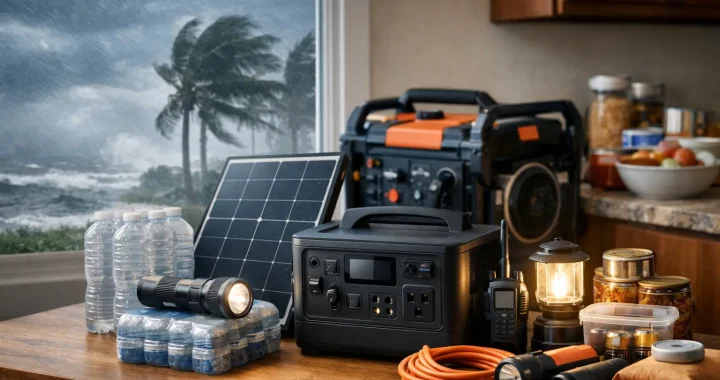
When a hurricane warning becomes real, backup power stops being a convenience purchase and becomes a household plan. This hurricane backup example shows how a family can keep essential devices running for several days without relying on noisy fuel storage, last-minute generator runs, or guesswork about what the battery can handle.
The goal is not to power every circuit in the house. It is to protect the things that matter most: communications, refrigerated food and medicine, lighting, cooling, and critical medical equipment. A portable power station paired with solar charging can cover many of those needs quietly, indoors, and with far less setup than a conventional gas generator.
Hurricane Backup Example: A Three-Day Essential Load Plan
Consider a household of four preparing for a hurricane that may cause a three-day outage. They live in a warm, humid area and want enough power to keep a refrigerator cold, charge phones, run lights, operate a fan, and support a CPAP machine overnight. They also want an option to recharge during daylight if the outage lasts longer than expected.
Their priority loads look like this:
- Refrigerator: about 1,200 to 1,800 watt-hours per day, depending on size, room temperature, door opening, and compressor cycling
- CPAP machine: roughly 250 to 500 watt-hours per night, depending on pressure settings and whether humidification is used
- Two fans: about 300 to 700 watt-hours per day when used selectively
- Phones, tablets, radio, and rechargeable lights: about 250 to 400 watt-hours per day
- Laptop or small television for weather updates: about 200 to 500 watt-hours per day
This household may need roughly 2,500 to 3,500 watt-hours each day. For a three-day outage, that equals 7,500 to 10,500 watt-hours of stored energy if there is no recharging at all. That is a serious amount of power, which is why a hurricane plan should include both battery capacity and a way to replace energy during the day.
A practical setup could include a portable power station with 2,000 to 3,000 watt-hours of LiFePO4 battery capacity, one or more expansion batteries, and 400 to 800 watts of portable solar panels. The power station should have a pure sine wave inverter and enough continuous AC output to handle the refrigerator’s startup surge. A unit with at least 2,000 watts of AC output offers useful flexibility for appliances, tools, and a small window air conditioner used in short intervals.
Why Battery Capacity Alone Is Not Enough
A large battery gives you a reserve. Solar charging turns that reserve into a system that can keep working after the first night. During hurricane season, the weather after landfall may still be cloudy, so it is wise to plan conservatively. Do not assume a 400-watt solar array will produce 400 watts for every hour of daylight.
For example, 600 watts of solar panels might generate around 1,500 to 2,500 watt-hours on a partly sunny recovery day after accounting for weather, panel angle, heat, and charging losses. That may not fully replace a heavy day of refrigeration and cooling, but it can cover communications, lighting, medical devices, and part of the refrigerator load. Every watt-hour replaced by solar is a watt-hour you do not have to reserve from the battery.
For this reason, the family should use power in a deliberate rhythm. Recharge phones, battery lights, and laptops during daylight while solar production is available. Run fans when heat and humidity are highest, but turn them off in empty rooms. Let the refrigerator cycle normally, but avoid standing with the door open while deciding what to eat. These simple choices extend runtime more effectively than most people expect.
Build the System Around Your Non-Negotiables
Every household has different essential loads. For one family, that may be a refrigerator and internet equipment. For another, it is a sump pump, a medical device, or a small window AC unit for a single safe sleeping room.
Start by identifying the devices that cannot reasonably go without power. Check each device label for watts, then estimate how many hours it will run per day. Watts tell you the immediate power draw. Watt-hours tell you how much battery capacity the device will consume over time.
The basic calculation is straightforward:
Watts × hours of use = watt-hours needed
A 50-watt fan running for eight hours uses about 400 watt-hours. A 10-watt LED lamp running for five hours uses 50 watt-hours. A refrigerator is more variable because its compressor cycles on and off, so use a conservative daily estimate instead of multiplying its listed wattage by 24 hours.
Also account for inverter losses and real-world usage. If your estimated daily load is 2,000 watt-hours, planning for 2,400 watt-hours provides a more realistic margin. In a hurricane outage, a little extra capacity protects against hot weather, additional phone charging, and unexpected needs.
A Note on High-Draw Appliances
Portable power can support more than small electronics, but high-draw appliances change the math quickly. A microwave, coffee maker, space heater, hair dryer, electric kettle, or full-size air conditioner can drain a battery much faster than expected.
A window AC unit may be worth powering for short periods, especially for older adults, children, pets, or anyone with heat-sensitive medical conditions. But it should be treated as a managed load. Run it in one closed room, use a moderate thermostat setting, and switch it off when the room is comfortable. The exact runtime depends on the unit’s wattage, its startup surge, room insulation, and outdoor temperature.
Prepare Before the Storm, Not During It
A power station is only useful if it is charged, accessible, and paired with the right cables. Hurricane preparation should happen when the forecast is still uncertain, not when stores are empty and roads are congested.
Charge the power station to full, charge expansion batteries, and test the AC outlets, USB ports, and DC outputs with the actual devices you expect to use. If you plan to run a CPAP machine, test it on battery power before an emergency. Check whether the device has a DC power option, since using DC may consume less energy than converting battery power to AC and back again.
Place solar panels where they can be deployed safely after the storm passes. Do not put panels outside during high winds, and never set them up in standing water or near damaged electrical lines. Once conditions are safe, position panels in direct sun and adjust them as practical through the day. Keep cables protected from foot traffic, water, and pinched doorways.
A compact preparedness kit near the power station should include charging cords, a power strip rated for the intended load, LED lanterns, a weather radio, spare batteries, and written operating notes. In an outage, simple labels help everyone in the household know which outlet is reserved for the refrigerator, medical equipment, or communications.
Know When a Portable System Is the Right Choice
A portable solar generator is an excellent fit for essential loads, apartment residents, renters, RV owners, and homeowners who want quiet indoor-capable power. It does not produce exhaust, so it can be used indoors in a dry, ventilated living space according to its operating instructions. That is a major advantage when rain, wind, and neighborhood restrictions make outdoor generator use difficult.
It is not the same as a whole-home standby generator. If your goal is to run central air conditioning, an electric water heater, a well pump, and every kitchen appliance without changing habits, you will need a much larger system and likely professional installation. For most hurricane plans, the smarter approach is to choose essential circuits and build enough battery and solar capacity to protect them.
Thundervolt Power customers often find that an expandable LiFePO4 system is the practical middle ground. It provides clean, quiet power now, while allowing additional battery capacity as household needs grow. LiFePO4 chemistry is especially well suited to preparedness because it offers long cycle life and dependable performance for equipment that may sit ready for months between outages.
The best hurricane backup plan is the one your household has practiced. Run a short evening test before storm season: power the refrigerator, charge phones, operate lights, and track the battery percentage overnight. That single test turns a backup power purchase into a plan you can trust when the lights go out.
