
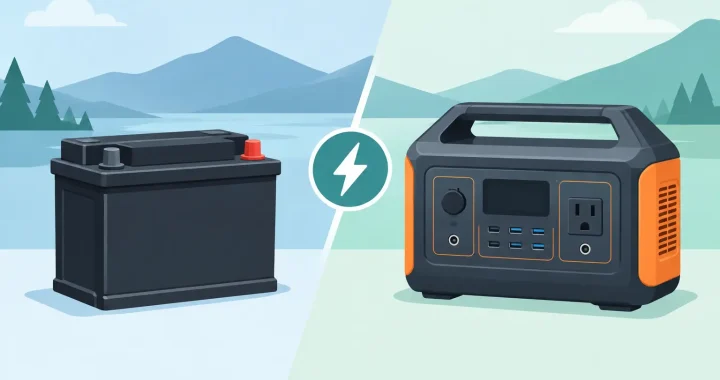
A dead refrigerator during a storm, a CPAP machine at a campsite, or a work truck that needs to charge tools creates the same question fast: should you bring a 12V battery or a complete power station? The 12V battery versus power station decision is not simply about which option stores more energy. It is about how safely and easily that energy can power the devices you rely on.
A standalone 12V battery can be an efficient building block for a custom DC system. A portable power station is a ready-to-use power system with the battery, inverter, charging hardware, and outlets already working together. The right choice depends on your loads, how often you will move the equipment, and how much setup you are prepared to manage.
What a 12V Battery Actually Provides
A 12V battery stores direct-current electricity. It can be a lead-acid deep-cycle battery, an AGM battery, or a lithium battery such as LiFePO4. The battery may be used in an RV, boat, off-grid shed, vehicle, or DIY backup system.
By itself, though, a 12V battery does not give you a household wall outlet. Most home appliances, laptop chargers, kitchen devices, and medical equipment expect 120V AC power. To run them from a battery, you generally need an inverter. You may also need a compatible charger, fuse block, cables sized for the current, disconnect switch, battery monitor, and solar charge controller if you plan to recharge with panels.
That flexibility is valuable for people building a permanent or semi-permanent system. You can choose each component, add batteries in parallel, install dedicated DC circuits, and tailor the system to a specific RV or cabin. But every added component creates another compatibility, wiring, and safety consideration.
Capacity also needs a closer look. A battery rated at 100 amp-hours sounds substantial, but its usable energy depends on voltage and battery type. A 12V 100Ah lithium battery provides roughly 1,200 watt-hours before conversion losses. A comparable lead-acid battery should usually not be drained as deeply if you want reasonable battery life, so usable capacity can be much lower.
What a Power Station Includes
A portable power station puts the major pieces of a battery system in one enclosed unit. It typically includes a lithium battery pack, battery management system, AC inverter, AC charging circuit, solar input, DC outputs, USB ports, display, and protective electronics.
Instead of selecting an inverter and wiring it to a battery, you can plug an appliance into the unit’s AC outlet. Instead of adding a separate battery meter, the display can show input wattage, output wattage, charge level, and estimated runtime. For homeowners and travelers, that simplicity can matter as much as capacity when power is out and time is limited.
Many modern stations use LiFePO4 battery chemistry, valued for long cycle life and thermal stability. Models with pure sine wave inverters are also better suited to sensitive electronics and motor-driven devices than low-cost modified sine wave inverters. Higher-capacity units may offer expansion batteries, allowing a household to begin with portable backup power and add storage later.
A power station still has limits. Its inverter rating determines what it can run at one time, while its watt-hour rating determines how long it can run it. A 2,000Wh station may store plenty of energy, for example, but it cannot operate a 2,400W appliance unless its inverter and surge capacity support that load.
12V Battery Versus Power Station: The Core Differences
The practical difference is integration. A 12V battery is a component. A power station is a finished system designed for portable use.
With a standalone battery setup, you control the quality and size of every part. That can be the better path for an RV renovation, a solar-equipped shed, or an off-grid system that will remain installed in one location. It can also be easier to service individual components over time. If an inverter fails, you replace the inverter rather than the entire system.
With a power station, the design work is largely done for you. The battery, inverter, outlets, and charging inputs are built to operate together. That makes it easier to move from a closet to a bedroom, vehicle, campsite, or jobsite. It also reduces the risk of undersized wiring, incorrect fusing, or using a charger that is not suited to the battery chemistry.
Portability is another dividing line. A 12V battery may be physically compact, but once you add an inverter, cables, charger, and enclosure, the system becomes less convenient to carry. A power station is purpose-built with a handle, protected ports, and a single housing. Larger stations are still heavy, but they are simpler to deploy.
Cost can favor either option depending on the project. A basic battery-based DC system may cost less when you only need to run 12V loads such as lights, a compressor fridge, or a water pump. A complete power station can represent better value when you need AC outlets, USB charging, solar capability, monitoring, and safe plug-and-play operation without assembling those parts separately.
Match the System to What You Need to Power
Start with the device label, not the battery label. Look for running watts and, for appliances with motors or compressors, startup surge watts. Then estimate how many hours you need the device to operate.
For small electronics, both options can work well. A 12V battery with USB adapters or a DC car socket can efficiently charge phones, tablets, routers, and some laptops. A power station is usually more convenient because it offers several USB ports and standard AC outlets in one place.
For camping and RV use, a 12V battery system makes sense when your loads are mostly native 12V equipment. Running a 12V compressor refrigerator directly from a battery avoids inverter losses. A power station is useful when you also want to power laptops, camera chargers, a CPAP machine, lights, or occasional small appliances without modifying your vehicle.
For home outages, a power station is often the clearer choice. It can be carried indoors and used immediately for a refrigerator, internet equipment, lamps, phones, and other priority loads within its output rating. A larger expandable system can provide longer runtime for essential circuits, but it should never be connected to home wiring without appropriate transfer equipment and qualified installation.
For contractor and mobile work, consider continuous wattage, surge capacity, recharge speed, and outlet count. Cordless-tool chargers and lighting are easy loads for many stations. High-draw saws, compressors, heaters, and welders may require a much larger power solution or a generator, particularly when used for extended periods.
Recharging Changes the Answer
A battery is only as useful as your plan to recharge it. A 12V battery may recharge from a vehicle alternator, shore power charger, or solar charge controller. That approach is effective, but the charging equipment must match the battery chemistry and voltage configuration.
Power stations usually accept AC wall charging, 12V vehicle charging, and solar input through a regulated built-in charging system. Fast AC charging can restore a large amount of power before severe weather arrives. Solar charging can extend runtime during a multi-day outage, provided panel conditions, input limits, and available sunlight support it.
Do not assume any solar panel will produce its advertised wattage all day. Weather, shade, panel angle, temperature, cable losses, and solar input limits affect real charging performance. Treat solar as a valuable replenishment source, not a promise of unlimited power.
Choose Based on Setup, Not Just Capacity
Choose a standalone 12V battery system when you need custom wiring, primarily DC loads, fixed installation, or the ability to select and replace individual components. Plan for proper fusing close to the battery, correctly sized cables, ventilation where required, and a charger designed for the battery type.
Choose a portable power station when speed, safety, AC power, and ease of use matter most. It is especially practical for apartment residents, homeowners preparing for outages, families supporting essential devices, weekend travelers, and anyone who wants power available without building an electrical system first.
Before buying either option, identify your highest-priority loads, add their wattage, account for startup surges, and decide how long you need power to last. Leave room for real-world losses and avoid planning around a battery’s full nameplate capacity. For critical medical equipment, confirm device requirements with the equipment provider and maintain the backup plan recommended by the manufacturer.
Preparedness works best when the system is familiar before an outage begins. Charge it, test it with the devices that matter, and keep it where you can reach it when the lights go out.
