
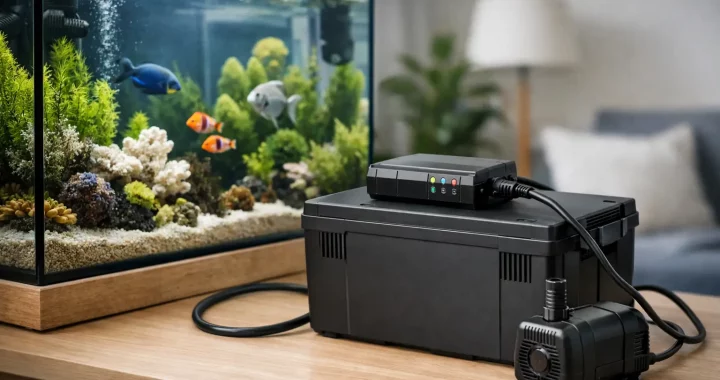
A power outage can turn an aquarium from stable to dangerous faster than most owners expect. Fish can tolerate a lot, but they cannot tolerate still water and falling oxygen for long. That is why backup power for aquarium life support is not a luxury purchase for reef keepers, breeders, or anyone with a stocked freshwater tank. It is basic preparedness.
The mistake many people make is assuming they need to power the entire aquarium exactly as it runs every day. In an outage, that is rarely the right goal. What matters most is keeping the tank alive, not keeping every accessory running. Once you make that distinction, choosing the right backup setup gets much easier.
What backup power for aquarium systems needs to cover first
During an outage, your first priority is gas exchange and circulation. In most tanks, that means an air pump, a circulation pump, or a return pump that keeps water moving. Oxygen levels can drop fast, especially in heavily stocked tanks, warm water setups, and reef systems with high biological demand.
Your second priority depends on season and livestock. In winter, heating may become critical. In summer, overheating can be the bigger risk, especially if your home loses air conditioning along with grid power. Lighting usually matters less in the short term. Corals and plants do not benefit much from draining your battery just to keep lights on for a few hours, and fish certainly do not need display lighting during an emergency.
Filtration is more nuanced. Biological filtration matters, but the bacteria do not instantly die when the power goes out. Water movement through the system is the urgent issue. If you can keep water circulating and oxygenated, you are solving the most immediate threat.
Start by separating must-run gear from nice-to-have gear
A practical backup plan begins with a simple question: what absolutely has to stay on for the next 4, 8, or 24 hours? For many tanks, the answer is smaller than expected.
A freshwater community tank may only need a small pump and, depending on room temperature, an occasional heater cycle. A reef tank usually has tighter margins. Corals, live rock, invertebrates, and high fish loads mean you typically want dependable circulation at minimum, with heating or cooling support if ambient conditions are extreme.
This is where many buyers overspend on inverter size but underspec battery capacity. Aquarium devices often do not require massive surge power. What they need is runtime. A backup system with enough watt-hours to support low to moderate loads for many hours is often more valuable than a high-output unit built for large appliances.
How to size aquarium backup power without overcomplicating it
Sizing backup power for aquarium use comes down to wattage and runtime. First, add up the watts of the devices you truly need to run. Then multiply that by the number of hours you want coverage.
If your emergency load is a 20W circulation pump, a 10W air pump, and a heater that averages 100W part of the time, your real-world power draw is not always the full heater rating continuously. Heaters cycle. That makes room temperature a major variable. If your house stays fairly warm, your average load may remain manageable. If your tank is in a cold basement during a winter outage, heating demand can dominate the whole equation.
This is why there is no one-size-fits-all number. A compact battery unit may be enough for overnight protection on a small tank. A large reef or fish room may need a much higher-capacity portable power station, possibly with expansion batteries, if you want meaningful runtime through a prolonged outage.
As a rough planning mindset, build around survival loads first. Then, if budget allows, add comfort loads such as lighting, UV sterilizers, media reactors, and full-time filtration extras.
Battery air pumps have a place, but they are not a full strategy
A lot of aquarium owners start with battery-powered air pumps, and that makes sense. They are affordable, simple, and useful. For short outages, they can buy valuable time by improving oxygen exchange.
But they also have limits. They generally do not power heaters, return pumps, wavemakers, or chillers. They may keep fish alive in a basic setup, but they are not a complete solution for temperature-sensitive tanks or more demanding reef systems. Think of them as a first layer of defense, not the whole plan.
For people protecting higher-value livestock, a portable power station is a stronger answer because it can support actual aquarium equipment through AC or DC outputs. That gives you flexibility when conditions are less forgiving.
Why portable power stations make sense for aquarium backup
Gas generators can work, but they are noisy, fuel-dependent, and not ideal for immediate indoor deployment. Portable battery power is different. It is quiet, clean, and ready in seconds. For aquarium owners, that matters because response time matters.
A well-matched portable power station can keep critical pumps running without the startup hassle of fuel storage, extension cords, or generator maintenance. Models with pure sine wave AC output are especially important if you are powering sensitive pumps, controllers, or other electronics that prefer stable current.
Lithium battery systems, especially LiFePO4-based units, also make sense for preparedness because they offer long cycle life and low maintenance. If you want a backup system that sits ready and can also be used for camping, RV travel, or home emergency use, this kind of versatility is a practical advantage.
For longer outages, solar recharging can add another layer of resilience. That does not mean every aquarium owner needs panels on day one. But if you live in an outage-prone area, the ability to recharge during daylight can extend protection well beyond the battery’s initial stored energy.
The trade-off between runtime and heater use
The hardest part of aquarium backup planning is temperature control. Pumps sip power compared to heaters. Once heating enters the picture, battery runtime can drop fast.
That does not mean battery backup stops making sense. It means you need a realistic strategy. In mild conditions, you may only need circulation and oxygenation. In colder conditions, insulating the tank with blankets, reducing heat loss, and running the heater only as needed can stretch runtime substantially. The same logic applies in hot weather, where controlling room temperature may be more efficient than trying to power aquarium cooling equipment continuously.
If your livestock is highly temperature-sensitive, size your system with that in mind from the start. A reef tank in a climate-controlled home has different backup needs than a garage breeding setup or a tank in an older house during a winter storm.
Common mistakes when choosing backup power for aquarium setups
One of the biggest mistakes is planning around total system wattage instead of emergency wattage. If you try to run everything exactly as normal, battery requirements jump fast and costs go up with little added survival benefit.
Another mistake is ignoring outlet type and startup behavior. Some pumps are straightforward. Others may have startup quirks, controllers, or transformer bricks that affect compatibility. You want a unit with stable output and enough headroom, not one running at its limit.
A third issue is waiting until storm season to test. Backup equipment should be charged, connected, and verified before you need it. That includes checking whether your heater, pump, or controller behaves normally on battery power.
Finally, some aquarium owners underestimate outage length. A two-hour outage is one thing. A twelve-hour outage in freezing weather is something else entirely. Buying too small may feel economical until it leaves you exposed when conditions are worst.
A smarter way to build your aquarium backup plan
The most reliable approach is layered preparedness. Keep a simple battery air pump for immediate oxygen support. Pair that with a portable power station sized for your critical aquarium load. If your area sees frequent or extended outages, consider a larger-capacity unit or one that supports expansion batteries. If outages can last a full day or more, solar charging capability becomes much more attractive.
This approach gives you options. You can respond quickly to short outages without overreacting, and you have deeper backup when the grid stays down. It also keeps your investment useful beyond the aquarium. The same power station can support home essentials, mobile use, and general emergency readiness.
For buyers comparing options, focus less on marketing labels and more on usable battery capacity, pure sine wave output, recharge speed, battery chemistry, and whether the unit can grow with your needs. That is where dependable performance comes from.
At Thundervolt Power, the core idea is simple: stable power matters most when power is not stable. For aquarium owners, that is not just convenience. It can be the difference between a temporary disruption and a tank full of preventable losses.
If you are planning backup power for aquarium protection, start with the livestock, not the equipment list. Keep the water moving, keep oxygen available, manage temperature as efficiently as you can, and choose a power solution based on runtime you can trust when the lights go out.
