
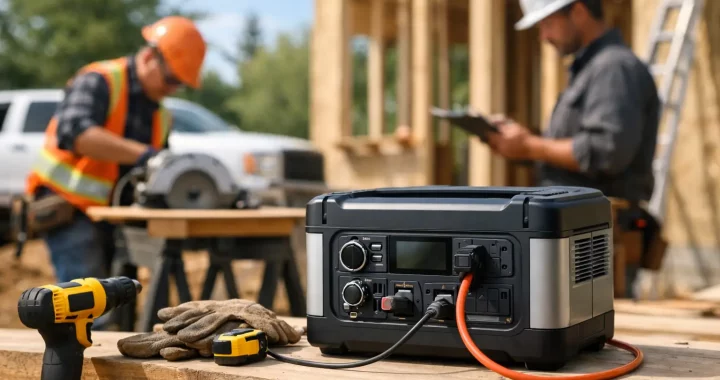
A dead outlet can stall a crew faster than bad weather. When you are running tools, charging batteries, and keeping a job moving, the best portable power stations for contractors are the ones that deliver stable output, recharge fast, and hold up to real jobsite use without the noise and fuel issues of a gas generator.
For many contractors, the appeal is straightforward. A portable power station gives you quiet, instant power where grid access is limited, temporary service is not ready, or indoor work rules out combustion equipment. It is not a perfect replacement for every generator on every site, but it can be the right solution for punch lists, finish work, service calls, remodeling, mobile trades, and backup power when the schedule cannot wait.
What makes the best portable power stations for contractors
Contractors do not shop for portable power the same way campers do. The first question is not whether the unit can charge a phone. It is whether it can support the actual tools and equipment that keep the workday on track.
Start with inverter output. Running watts tell you what the power station can handle continuously. Surge capacity matters too, especially for tools or equipment with a startup spike. A unit that looks strong on battery capacity but falls short on output may run lights and chargers just fine, yet shut down under a miter saw or shop vac.
Battery capacity matters differently depending on the trade. If you are mostly charging cordless tool batteries, tablets, inspection equipment, and laser levels, watt-hours can stretch surprisingly far. If you need to run a saw, fan, dust extractor, or compressor for long periods, capacity drains much faster. That is where larger battery banks or expandable systems start to make sense.
Battery chemistry is another practical issue. LiFePO4 has become the preferred choice for many serious users because it offers better cycle life, thermal stability, and long-term value than older lithium chemistries. For contractors who expect frequent use rather than occasional emergency backup, that durability matters.
Port selection is easy to overlook until the site gets busy. AC outlets are obvious, but a good jobsite setup may also need USB-C for tablets and phones, 12V outputs for specialty equipment, and enough spacing between outlets to handle bulky charger bricks. The best units reduce clutter instead of creating it.
Portable power station vs gas generator on a jobsite
There is a reason gas generators still show up on demanding jobs. They can support heavy loads for long periods if fuel is available, and for large power-hungry equipment they may still be the better fit. But that does not automatically make them the best option.
Portable power stations are quieter, easier to use, and better suited for indoor work, occupied spaces, and jobs where noise control matters. They start with the push of a button. There is no fuel storage, no exhaust, and less maintenance. For contractors working in finished homes, commercial interiors, service vans, basements, or tight urban lots, those advantages are hard to ignore.
The trade-off is runtime under heavier loads. If you are trying to run multiple high-draw corded tools all day, a battery system can deplete quickly unless you size up significantly. For intermittent loads, battery charging, diagnostics, lighting, and mobile office power, portable stations often fit the work better.
How to choose the right size for contractor use
If you want the best portable power stations for contractors, matching the unit to the workload is more important than chasing the biggest model on the page.
For light-duty contractor use, think service techs, inspectors, finish carpenters, and punch-out crews. A smaller to mid-size power station can handle battery chargers, laptops, routers, lights, and occasional small tool use. These setups are easier to move, easier to store in a van, and often enough for short work windows.
For mid-demand applications, remodelers and trade crews often need more headroom. This is where higher inverter output and more battery capacity pay off. You may be supporting a miter saw for cuts, charging multiple battery packs, running fans, and keeping phones and tablets powered through the day. A mid-to-large station offers more flexibility without becoming too cumbersome.
For heavier demand, larger units with expansion battery support are the more realistic choice. If the job requires longer runtime, repeated use of higher-wattage tools, or backup support for temporary site equipment, expansion can be the difference between getting through the day and stopping to recharge too early.
Features that matter more than the marketing
Fast recharging is one of the most valuable features for contractors. A unit that can recover quickly from AC wall charging or solar input gives you more scheduling flexibility. If the station can recharge overnight, during lunch, or while moving between jobs, it becomes much easier to rely on daily.
Pass-through charging can also help in some setups, especially when the station is supporting light loads while recharging. Not every contractor needs this, but for mobile workstations and ongoing battery charging, it can be useful.
Display quality matters more than it sounds. A clear screen that shows input, output, battery percentage, and estimated runtime lets you make better decisions on the fly. On a busy site, guessing is inefficient.
Weight and portability are another real-world factor. Bigger capacity usually means more weight. That sounds obvious, but it changes how often the unit actually gets used. A powerful station that takes two people to move may be fine in a trailer or for planned backup. A lighter model with less capacity may see more everyday use because it is easy to carry into a house, up stairs, or across a site.
Durability should be viewed realistically. Most portable power stations are not built like demolition equipment. They need sensible handling, dry placement, and protection from impact and dust. Contractors should look for sturdy housing, strong handles, and stable footing, but also understand that a portable battery system is an electrical asset, not something to throw in the bed of a truck without protection.
Best use cases for contractor power stations
Portable power stations work especially well when the work is mobile, intermittent, or happening where clean and quiet power is a requirement.
Electrical and low-voltage contractors often use them to keep diagnostic tools, laptops, battery chargers, and networking gear ready in buildings where service is not active yet. Finish carpenters and installers can use them for trim work, small saws, lights, and charging without dragging extension cords through a client’s home. HVAC, plumbing, and service professionals can use them to support tools and communications on calls where fast setup matters.
They also make sense as backup power for the crew itself. Charging phones, tablets, and inspection equipment may not sound like the main event, but losing access to communication and documentation can slow a project fast. A dependable power station helps keep the whole workflow moving.
When a contractor should go bigger
If your crew regularly runs high-draw tools, charges multiple battery platforms, or needs dependable backup for long shifts, going bigger usually saves frustration. Buying too small often leads to the same outcome – the station works, but only for part of the workday or only for limited tasks.
This is where established portable power brands with higher-capacity lithium systems, pure sine wave inverters, and expansion options stand out. A curated product lineup like the one at Thundervolt Power is built around that practical middle ground: enough performance for serious users, without pushing people toward overcomplicated setups they do not need.
That said, bigger is not always better. If the power station is mainly living in a van for service calls and light support tasks, a more compact model may be the smarter buy. The right answer depends on the load profile, runtime expectation, and how often the unit needs to be moved.
A contractor buying checklist that keeps things simple
Before you buy, add up the wattage of the devices you plan to run at the same time, then allow room for startup surges and a little growth. Think honestly about runtime, not just whether the station can start the tool. Check the recharge speed, outlet mix, battery chemistry, and total weight. If your workload is likely to increase, consider whether expansion batteries are available.
Also think about where the unit will live. In a trailer, a larger system can work well. In a service van or for stair-heavy residential work, portability may matter just as much as output. The best portable power stations for contractors are not the ones with the biggest numbers. They are the ones that fit the way the job actually gets done.
Power problems on a jobsite rarely happen at a convenient time. Choosing a station that is sized for real work, built for repeat use, and easy to deploy gives you one less thing to worry about when the schedule is already tight.
