
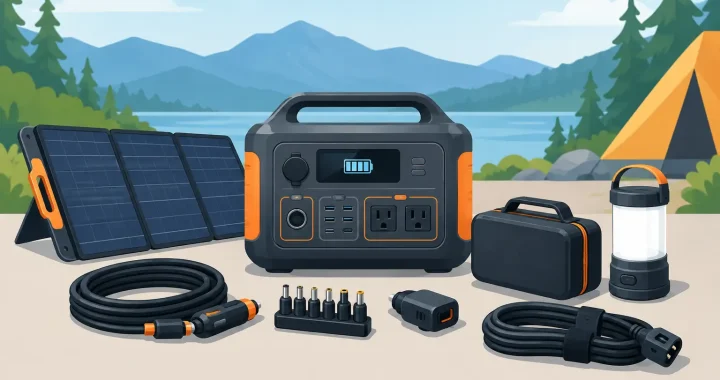
A power station is only as useful as the equipment that lets you charge it, protect it, and put its stored energy to work. The best power station accessories turn a battery into a practical backup plan for a storm outage, a dependable RV power source, or a quiet jobsite setup. The right choices depend on your station’s input limits, output ports, and the devices you need to keep running.
Buying accessories by category alone can lead to expensive mismatches. A solar panel may have the right connector but exceed the station’s voltage limit. An extension cord may fit the outlet but be too light for a high-draw appliance. Start with the power station manual, then choose accessories that make your system more capable without compromising safety.
Best Power Station Accessories for Backup and Travel
1. Compatible portable solar panels
Portable solar panels are among the most valuable accessories because they give your power station a way to recharge when wall power is unavailable. For evacuation, camping, RV travel, and extended outages, solar charging can stretch a finite battery supply into a longer-term source of essential electricity.
Compatibility matters more than panel size alone. Check the station’s maximum solar input wattage, voltage range, amperage limit, and connector type. Many portable power stations use an XT60, DC, Anderson-style, or proprietary connection. A suitable adapter can help, but it does not make an electrically incompatible panel safe.
Panel wattage should match how you use the system. A compact panel is easier to carry and useful for phones, lights, and light daytime loads. A 200W to 400W folding panel can make a meaningful difference for larger stations, especially when weather permits several hours of direct sun. Real-world output is often lower than the number printed on the panel due to cloud cover, heat, shade, panel angle, and time of day.
2. Expansion batteries for longer outages
An expansion battery is the accessory to consider when your existing power station has enough inverter capacity but not enough runtime. It can be a better fit than purchasing a second complete unit when you need to support refrigerators, CPAP machines, internet equipment, sump pumps, or other essential loads through a longer outage.
Expansion batteries are typically designed for specific power station models. Use only the compatible battery and connection cable approved for your unit. Capacity may increase substantially, but adding battery storage does not automatically increase the wattage your inverter can deliver. A station with a 2,000W AC output remains limited to that output rating even if its battery capacity doubles or triples.
This distinction matters at home. More watt-hours help a refrigerator run longer. More output watts determine whether the station can start and operate an appliance in the first place. Check both before building a larger backup system.
3. A properly rated extension cord
A heavy-duty extension cord makes a power station far more practical during an outage or outdoor project. It lets you place the unit where airflow and weather protection are better while bringing power to a refrigerator, workbench, television, or charging area.
Choose cord gauge based on load and length. A shorter, thicker 12-gauge or 14-gauge outdoor-rated cord is generally the safer choice for higher-draw equipment. Long, thin cords can create voltage drop, run warm, and reduce appliance performance. For a lamp, router, or phone charger, cord demands are modest. For a space heater, power tool, microwave, or refrigerator, use a cord rated for the load and avoid unnecessary length.
Do not run a power station in standing water, cover its ventilation openings, or route cords where they can be pinched by doors or driven over. If you need to connect household circuits, work with a qualified electrician on an appropriate transfer solution. Never backfeed a home through a wall outlet.
4. Vehicle charging cables and DC adapters
A 12V vehicle charging cable adds useful flexibility for road trips, work vehicles, and evacuation plans. It allows you to replenish the station while driving, although vehicle charging is usually slower than AC charging or a well-sized solar array.
For RV owners, campers, and mobile professionals, DC adapters can also support devices that normally run from 12V power. This may be more efficient than converting battery power from DC to AC in the station, then back to DC inside a device’s wall charger. Common examples include compatible coolers, lights, routers, and certain communications equipment.
Pay close attention to polarity, voltage, connector size, and fuse requirements. A plug that physically fits is not necessarily the right electrical match. If a device needs regulated 12V power, confirm that the power station’s car outlet provides it under the conditions you expect.
5. A protective carrying case or cover
Power stations are built for portability, but batteries, displays, ports, and cooling vents still need protection. A fitted carrying case or padded equipment bag helps prevent damage during RV travel, camping trips, jobsite transport, or storage in a vehicle.
Look for a case that protects against dust and bumps without blocking ventilation when the unit is operating. A storage cover can be useful for keeping dirt off a station between uses, but it should be removed before charging or powering loads. Heat management is part of battery care, particularly in garages, vehicles, and outdoor environments.
A good case also keeps cables, adapters, manuals, and solar connectors together. During an emergency, having the correct charging lead in the same place as the power station saves time when it matters most.
6. A DC-to-DC solar extension cable
Solar panels work best when they are placed in direct sunlight, which is not always where the power station should sit. A quality solar extension cable allows you to keep the station inside an RV, beneath an awning, or in a protected area while positioning panels away from shade.
Use solar-rated cable with the correct connector type and an appropriate wire gauge for the run length and charging current. Excessively long or undersized cable can reduce charging performance. Keep connections dry and firmly seated, and inspect them occasionally for wear, cracked insulation, or bent contacts.
This accessory is especially useful during outages. You can move panels as sunlight shifts without repeatedly moving a heavy power station across a yard or driveway.
7. A power meter for managing critical loads
A plug-in power meter removes guesswork from runtime planning. Before an outage, use one to measure how many watts an appliance uses while running and, where relevant, how much energy it consumes over several hours. This is useful for refrigerators, freezers, fans, CPAP machines, networking equipment, televisions, and work tools.
The difference between rated wattage and actual usage can be significant. A refrigerator does not draw its running wattage every minute, while a heater may draw a high, steady load that drains a battery quickly. Measuring your real loads helps you decide whether you need more battery capacity, solar input, or a different appliance plan.
8. Low-draw lighting and charging equipment
A power station lasts much longer when it supports efficient devices. LED lanterns, rechargeable headlamps, USB-C cables, and multiport charging hubs deliver meaningful comfort and communication with a small energy draw. They are practical accessories for storm preparation, tents, vehicles, and temporary workspaces.
For phones, tablets, and many laptops, use USB-C Power Delivery when your power station supports it. Charging directly from a USB-C port is often more efficient than using an AC wall brick. Reserve AC outlets for appliances and equipment that truly require them.
9. A weather radio and communications backup
During severe weather, a powered phone is useful only if cellular networks and local information remain available. A battery-powered or rechargeable NOAA weather radio provides another way to receive alerts, forecasts, and emergency instructions. Pair it with spare charging cables and an efficient light source in the same preparedness kit.
This is not a high-wattage accessory, but it supports the reason many households invest in backup power: staying informed and making sound decisions when normal services are disrupted.
How to Choose Accessories Without Creating Problems
The best accessory is not always the largest or most expensive one. Start with your use case. A family preparing for short outages may prioritize a solar panel, heavy-duty cord, power meter, and low-draw lighting. An RV traveler may benefit more from vehicle charging, solar extensions, protective storage, and DC adapters. A homeowner supporting essential devices through multi-day outages may place expansion capacity and solar recharging at the top of the list.
Then confirm four specifications: connector type, voltage range, current limit, and power rating. For AC accessories, check wattage, surge needs, cord gauge, and outdoor rating. For solar accessories, verify open-circuit voltage as well as rated operating voltage. For battery expansion, confirm model-specific compatibility rather than assuming that two units from the same brand will connect.
Thundervolt Power customers often compare capacity first, and that is reasonable. But a well-matched accessory setup is what makes that capacity available where and when you need it. Build around the loads that matter most, keep the system organized, and test it before the weather forecast turns serious.
