
A dead RV battery at the end of a long travel day is more than an inconvenience. It can mean no refrigeration, no CPAP power, no remote work setup, and no practical way to recharge before morning. RV energy planning gives you a clear answer before you leave: what you can run, for how long, and how you will replace the energy you use.
The goal is not to carry the biggest battery possible. It is to build a dependable system around your actual travel habits, with enough reserve for bad weather, shaded campsites, and the appliances that matter most.
Start RV Energy Planning With Your Daily Power Use
Every reliable RV power setup begins with a daily energy estimate. Most travelers focus first on watts, but watt-hours are usually the more useful number for planning. Watts tell you how much power an appliance needs at one moment. Watt-hours tell you how much battery capacity it consumes over time.
Use this simple calculation:
Watts × hours used per day = watt-hours used per day
A 60-watt laptop used for five hours consumes about 300 watt-hours. A 45-watt portable refrigerator running intermittently may use 400 to 700 watt-hours per day, depending on outdoor temperature, insulation, and how often the door opens. A 1,000-watt microwave may only run for 10 minutes, but that still adds roughly 167 watt-hours to your daily demand.
Write down every device you expect to use on a normal day. Include the less obvious loads: phone charging, lights, Wi-Fi equipment, water pumps, fans, electric blankets, coffee makers, and pet devices. Then separate them into essentials and conveniences. This matters when cloudy weather or an unexpected stop reduces your ability to recharge.
For most RV travelers, daily use falls into one of three broad ranges. A light setup for phones, lighting, a laptop, and modest refrigeration may use 800 to 1,500 watt-hours daily. A typical family RV using more electronics, fans, kitchen appliances, and work equipment may need 1,500 to 3,000 watt-hours. Extended boondocking with a residential refrigerator, significant cooking loads, or air conditioning can push demand much higher.
Size the Battery for More Than One Good Day
Your battery bank should cover daily use plus a realistic reserve. A single sunny day is not a power strategy. Campsites can be shaded, travel days can limit solar collection, and storms can reduce production for several days.
A practical starting point is one to two days of essential energy use. If your essential loads total 1,200 watt-hours each day, a 2,000Wh battery may cover a day with useful margin. For two days of reserve, you may need 2,400Wh or more after allowing for inverter losses and charging inefficiency.
LiFePO4 battery systems are a strong fit for RV use because they offer long cycle life, stable performance, and usable capacity in a package that is easier to manage than a fuel-powered generator. Many portable power stations also provide built-in battery management, regulated outputs, and pure sine wave AC power for sensitive electronics.
Expansion batteries can make sense when your power needs grow over time. Start with a portable power station sized for your core loads, then add capacity if you begin taking longer off-grid trips or need to support more appliances. This approach can be more practical than buying an oversized system before you know how you actually camp.
Battery Capacity and Inverter Output Are Different
A large battery does not automatically mean you can run every appliance. Capacity is measured in watt-hours, while the inverter rating determines how much AC power the station can supply at once.
For example, a 2,000Wh power station with a 2,000-watt inverter may run a 1,200-watt coffee maker, assuming other loads are modest. But an appliance with a high startup surge, such as an air conditioner, may require more inverter capacity than its running wattage suggests.
Check both numbers before buying. Match battery capacity to runtime and inverter output to the largest loads you plan to operate. If you need to power a window AC unit, microwave, induction cooktop, or power tools, pay close attention to continuous output and surge capability.
Plan How You Will Recharge
Energy independence in an RV depends on replenishment. Your battery is the reserve. Your charging plan determines how long that reserve lasts.
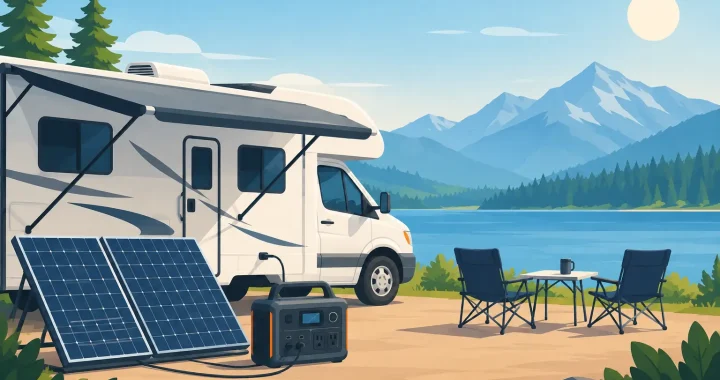
Solar is often the most useful charging source for stationary camping. Portable solar panels let you place panels in direct sun while keeping the RV in shade, which can be a major advantage in hot weather. Fixed roof panels are convenient because they are always ready, but they cannot be moved when the RV is parked under trees.
Solar output is never identical to the panel rating. A 400-watt panel array may not produce 400 watts all day. Sun angle, cloud cover, panel temperature, dirt, wiring losses, and shading all affect real-world production. In favorable summer conditions, 400 watts of solar might produce roughly 1,200 to 1,800Wh in a day. In winter, heavy shade, or poor weather, that number may be far lower.
Charging while driving is another valuable part of RV energy planning. If your power station supports vehicle charging, it can recover some energy between campsites. Standard 12V vehicle charging is often slow, so travelers with larger power demands may prefer systems that support faster alternator charging. Shore power remains the easiest way to recharge fully when you have access to an RV park or campground hookup.
A dependable setup usually uses more than one charging method. Solar supports off-grid stays, driving adds recovery during travel, and shore power provides a reliable reset when available.
Treat High-Draw Appliances as a Separate Decision
Air conditioning, electric heat, hair dryers, toaster ovens, and induction cooktops can change your entire power plan. These appliances are not impossible to run from a battery system, but they require honest math.
A 1,500-watt space heater can drain 1,500Wh in one hour before accounting for inverter losses. Electric heat is generally one of the fastest ways to exhaust a portable battery. Propane heat, proper insulation, and warm bedding are often more efficient choices for cold-weather camping.
Air conditioning depends heavily on unit size, outside temperature, insulation, and thermostat settings. A small window AC may be manageable for limited periods with a high-output power station and substantial battery capacity. A rooftop RV air conditioner usually demands a much larger system, especially if you expect overnight runtime. Soft-start equipment can reduce startup surge, but it does not eliminate the unit’s ongoing energy use.
This is where trade-offs matter. If cooling is a safety requirement for pets, medical needs, or extreme heat, plan for the load first and build the battery, inverter, and charging system around it. If cooling is occasional comfort, use shore power when possible and reserve battery power for essentials.
Build in a Reserve for What Cannot Wait
Your RV power system should not run at the edge of empty every night. Keep a protected reserve for critical needs: medical equipment, phones, communications, refrigeration, lights, and a way to start the next day.
Many power stations allow you to monitor input, output, and remaining runtime from a display or app. Use those numbers to adjust early rather than waiting for a low-battery warning. If solar production is weak by midday, reduce nonessential use. If you arrive at camp with a partially charged battery, recharge before preparing dinner or running high-draw appliances.
Good habits extend your power window. Charge laptops and tools while driving or during peak solar hours. Use DC or USB outputs for compatible devices instead of converting battery power to AC and back again. Run the microwave, coffee maker, or other short-term high-draw appliances when the battery is well charged.
Choose Equipment That Fits the Way You Travel
The best RV power system is not always the most complex one. Weekend campers may only need a compact LiFePO4 power station and portable solar panel for lights, phones, a cooler, and basic electronics. Full-time travelers or remote workers may need higher capacity, faster charging, and expansion options. Families traveling through storm-prone areas may prioritize a system that can also serve as quiet emergency backup power at home.
Thundervolt Power focuses on portable energy systems that help travelers build from practical needs upward, whether that means a straightforward solar generator or a larger expandable setup for longer stays off-grid. Look for pure sine wave AC output, enough ports for your devices, a charging speed that matches your travel schedule, and battery capacity that leaves room for real-world conditions.
Before your next trip, test your system at home. Run the refrigerator, charge your devices, use the coffee maker, and see what your actual battery draw looks like. A few hours of testing turns RV energy planning from a guess into a dependable routine, so the power you need is ready when the road takes you farther from the grid.
