
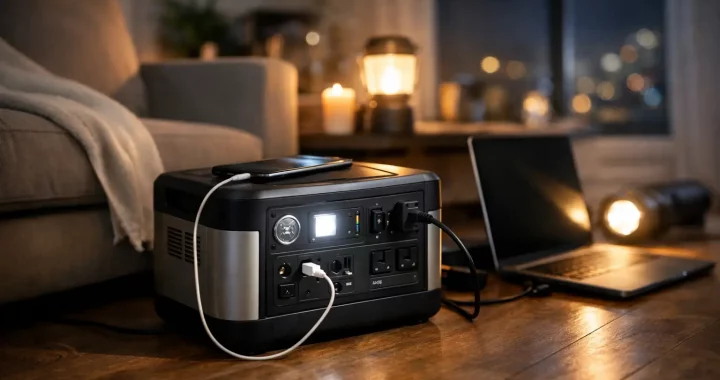
A city-wide outage changes apartment life fast. Elevators stop, building Wi-Fi drops, refrigerators begin warming, and a phone battery becomes more than a convenience. The best power stations for apartment emergencies provide quiet, fuel-free electricity inside your home, giving you time and options when the grid is not stable.
For most apartment residents, the right unit is not the largest power station available. It is the one you can store easily, lift safely, recharge quickly, and rely on for the devices that matter most. That usually means prioritizing battery capacity, inverter output, charging flexibility, and LiFePO4 battery chemistry over oversized specifications that do not fit your space or your actual emergency plan.
What Makes a Power Station Right for an Apartment?
A portable power station stores electricity in a rechargeable battery and supplies it through AC outlets, USB ports, and often 12V DC outputs. Unlike a gas generator, it produces no exhaust fumes during use. That makes a properly maintained battery power station a practical indoor backup option for apartment living. Gas generators must never be run indoors, on balconies, in hallways, or near windows because of carbon monoxide risk.
Apartment emergencies also require a different mindset than whole-house backup. You may not need to run every appliance. Your priority is keeping communication, lighting, food, work equipment, and health-related devices available until the outage ends or you can relocate.
The strongest apartment setup usually has enough capacity for a refrigerator, phones, a router, lights, and a laptop, plus enough inverter power to handle the refrigerator’s startup demand. It should also have a clear place to live between emergencies, rather than becoming a heavy box that is difficult to access or recharge.
Best Power Stations for Apartment Emergencies by Need
Best for essential devices: 300Wh to 600Wh
A 300Wh to 600Wh power station is a sensible choice for residents focused on short outages and personal essentials. This size can keep phones, tablets, rechargeable lights, a laptop, and a modem or router operating for many hours. It is generally easier to carry from a closet to a living area and easier to take along if you need to leave the building.
The limitation is appliance runtime. A compact station may run a small refrigerator for only a limited period, especially if the refrigerator cycles frequently or has a high startup surge. It is better viewed as a communications and comfort solution than a full kitchen backup system.
Look for at least 500W of AC output if you expect to connect anything beyond electronics. A pure sine wave inverter is also worth having because it delivers clean power suitable for sensitive electronics, chargers, and many modern appliances.
Best for most households: 700Wh to 1,200Wh
For many apartments, a 700Wh to 1,200Wh LiFePO4 power station is the practical sweet spot. It offers meaningful reserve power without demanding the storage footprint of a much larger system. This range can support a refrigerator for several hours, while still covering phones, a laptop, LED lights, internet equipment, and small medical devices.
Capacity alone does not determine whether it can run an appliance. Check continuous AC output and surge capability. A refrigerator may use modest wattage while running but require a brief higher surge when its compressor starts. A station with 1,000W or more of continuous output gives most apartment residents useful flexibility for a refrigerator, coffee maker, microwave in short intervals, or basic cooking appliance. Do not assume all of those can run at once.
This range is also a strong choice for people who work from home. Keeping a laptop, monitor, router, and phone charged can preserve communications and allow work to continue during a daytime outage. If your building’s internet service stays online, a small backup power station may be all that separates a disruption from a lost workday.
Best for extended outages: 1,500Wh and above
A 1,500Wh to 2,500Wh station is better suited to longer outages, households with medical-power needs, or residents who want to run a refrigerator alongside more equipment. Larger units can support higher-wattage appliances and deliver substantially longer runtime, particularly when paired with an expansion battery.
The trade-off is weight, price, and space. Some high-capacity stations are difficult for one person to move safely. Before buying, measure the storage area, check the unit’s weight, and decide where you will use it during an outage. A station that remains stuck in a crowded closet is not a dependable emergency resource.
For apartment use, expansion capacity is valuable only when you have a specific reason for it. An expandable LiFePO4 system can make sense for multi-day outage planning, remote work requirements, or powering critical medical equipment. For occasional short outages, a simpler mid-capacity station may be the better investment.
How Much Battery Capacity Do You Need?
Battery storage is measured in watt-hours, or Wh. A 1,000Wh power station theoretically stores 1,000 watts for one hour, 100 watts for 10 hours, or 50 watts for 20 hours. Real-world runtime is lower because inverter operation and charging electronics use some energy.
A practical estimate is to multiply the station’s watt-hour rating by 0.85, then divide by the wattage of the device. For example, a 1,000Wh station has roughly 850Wh of usable AC energy. A 75W router, laptop, and lighting load could run for around 11 hours. A refrigerator’s consumption is more variable because it cycles on and off, so its label wattage does not tell the whole story.
Start with the devices you would actually use during the first 12 to 24 hours. For a typical apartment emergency, that may include a refrigerator, phone chargers, a Wi-Fi router, LED lamps, a laptop, and a CPAP machine if applicable. Avoid building a plan around electric space heaters, portable air conditioners, electric ranges, or large microwave use. Those appliances consume battery capacity quickly, even when a power station has sufficient output to start them.
If staying cool is a concern, a small fan is far more realistic than a window air conditioner for most apartment battery setups. A larger station may run a window unit for a period, but air conditioning can drain even a large battery quickly. Use it as targeted relief, not an assumption of all-night cooling.
Features That Matter More Than Extra Ports
For emergency readiness, LiFePO4 battery chemistry should be high on the list. These batteries are designed for long cycle life and thermal stability, making them a strong fit for equipment that may sit charged and ready for long periods. Follow the manufacturer’s storage and charging guidance, especially if the station will be kept in a hot storage room or unconditioned area.
Fast AC recharging is another major advantage. A station that can recharge in a short window is easier to prepare before an approaching storm and easier to restore after a partial outage. If you have access to a balcony, patio, or outdoor common area that permits it, compatible portable solar panels can add useful charging resilience. Solar output depends heavily on direct sunlight, panel placement, weather, and building shade, so it should complement wall charging rather than replace it in an emergency plan.
An uninterruptible power supply, or UPS, function can be useful for a modem, router, desktop computer, or medical device. However, transfer time and compatibility vary by model. Anyone powering medically necessary equipment should confirm the device’s power requirements and consult its manufacturer or care provider before relying on any backup system.
Pay attention to outlet placement, app monitoring if available, and a display that clearly shows input, output, and remaining battery percentage. During an outage, you should be able to see what is drawing power and make decisions before the battery is depleted.
Set Up Your Apartment Backup Plan Before the Lights Go Out
A power station is most useful when it is already charged, tested, and easy to reach. Keep it in a dry, ventilated indoor location with its charging cable and any essential adapters nearby. Test it with your actual refrigerator, router, CPAP, or work setup while grid power is available. This confirms that the appliance starts correctly and shows you the real power draw.
During an outage, connect only priority loads first. Turn off unnecessary lights, avoid repeatedly opening the refrigerator, and charge devices in batches. If the outage may last overnight, preserve battery capacity for the equipment that protects food, communication, health, and safety.
For most residents, the best choice is a LiFePO4 power station in the 700Wh to 1,200Wh range with a pure sine wave inverter, at least 1,000W of AC output, and fast recharging. Compact units are excellent for essentials, while larger expandable systems are appropriate when longer runtime is genuinely necessary. The goal is not to recreate normal life on battery power. It is to keep your apartment safer, connected, and more livable until normal power returns.
