
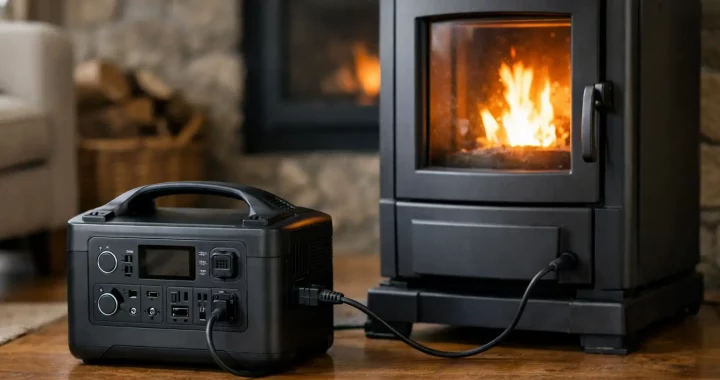
A pellet stove can keep a home comfortable through a winter outage, but only while its auger, combustion fan, control board, and igniter have electricity. A portable power station for pellet stove backup gives those essential components quiet, fuel-free power when the grid drops – without hauling a gas generator through snow or running extension cords from a neighbor’s house.
The right system is not simply the largest battery you can buy. It must deliver clean AC power, handle the stove’s startup demand, and store enough energy for the outage you are planning for. A few minutes spent matching the station to your stove can make the difference between dependable heat and a unit that shuts down when you need it most.
Why Pellet Stoves Need Backup Power
Unlike a traditional wood stove, a pellet stove depends on electricity to move pellets from the hopper to the burn pot and to manage combustion. Most models also use fans to distribute warm air and exhaust gases safely. When the power fails, the stove will generally stop feeding pellets and shut down.
That does not mean a pellet stove uses a huge amount of electricity. Many units draw roughly 100 to 400 watts during normal operation, depending on the heat setting, blower speed, and stove design. The demand can be higher during ignition, when the igniter heats up, or when motors first start. Exact numbers vary widely, so the rating label and owner’s manual for your specific stove should always be the starting point.
For homeowners in areas with winter storms, a battery-powered backup system is particularly useful because it is quiet, operates indoors, and requires no gasoline. It can also be moved to support a refrigerator, communications equipment, or medical device once heating is no longer the priority.
How to Size a Portable Power Station for a Pellet Stove
Sizing comes down to two numbers: watts and watt-hours. Watts tell you whether the power station can run the stove at a given moment. Watt-hours tell you how long it can do so.
Start with the Stove’s Running and Startup Watts
Find the stove’s listed power consumption in its manual, on its data plate, or from the manufacturer. If it lists amps instead of watts, multiply amps by 120 volts for a reasonable estimate. For example, a stove rated at 2 amps may use about 240 watts.
Then allow room for startup or ignition demand. A power station with a pure sine wave inverter and at least 1.5 to 2 times your stove’s expected running wattage is a practical target. If your stove runs around 250 watts, a 600-watt station may work, but a 1,000-watt or larger inverter gives more breathing room for startup loads and a phone charger, lamp, or internet modem.
Pure sine wave output matters. Pellet stoves contain motors, fans, and electronic controls that are designed for standard household AC power. A pure sine wave inverter produces cleaner power than a modified sine wave design and is the better choice for protecting sensitive electronics and avoiding motor noise or unreliable operation.
Estimate the Battery Capacity You Need
Battery capacity is usually expressed in watt-hours, or Wh. The basic planning formula is:
Usable battery watt-hours ÷ stove watt draw = estimated runtime in hours
A 1,024Wh power station running a 150-watt pellet stove might provide roughly 5 to 6 hours after inverter losses. A 2,048Wh model could provide about 11 to 12 hours under the same steady load. Real-world runtime may be longer if the stove cycles between lower and higher settings, but it may be shorter during ignition or when the convection blower runs hard.
Do not plan around the advertised battery capacity alone. AC conversion consumes some energy, and cold temperatures can reduce battery performance. For an overnight outage, it is wise to build in a meaningful reserve rather than expecting every rated watt-hour to be available at the outlet.
For many homes, 1,000Wh is a short-outage solution. A 2,000Wh class power station is better suited to an overnight event or a stove with moderate power use. For multi-day winter outages, consider a unit that accepts expansion batteries, along with a reliable plan to recharge it from solar, a vehicle where appropriate, or a generator used safely outdoors.
Features That Matter During a Winter Outage
A high battery number is only part of the decision. Look for equipment built for repeated backup use, not just charging electronics at a campsite.
LiFePO4 battery chemistry is a strong fit for home preparedness because it typically offers long cycle life and stable performance. Fast AC recharging can be equally valuable. If utility power comes back for only a few hours before another outage, you want to restore as much reserve capacity as possible.
An integrated UPS or emergency power supply mode can be useful if you want the pellet stove connected during normal conditions, with the station taking over when the grid fails. However, transfer behavior differs by model. Check the transfer time, continuous AC output rating, and the pellet stove manufacturer’s guidance before relying on any station as a permanently connected backup source.
Also pay attention to practical details: a clear battery display, enough AC outlets, a sturdy handle, and an output rating that does not require operating at its limit. A power station that is easy to check and move is more likely to be ready when the weather turns.
Set Up Your Pellet Stove Backup Safely
Test the complete setup before an emergency. Plug the stove into the power station, start it from cold, and let it run through its normal ignition cycle. This verifies that the inverter handles the igniter and that you understand the station’s actual power draw.
Keep the power station on a stable, dry surface with ventilation around it. It does not produce exhaust, but electronics and batteries should not be crowded against a hot stove or covered with blankets, coats, or storage bins. Use the stove’s original power cord whenever possible. If an extension cord is necessary, use a properly rated, grounded cord in good condition and keep it out of walkways.
Never modify the stove wiring or attempt to backfeed household circuits through a wall outlet. If you want a pellet stove connected to a dedicated home backup system, have a qualified electrician design the proper transfer equipment. A portable station is often simplest and safest when it powers the stove directly.
Before relying on any setup, confirm these four points:
- The station’s continuous AC output exceeds the stove’s running demand.
- Its surge capability can handle ignition and motor startup.
- The battery capacity meets your realistic runtime goal with reserve power left over.
- The stove manufacturer permits operation from a pure sine wave inverter or battery backup source.
Extending Runtime When the Outage Lasts
Battery power lasts longer when the stove does not have to fight unnecessary heat loss. Close off unused rooms, lower the thermostat or heat setting when safe and comfortable, and keep exterior doors closed. A lower stove setting may reduce electrical draw from blowers as well as pellet consumption.
Solar panels can help recharge a compatible power station during a prolonged outage, especially on clear winter days. Still, solar output depends on panel size, sun angle, snow cover, and weather. Treat solar as a recharge tool that can extend an existing battery plan, not a guaranteed replacement for the grid during a storm.
If you have access to a gas generator, it can recharge the power station outdoors while the station continues to provide clean, quiet AC power inside. This approach can reduce generator run time and avoid exposing a pellet stove’s electronics to inconsistent generator output. Follow all manufacturer instructions, keep combustion generators well away from doors and windows, and never run one indoors or in a garage.
Choose Capacity for the Outage You Expect
The best portable power station for pellet stove use is sized around your home, your stove, and the kind of outages your area actually experiences. A compact unit can bridge a brief interruption. A larger LiFePO4 system with expansion capability can protect overnight heat and give your household more options when restoration takes longer.
Thundervolt Power focuses on practical backup equipment because readiness should not depend on noise, fuel runs, or guesswork. Check your stove’s electrical requirements now, test a properly sized station before winter, and keep enough stored energy to make the next outage a manageable inconvenience instead of a cold-weather emergency.
