
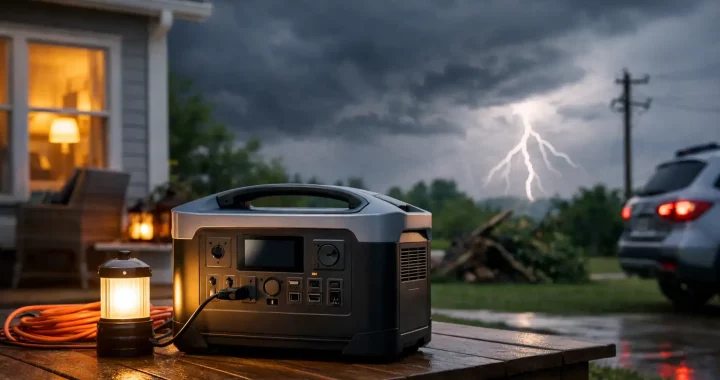
A storm warning changes the value of stored electricity fast. A power station for storm season gives your household quiet, fuel-free backup for the devices that matter when the grid goes down: phones, lights, refrigeration, internet equipment, medical devices, and more. The right unit is not simply the largest battery you can afford. It is the one that matches your essential loads, can recharge when conditions allow, and is ready before the first outage alert arrives.
Unlike a gas generator, a portable power station produces no exhaust and can be used indoors when operated according to its instructions. That makes it a practical first line of backup power for apartments, homes, RVs, and families who need a straightforward way to maintain basic comfort and communication. But preparation starts with realistic expectations about what you need to run and for how long.
Start With the Loads You Cannot Go Without
During an outage, convenience loads and critical loads are not the same thing. A television may help pass the time, but a refrigerator protecting food, a CPAP machine, a phone, or a modem can have a more immediate purpose. Begin by deciding what stays powered during the first few hours and what needs support through an overnight outage.
A practical storm-season priority list often includes a refrigerator or freezer, a few LED lights, phones, a laptop, a modem and router, a fan, and any medically necessary equipment. If your household uses a sump pump, well pump, or a window air conditioner, include those only after checking their running and startup requirements. These appliances can require far more power than their labels suggest when the motor first starts.
Write down the wattage of each device, usually found on its label, manual, or power adapter. For appliances listed in amps, multiply amps by volts to get an approximate wattage. In a typical US household, that means amps multiplied by 120 volts. This simple inventory prevents a common mistake: buying a station with plenty of battery capacity but not enough inverter output to start the appliance you need.
Power Station for Storm Season: Watts vs. Watt-Hours
Two specifications determine whether a portable power station fits your emergency plan: output in watts and battery capacity in watt-hours.
Watts tell you how much power the station can deliver at one time. If a refrigerator needs 150 running watts but briefly surges to 1,200 watts at startup, the power station needs an inverter that can handle that surge. A pure sine wave inverter is especially valuable for sensitive electronics and motor-driven equipment because it delivers cleaner AC power comparable to household electricity.
Watt-hours tell you how long the battery can run a load. A 1,000Wh power station can theoretically run a 100-watt load for 10 hours. In real use, expect less due to inverter losses, battery management, changing appliance cycles, and conversion losses. Planning for 75% to 85% of stated capacity is a sensible starting point when using AC outlets.
For example, a 1,000Wh unit may keep a modem, router, several LED lights, and phones operating for a long evening. It may also support a refrigerator for several hours, depending on the refrigerator’s cycling pattern and room temperature. It is not likely to run a central air conditioning system or an electric range. Those are whole-home loads and generally require a much larger battery and transfer setup.
Capacity should be chosen around your expected outage length. A compact unit can cover communication and lighting. A mid-size station in the 1,000Wh to 2,000Wh range can support a broader set of essentials. For multi-day outages, look at higher-capacity systems with expansion battery options, especially if refrigeration, medical equipment, or remote work must continue.
Do Not Overlook Startup Surge and 120V Requirements
Storm preparation often exposes the difference between an electronic device and a motor-driven appliance. Phones, tablets, laptops, and LED lamps draw predictable, modest amounts of electricity. Refrigerators, pumps, fans, power tools, and air conditioners can draw a brief but substantial startup surge.
Check both the continuous AC output and surge rating of a power station before connecting these loads. A unit that can supply 1,800 watts continuously may be suitable for many household essentials, while a lower-output model may be better reserved for electronics and small appliances. It depends on the specific equipment in your home, not just the category printed on the product box.
Also verify the outlet type and voltage. Most portable stations provide standard 120V AC outlets for common US household devices, along with USB-A, USB-C, and 12V outputs. A 240V appliance, hardwired furnace, central AC system, or large well pump requires specialized planning. Do not attempt to improvise connections to household wiring or backfeed power through a wall outlet. If you need selected circuits powered during an outage, work with a qualified electrician on a properly designed transfer solution.
Plan How You Will Recharge During a Long Outage
A charged power station is useful for one outage. A recharge plan makes it useful for a storm season.
AC wall charging is the fastest and most convenient way to prepare before bad weather arrives. Fully charge the station when a storm watch is issued, then keep it plugged in only if the manufacturer permits standby use. Fast-charging models can restore a meaningful amount of capacity before weather conditions deteriorate, but do not wait until the final hour if you can avoid it.
Solar charging can extend runtime during a prolonged grid outage. Portable solar panels are quiet, renewable, and particularly useful once skies clear. Their output, however, depends on direct sunlight, panel size, angle, shading, and weather. A rainy hurricane day is not the time to expect peak solar production. Treat solar as a valuable recharging option, not a guarantee that removes the need for adequate stored battery capacity.
Car charging can be helpful for smaller stations while traveling or evacuating, though it is generally slower than wall charging. Expansion batteries offer another path for households that need longer runtime without moving to a noisy fuel generator. LiFePO4 battery chemistry is especially well suited to preparedness use because it is built for long cycle life and stable performance over repeated charging.
Set Up Before the Forecast Turns Serious
A power station should not stay sealed in a box until the lights go out. Test it while conditions are normal. Plug in your modem, charge your phones, run a fan, and confirm that the refrigerator starts if that is part of your plan. This helps you identify incompatible loads, short cables, or settings you need to adjust before an actual emergency.
Keep the station in a dry, ventilated indoor location away from direct heat, moisture, and flammable materials. Do not cover cooling vents. Place it where cords will not create a trip hazard, and avoid running cables through standing water, damaged windows, or doorways that cannot close safely.
Your storm kit should also include the practical accessories that make stored power useful: compatible charging cables, a surge protector rated for the planned load, LED lights, extension cords appropriate for indoor use, and printed instructions for essential equipment. For households with medical devices, confirm the device’s power needs with the equipment provider and maintain the backup plan recommended by your clinician or provider.
Use Your Battery Capacity Deliberately
When the outage begins, run the highest-value loads first and avoid leaving unnecessary devices connected. Refrigerators do not need to be opened frequently, and many can be powered in cycles rather than continuously if food safety and the appliance manufacturer’s guidance allow. Charge phones and battery banks during the day, then reduce nonessential use overnight.
This approach is more effective than trying to recreate normal household life on a limited battery. A power station is designed to preserve stability: communication, light, temperature management for food, and the ability to operate essential equipment. Used with discipline, a properly sized system can make an outage far more manageable.
Thundervolt Power offers portable and expandable backup options for households that want dependable electricity without fuel storage, exhaust, or generator noise. The best time to choose your system is when you can compare real loads calmly, not when the forecast is already urgent.
Before the next storm arrives, charge your station, test the devices that matter, and place your backup power where it can be reached in the dark. Readiness is built one practical decision at a time.
