
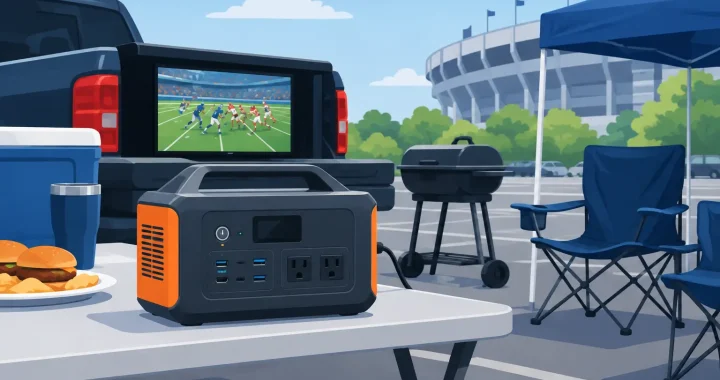
A packed stadium lot has its own soundtrack: music, conversation, grills firing up, and game-day excitement. A loud gas generator does not need to be part of it. The best quiet power for tailgating is usually a portable power station sized for what you actually plan to run, with enough battery capacity to last from setup through the final whistle.
For most tailgaters, that means clean, fume-free electricity for phones, a TV, a small fan, lights, a cooler, and charging gear. Larger setups may also need power for a pellet grill, electric griddle, blender, or projector. The right choice comes down to two separate numbers: how much power your equipment needs at one time and how much energy it will use during the day.
Why a Portable Power Station Fits Tailgating
Traditional generators can produce plenty of power, but they bring fuel storage, exhaust, routine maintenance, and noise. At a crowded event, that noise can affect your own setup as much as your neighbors’. Some venues also restrict fuel-powered equipment or require generators to be placed well away from parking areas and gathering spaces.
A lithium portable power station runs silently at the battery level. You may hear a cooling fan when powering heavier loads or fast-charging the unit, but the experience is far quieter than an engine-driven generator. There are no gas fumes near food, no pull-start procedure, and no oil to check before you leave home.
That does not mean every battery station is automatically the right fit. A compact unit is excellent for charging devices and running LED lighting, but it may not support a cooking appliance. Choosing well starts with an honest look at your game-day load.
How to Choose the Best Quiet Power for Tailgating
Start with the running watts of every device you expect to use at the same time. Running watts describe the continuous power a device needs while operating. A power station’s AC output rating must be higher than that combined number, with room to spare.
A practical mid-size tailgate might use a 65-watt TV, a 45-watt portable cooler, 20 watts of lights, 15 watts of phone charging, and a 50-watt speaker. That is about 195 watts of continuous demand. A power station with 500 to 1,000 watts of pure sine wave AC output gives that setup useful overhead for occasional additional loads.
Cooking equipment changes the calculation quickly. Electric griddles commonly draw 1,200 to 1,800 watts. Many pellet grills need modest power while running but can use a higher surge during ignition. Coffee makers, air fryers, and microwaves also demand substantial wattage. If these are part of your plan, look for at least 1,800 watts of AC output and confirm the specific appliance’s rated draw before you buy.
Separate watts from watt-hours
Watts tell you whether a power station can run a device. Watt-hours, shown as Wh, estimate how long it can run it. This is the number that determines whether your power holds up through a four-hour pregame and postgame gathering.
Use this simple planning formula:
Device watts x hours of use = watt-hours needed
A 60-watt TV used for five hours needs roughly 300Wh. A 45-watt cooler operating for five hours could use up to 225Wh, though many compressor coolers cycle on and off and may consume less in moderate weather. Add your smaller loads, then include a margin for inverter losses, warm weather, and unexpected charging needs.
For a basic electronics-and-lighting tailgate, a 500Wh to 800Wh power station is often enough. For a TV, cooler, speakers, charging, and several hours of use, 1,000Wh to 1,500Wh provides more confidence. If you intend to cook electrically or power a larger entertainment setup, consider a 2,000Wh class unit, especially if it has an expansion battery option.
Account for surge power
Certain appliances draw extra power for a brief moment when they start. This is called surge, starting, or peak power. A cooler compressor, small refrigerator, and some fans may need more power at startup than their listed running wattage suggests.
Check both the continuous output and surge rating of the power station. Pure sine wave output also matters. It delivers clean AC electricity appropriate for sensitive electronics such as TVs, laptops, gaming consoles, and modern charging equipment. It is the standard to look for when your tailgate setup includes more than simple lights and USB ports.
Match the Battery to Your Tailgate Style
There is no single capacity that serves every parking lot setup. The right choice depends on how you tailgate.
A compact setup centered on phones, a tablet, LED string lights, and a Bluetooth speaker can travel light. A smaller power station with USB-C ports, standard USB outputs, and a 12V vehicle-style outlet keeps gear charged without taking up much cargo space.
A family setup often needs more. A TV or projector, Wi-Fi hotspot, fan, portable cooler, and multiple phones create a steady draw over several hours. In this case, battery capacity matters more than a high peak-wattage number alone. A 1,000Wh-class station can be a practical balance of runtime, portability, and capability.
A full cooking-and-entertainment setup calls for serious output and capacity. It may be better to separate loads: use a larger station for the grill or griddle and another unit for the TV, cooler, and charging table. This keeps one high-draw appliance from draining the battery intended for the essentials.
Features That Make Game Day Easier
LiFePO4 battery chemistry is a strong choice for frequent tailgating because it is designed for long cycle life and dependable use. If you expect to use the station for camping, home backup, road trips, and outages as well, the added durability matters.
Look for a clear display that shows input watts, output watts, battery percentage, and estimated remaining runtime. These readings help you make decisions before the battery gets low. You can see when a grill is drawing more than expected or when it is time to turn off extra lighting.
Output variety also matters. At minimum, most groups benefit from several AC outlets, USB-A ports, USB-C charging, and a regulated 12V outlet. USB-C is especially useful for newer phones, tablets, and laptops, often avoiding the need to occupy an AC outlet with a wall charger.
Fast wall charging is valuable when your next tailgate is not far away. Solar charging is useful for extended outdoor events, camping weekends, or emergency readiness, but it should be viewed realistically for a single game day. Solar panels need direct sun, proper placement, and time. They can extend runtime, but they may not fully recharge a large power station during a cloudy afternoon or in a crowded lot with limited open space.
Set Up for Safe, Reliable Power
Charge the station fully at home and test the appliances you plan to bring. A quick test reveals whether a particular griddle trips overload protection or whether your cooler uses more energy than expected. It is much better to find that out in your driveway than two hours before kickoff.
Keep the power station on a stable, dry surface with clear ventilation around its cooling vents. Do not leave it in direct sun inside a closed vehicle for extended periods, and do not operate it in standing water. Use outdoor-rated extension cords when needed, route cords away from walkways, and avoid daisy-chaining power strips.
For high-wattage cooking appliances, plug directly into the power station when possible. Monitor the display during startup and cooking. If the output is close to the unit’s maximum rating, reduce other loads first. Your TV and cooler will not care if a phone charger is unplugged for a few minutes, but they will care if the entire system shuts down from an overload.
Thundervolt Power focuses on portable energy systems that can serve beyond game day, so a properly sized station can also support travel, camping, and home outage readiness. That broader value is worth considering when comparing a larger battery against a smaller unit that only barely meets today’s needs.
A quiet tailgate is not about sacrificing comfort or capability. It is about bringing the power you need without adding fuel fumes, engine noise, or last-minute uncertainty. Size your station for the loads that matter most, leave a margin for real-world conditions, and you can spend game day with your crew instead of managing a generator.
