
The wrong solar setup shows up fast in an RV. Your battery drops overnight, the fridge starts pulling harder in hot weather, and suddenly a panel that looked fine on paper is not keeping up. If you are trying to find the best solar charger for RV use, the real question is not which unit has the biggest marketing claim. It is which setup can reliably match how you camp, how long you stay off-grid, and what you need to power.
For most RV owners, a solar charger is not just a convenience accessory. It is part of a power plan. It helps keep batteries topped off, reduces generator run time, and gives you a quieter, cleaner way to stay prepared on the road. But the best option changes depending on whether you are maintaining a small house battery, charging a portable power station, or supporting a larger off-grid electrical setup.
How to choose the best solar charger for RV travel
The best place to start is with your actual power use. If you only need to keep lights, phones, a water pump, and a vent fan running, your needs are very different from someone trying to support a 12V fridge, laptops, a TV, and occasional appliance use. Solar charging works best when the panel input, battery capacity, and daily energy consumption are in balance.
Panel wattage matters, but it is not the whole story. A 200W panel sounds strong until you park in partial shade, travel during winter, or angle the panel flat on the roof and lose production. Real-world solar output is usually lower than the nameplate rating. That is why buying too close to your minimum daily need often leads to frustration.
Battery chemistry also matters. Many RV owners now prefer LiFePO4 because it offers long cycle life, stable performance, and better usable capacity than older lead-acid batteries. If your RV still uses lead-acid, your charging profile and usable battery capacity will be different. A solar charger that works well with one battery type may not be ideal for another unless the charge controller is properly matched.
Then there is portability. Some RV travelers want fixed roof panels for daily charging with no setup. Others want folding portable panels they can move into direct sun while the RV stays parked in the shade. Neither approach is automatically better. It depends on where you camp and how hands-on you want to be.
What makes a solar charger good enough for real RV use
A dependable RV solar charger needs more than decent panel output. It should be durable, reasonably efficient, and easy to integrate into the rest of your power system. That means looking closely at panel construction, connector compatibility, controller quality, and charging performance in less-than-ideal conditions.
Monocrystalline panels are generally the better fit for RV use because they offer stronger efficiency in a smaller footprint. Space is limited on an RV roof, and even ground-deployed portable panels need to earn their keep. Higher efficiency does not fix bad weather, but it helps you get more charging from the space you have.
The charge controller is just as important as the panel. If your solar charger includes or requires a controller, MPPT is usually the stronger choice for RV applications than PWM, especially on larger systems. MPPT controllers are more efficient and better at converting available solar input into usable battery charging power. They cost more, but on a serious RV setup, that extra performance often makes sense.
Weather resistance matters too. RV gear gets bounced around, stored in heat, used in dust, and sometimes deployed fast before a storm rolls in. A portable solar charger that feels flimsy in the driveway will not get better after a season of travel. Solid kickstands, reinforced corners, and dependable cables are not luxury features. They are part of reliability.
Best solar charger for RV owners by setup type
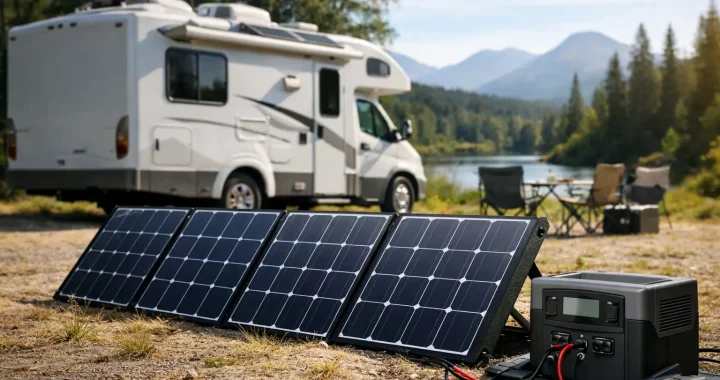
If you are charging a portable power station, the best solar charger is usually a folding panel or set of panels designed to match that station’s solar input range and connector type. This is one of the simplest ways to add clean power to an RV without modifying the vehicle’s electrical system. It works especially well for weekend travel, mobile work, and backup use beyond the campsite.
If you are maintaining a standard RV battery bank, a panel and controller combination is usually the better route. In this case, you want enough daily charging capacity to offset routine loads and recover after overnight use. For many RV owners, 200W to 400W is a realistic starting point for light to moderate energy needs, while heavier off-grid use may require 600W or more.
If you run a larger battery bank and inverter setup, your solar charger should be treated as part of a complete energy system, not a standalone gadget. At that level, charging speed, expansion capability, and battery storage become tightly connected. A bigger panel array with a quality MPPT controller can make a real difference in daily usability, especially when running appliances or staying out for extended periods.
This is also where a portable power station with solar input can make sense for RV owners who want modular power without a full custom install. Brands carried by retailers like Thundervolt Power often appeal to buyers in this category because they combine lithium storage, inverter output, and solar charging compatibility in a more approachable package.
Portable vs roof-mounted solar for RVs
Portable panels are often the better choice for flexibility. You can aim them directly at the sun, reposition them throughout the day, and keep your RV parked in cooler shade. That is a real advantage in hot climates, where direct sun on the RV can raise interior temperatures and force more fan or air conditioner use.
The trade-off is setup time and security. Portable panels need to be deployed, adjusted, and stored. They also take up cargo space. If you move often or want charging to happen automatically while driving or parked, roof-mounted panels are more convenient.
Roof-mounted systems are cleaner and more hands-off once installed. They are always working when sunlight is available, and there is nothing extra to carry outside. But roof space is limited, shading from vents or AC units can reduce output, and upgrades are more involved. If your camping style changes often, a fixed system can feel less adaptable.
For many RV owners, the best answer is a mix of both. A modest roof setup can cover baseline charging, while a portable panel adds extra input when you stay put for a few days. That kind of layered power strategy is often more dependable than relying on one source alone.
Common mistakes when buying the best solar charger for RV use
One of the biggest mistakes is choosing based on panel wattage alone. A 300W panel paired with the wrong controller, poor cable runs, or an undersized battery setup may still underperform. Another common problem is underestimating daily energy use. Fans, fridges, routers, laptops, and coffee makers add up faster than many buyers expect.
It is also easy to overlook charging speed. If your battery bank is large, a small panel may technically work but recover too slowly after overnight use. That leaves you in a constant power deficit, especially during cloudy stretches.
Compatibility creates problems too. Connector types, voltage ranges, controller settings, and battery requirements need to line up. This matters even more if you are using a solar charger with a portable power station. A good panel is only good if the system can actually use its output efficiently.
Finally, some RV owners buy for ideal weather and forget about real travel conditions. Trees, storms, winter sun angles, dust, and heat all affect charging. It is usually smarter to size a little above your expected need than to buy the absolute minimum and hope conditions stay perfect.
What size solar charger is best for an RV?
For battery maintenance and very light loads, a smaller panel setup may be enough. But for practical off-grid RV use, many travelers find that 200W is the low end of comfortable solar charging, not the high end. That might cover lights, device charging, and light battery recovery, assuming decent sun and disciplined power use.
At 400W, you gain more breathing room. That is often a strong range for RV owners who want to support moderate daily loads without constantly monitoring every watt. If you use a compressor fridge, work remotely, or camp off-grid often, this is where solar starts feeling more useful instead of merely helpful.
Above that, you are usually building around a more serious battery system or longer stays without shore power. The best size depends on your battery storage, inverter loads, and how willing you are to manage energy day to day. More panel is not wasteful if it shortens recharge time and improves reliability during weak sun conditions.
The best solar charger for RV life is the one that keeps your power stable when conditions are not ideal. That means buying for your real usage, not your lightest possible day. A little extra charging capacity can make the difference between cutting power use every evening and traveling with confidence. When you are miles from hookups and weather changes fast, reliability is what matters most.
