
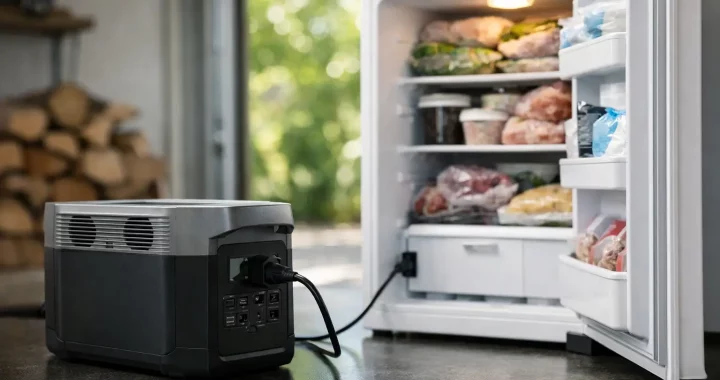
A freezer full of food can become a costly problem fast when the grid goes down. If you’re asking can a power station run a freezer, the short answer is yes – but only if the power station is sized correctly for startup surge, running wattage, and the number of hours you need backup power.
That distinction matters. A freezer is not usually a hard appliance to run once it is operating, but it can be demanding for a few seconds when the compressor kicks on. That is where many undersized backup units fail. If you want dependable cold storage during outages, storms, RV travel, or off-grid use, you need to look past the label on the front of the power station and focus on the real numbers.
Can a power station run a freezer reliably?
Yes, a portable power station can run many chest freezers and upright freezers, but reliability depends on three things: inverter output, surge capacity, and battery capacity. The inverter has to supply enough continuous wattage to keep the freezer running. It also needs enough surge power to handle the compressor startup. Then the battery has to be large enough to support the freezer for the length of time you actually need.
This is why a small unit that works for phones, lights, and a router may not work for cold storage. A freezer is a more serious backup load. If your goal is food protection during a multi-hour outage, it makes sense to start with a power station built for appliances, not just electronics.
For most households, the right answer is not the smallest model that can technically turn the freezer on. It is the model that gives you margin. That extra headroom helps with compressor cycling, battery aging, warmer ambient temperatures, and adding another essential load like a modem or a few lights.
What size power station do you need for a freezer?
The right size depends on your freezer type and how long you need to run it. Many freezers operate somewhere around 60 to 300 running watts, but startup surge can jump much higher for a moment. Smaller, efficient chest freezers often use less power than older upright models, while large garage freezers may demand more than expected.
A good first step is to check the appliance label or manual. Look for running watts, amps, or rated power. If the label only lists amps, multiply amps by 120 volts to estimate watts. So a freezer rated at 2 amps may draw about 240 watts while running. That does not always reveal startup surge, which may be two to three times higher.
As a practical baseline, many people shopping for freezer backup should look for a power station with at least 600 to 1,000 watts of continuous AC output and enough surge support for compressor startup. On the battery side, 1,000Wh and up is often the point where freezer backup becomes meaningfully useful rather than very short-term.
If you are protecting a large upright freezer or planning for a long outage, stepping into higher-capacity systems with expansion batteries makes more sense. This is especially true if the freezer is not the only thing you need to keep running.
Running watts matter, but battery capacity decides runtime
This is the part many buyers miss. A power station can be powerful enough to run a freezer and still not run it for very long.
Power output, measured in watts, tells you whether the unit can handle the appliance. Battery capacity, measured in watt-hours, tells you how long it can keep going. If your freezer averages 100 watts over time, a 1,000Wh power station will not deliver a perfect 10 hours in real-world use because inverter losses and cycling behavior reduce usable runtime. A more realistic result might be somewhat lower.
Freezers also do not pull full power nonstop. They cycle on and off as they maintain temperature. That helps runtime, especially if the freezer is full and stays closed. A packed freezer holds cold better than a half-empty one, and every unnecessary door opening makes the backup system work harder.
As a rough planning example, a freezer that averages 80 to 120 watts over time may run for several hours on a 1,000Wh unit, longer on a 2,000Wh unit, and much longer with solar input during daylight or with battery expansion. Actual results vary based on room temperature, freezer efficiency, food load, and how often the compressor cycles.
Chest freezer vs upright freezer
If you are comparing freezer types, chest freezers usually have an advantage for backup power. They tend to be more energy efficient, and they hold cold better when opened because cold air does not spill out as quickly. That can translate to longer runtime from the same battery capacity.
Upright freezers are often easier to organize, but they can use more energy and may cycle more aggressively in warm conditions. Older units of either type can be significantly less efficient than newer models, so age matters.
This is why two households with similar freezer sizes can get very different results from the same power station. Appliance efficiency matters just as much as battery capacity.
How to check if your setup will work
The safest approach is to verify actual consumption before an emergency happens. If you can, use a plug-in watt meter to measure your freezer’s running draw and cycling pattern over a full day. That gives you a much better picture than guessing from a label.
You should also confirm that the power station has a pure sine wave inverter. Most modern freezers should be paired with pure sine wave AC output for stable appliance operation. Then check the surge rating. If your freezer pulls 200 watts running but needs 800 watts for startup, the inverter must handle that short burst.
Placement matters too. If the power station is being used indoors during an outage, keep it in a dry, ventilated area and follow the manufacturer’s temperature guidelines. Lithium-based systems are much cleaner and quieter than gas generators, which makes them far easier to use around the home, but they still need proper airflow and safe operation.
When a smaller power station is enough
A smaller power station can make sense if your goal is short-duration backup, not all-day freezer support. For example, if outages in your area typically last one to three hours, a mid-sized unit may be enough to bridge the gap and protect food until utility power returns.
It can also work if you are rotating power strategically. Some users only plug the freezer in periodically to maintain safe temperature rather than trying to power it continuously. That approach depends on how cold the freezer already is, how full it is, and how often it is opened. It can extend backup time, but it requires attention and is less predictable than using a larger battery system.
If your outage plan is more serious – overnight interruptions, storm-related blackouts, or hurricane season preparation – sizing up is the better move.
Can solar help keep a freezer running longer?
Yes, solar can extend runtime and in some cases keep a freezer going through multi-day outages, but only if the system is sized realistically. Freezer backup with solar depends on daily sunlight, panel wattage, charge efficiency, and whether your battery starts the day partially drained or fully recharged.
This is where higher-capacity portable power systems stand out. A unit with fast solar charging, a strong inverter, and expandable storage gives you more flexibility than a fixed-size battery alone. For customers preparing for weather disruptions or off-grid use, that combination offers a more stable backup plan than hoping a small power bank will cover an appliance load.
Thundervolt Power focuses on these larger, appliance-capable systems for a reason. When food preservation, emergency readiness, and energy resilience matter, capacity and inverter quality are not extras – they are the foundation.
Common mistakes to avoid
The most common mistake is buying based only on peak marketing claims instead of actual battery capacity and continuous output. Another is ignoring surge requirements. A third is assuming every freezer uses the same amount of power.
People also underestimate how much runtime they need. A four-hour outage and a 24-hour outage are completely different planning scenarios. If the freezer contains expensive meat, bulk groceries, or medication that needs cold storage nearby, it is worth building in margin instead of cutting it close.
Finally, do not forget the bigger picture. If your household also needs lights, phone charging, internet, a CPAP, or a refrigerator, your freezer backup plan should account for those loads from the start.
The real answer
So, can a power station run a freezer? Yes – and for many households, it is one of the most practical uses for a high-capacity portable power system. The key is choosing a unit with enough continuous wattage, enough surge support, and enough battery capacity for your actual outage plan.
If you want confidence when power is not stable, size for real conditions, not best-case assumptions. A freezer is too important to leave to guesswork, and the right backup setup can keep your food protected when it matters most.
