
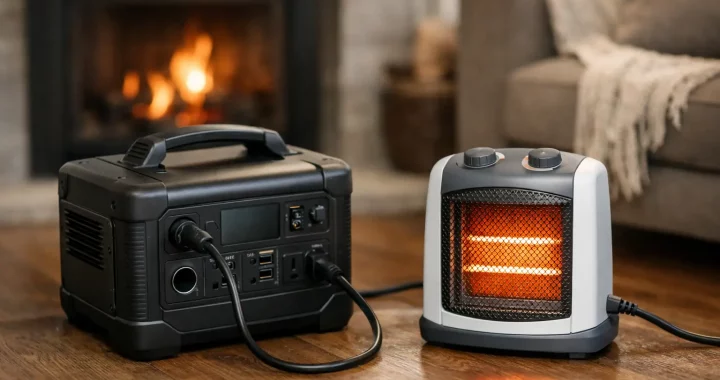
A space heater can empty a battery faster than most people expect. That is why the real question is not just can portable power stations run heaters, but which heaters, for how long, and whether it makes sense in an outage or off-grid setup.
The short answer is yes, some portable power stations can run some heaters. The catch is that electric heaters are among the most demanding household devices you can plug in. Many portable power stations can handle a small heater or a low setting for a limited time. Fewer can support a full-size space heater at high output, and even then the runtime is usually shorter than people want.
If you are buying backup power for winter storms, RV travel, or emergency use at home, this is one of the most important limits to understand before you need it.
Can portable power stations run heaters in real use?
They can, but it depends on two numbers more than anything else: the heater’s wattage and the power station’s inverter and battery capacity.
A portable power station has to do two jobs at once. First, its inverter has to supply enough continuous AC output to start and run the heater. Second, the battery has to store enough energy to keep that heater going for a useful amount of time. A unit might technically run a heater, but only for 30 to 90 minutes. That may help in a cold room or short outage, but it is not the same as all-night heating.
This is where many buyers get tripped up. They see a large-capacity power station and assume it can replace a home heating system. In most cases, that is not realistic. Portable power stations are excellent for quiet, fuel-free backup power, but resistance heating is one of the hardest loads you can ask them to carry.
Why heaters are so hard on battery power
Most electric heaters use resistance heating. That means they convert electricity directly into heat, and they do it at high wattage.
A typical personal heater may draw 200 to 600 watts. A common ceramic space heater often runs at 750 watts on low and 1,500 watts on high. Oil-filled radiators and infrared heaters can land in a similar range. By comparison, a laptop may use 60 watts, a Wi-Fi router 10 watts, and a full-size refrigerator often cycles on and off instead of pulling maximum power nonstop.
Heaters are different because the draw is steady and heavy. If you run a 1,500-watt heater, the battery drains fast. There is no getting around that. Even with an efficient inverter and a large lithium battery, the runtime math stays pretty unforgiving.
The runtime math that matters
Battery capacity is usually measured in watt-hours. Heater demand is measured in watts. To estimate runtime, divide the power station’s usable watt-hours by the heater’s wattage, then allow for some energy loss through inversion and real-world conditions.
For example, if you have a 1,024Wh power station and plug in a 500W heater, you might get roughly 1.7 to 1.9 hours of runtime under ideal conditions, and often a bit less in practice. If that same power station runs a 1,500W heater and the inverter supports it, the runtime may be closer to 35 to 45 minutes.
Now scale that up. A 2,000Wh class unit running a 1,500W heater may still only last around 1 to 1.2 hours. That is useful for spot heating, but not for heating a room through the night.
The practical lesson is simple: high battery capacity helps, but heaters consume power so quickly that runtime remains limited unless you move into very large or expandable systems.
Which heaters are most realistic for portable power stations?
Small personal heaters are the easiest match. If a heater draws 200W to 400W, many mid-size and larger portable power stations can run it without stress, and the runtime may be enough to warm a small work area, tented indoor emergency zone, or desk space.
Compact ceramic heaters on low are often the next best fit. A low setting around 700W to 800W is still substantial, but more manageable than 1,500W high mode. This can make sense if you need temporary heat in a small room and you have a power station with both the inverter headroom and enough battery capacity.
Full-size 1,500W space heaters are the toughest case. Some high-output power stations can run them, especially models built with strong pure sine wave inverters and larger lithium battery banks. But even when they work, the runtime is usually short enough that you need to think of them as targeted, short-duration heat rather than sustained room heating.
Heating pads, heated blankets, and low-draw warming devices are often a smarter battery-powered option. They use far less power and can keep people comfortable much longer than a space heater can keep a room warm.
What to check before plugging in a heater
Start with the heater label. Do not guess. Check the rated wattage and whether there is a lower setting.
Then look at the power station’s continuous AC output, not just the surge rating. A heater is not a startup-surge problem like some motors, but it does require sustained output. If your heater draws 1,500W, your power station must support at least that much continuous AC output, with some margin being preferable.
Next, look at battery capacity. This tells you whether the setup is merely possible or actually useful. A power station that can technically run the heater for 20 or 30 minutes may not meet your needs.
Battery chemistry matters too. LiFePO4 systems are especially well suited for preparedness because they offer long cycle life, thermal stability, and dependable performance over time. For buyers building a serious backup plan, that matters as much as peak output.
Better ways to use portable power during cold-weather outages
In most winter outages, the smartest use of a portable power station is not trying to heat the whole room electrically. It is preserving comfort, communication, and essential devices while stretching available energy.
That usually means powering lights, phones, internet equipment, radios, medical devices, a furnace blower if the system setup allows it, or a small electric blanket instead of a high-draw space heater. If you have solar input available, you may be able to extend runtime further during daylight, but winter weather and limited sun can reduce charging performance.
For RV users and off-grid travelers, the same logic applies. Running a heater from battery power can work for short bursts or low-wattage heating, but it is rarely the most efficient way to stay warm. Managing insulation, using layered bedding, and reserving battery power for critical electronics often delivers better results.
When a portable power station makes sense for heating
A portable power station is a good fit if you need temporary, localized heat. It also makes sense if you want a quiet indoor-safe power source for low-wattage warming devices, or if you are pairing a larger expandable system with careful energy planning.
This is especially true for people who want clean backup power without fuel storage, exhaust, or generator noise. Brands and retailers focused on preparedness, including Thundervolt Power, increasingly center their systems around practical resilience rather than unrealistic whole-home promises. That is the right approach here.
When it does not make sense
If your goal is to run a 1,500W space heater for many hours, a portable power station alone is usually not the best answer. The energy demand is just too high for most compact systems.
It also may not make sense if you are trying to heat a large room, support multiple heaters, or depend on battery heating as your primary overnight winter plan. In those cases, you need to rethink the load, increase battery capacity dramatically, or use another heating strategy while reserving the power station for essentials.
A practical buying mindset
If heater use is part of your plan, buy for continuous output first, then battery capacity second. Make sure the unit can comfortably support the heater’s wattage. After that, be honest about runtime. A large inverter without enough battery storage solves only half the problem.
Expandable systems can improve the picture because they add stored energy, but even then, electric resistance heat remains a heavy load. It is often better to size your system for a mix of essentials and low-draw comfort devices than to chase full-time electric heating from a battery.
Portable power stations can absolutely play a role in cold-weather preparedness. Just use them where they perform best: dependable backup for critical loads, quiet indoor operation, and selective heating choices that do not burn through your battery in a hurry. If staying warm is the goal, the smartest setup is usually the one that balances heat, runtime, and readiness before the next outage hits.
