
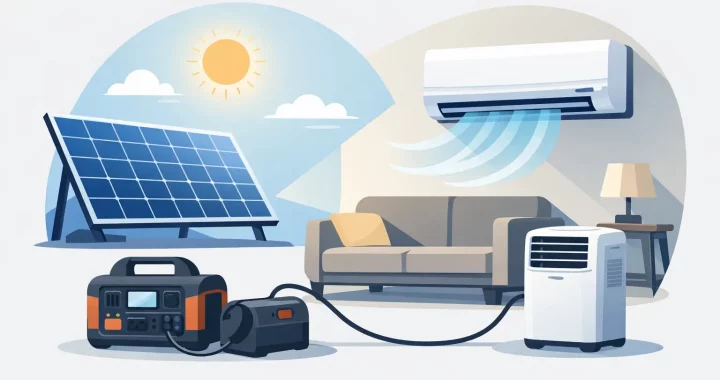
A hot room during a summer outage changes the question fast. People stop asking whether backup power is nice to have and start asking whether can solar generators run air conditioners in a real, practical way. The short answer is yes – but only when the system is sized correctly for the air conditioner’s startup surge, running wattage, and how long you need cooling.
That is the part many shoppers miss. An air conditioner is not like charging a phone or running a TV. Cooling takes serious power, and some AC units are much easier to run from a solar generator than others. If you want dependable results, you need to match the air conditioner to the power station instead of assuming any large battery will do the job.
Can solar generators run air conditioners reliably?
They can, but reliability comes down to three things: inverter output, battery capacity, and the type of air conditioner. A solar generator with a pure sine wave inverter and enough surge handling can run many small to mid-size window units, portable ACs, and some highly efficient mini splits. It may struggle, or fail outright, with larger central air systems.
The inverter matters because air conditioners pull extra power when the compressor starts. A unit that runs at 700 watts may briefly need well over 1,500 watts to kick on. If the inverter cannot handle that surge, the AC will not start even if the battery has plenty of stored energy.
Battery capacity matters for a different reason. Starting the AC is one challenge. Keeping it running through the afternoon or overnight is another. Air conditioning is one of the fastest ways to drain stored energy, so runtime is often the limiting factor.
The air conditioners most solar generators can handle
Not all AC systems belong in the same conversation. A small window air conditioner in a bedroom is a very different load than a whole-home central unit.
Window air conditioners
This is often the best fit for portable power stations and solar generators. Smaller window units in the 5,000 to 8,000 BTU range may run at roughly 400 to 900 watts, depending on efficiency and settings. Many high-capacity solar generators can support that load, especially if they have strong surge output.
For outage planning, a window AC is often the most realistic cooling solution. Instead of trying to cool the whole house, you can keep one bedroom or a small living area safe and livable.
Portable air conditioners
Portable AC units are common, but they are not always the easiest match. Many draw more power than similarly sized window units because they are less efficient. That means a portable AC may work with a large solar generator, but runtime will usually be shorter than people expect.
If you already own a portable unit, check the label before assuming compatibility. The advertised BTU rating does not tell the whole story. The actual watt draw is what matters.
Mini split air conditioners
Some inverter-style mini splits are surprisingly solar-friendly because they ramp power more gradually and operate efficiently once running. A well-matched high-capacity system may support a small mini split better than a conventional compressor unit with a hard startup surge.
Still, this is where details matter. Voltage, startup behavior, and real-world power draw all need to line up with the power station.
Central air conditioning
This is where expectations need to be realistic. Most standard central air systems draw too much power for a typical portable solar generator, especially at startup. Even if a large expandable battery system can support part of the load, the runtime may be limited unless you have a very substantial energy setup.
For most homeowners, using battery power to run central AC is not the most practical path. Running a smaller dedicated cooling device during an outage is usually the smarter and more efficient choice.
How to tell if your setup will work
You do not need to be an electrician to size a system correctly, but you do need a few real numbers.
Start with the air conditioner’s running wattage. This may be listed on the label, in the manual, or derived from volts and amps. Then look at startup surge. Some manufacturers list it clearly. Others do not, which is why compressor-based appliances can be tricky.
Next, compare those numbers to the solar generator’s inverter rating. You need enough continuous wattage for normal operation and enough surge capacity for startup. A pure sine wave inverter is the right choice for air conditioners and other sensitive motor-driven appliances.
Then look at battery capacity, measured in watt-hours. This tells you how much stored energy you have available. If your AC uses 700 watts and your battery stores 2,000 watt-hours, you will not get a full 2.8 hours in the real world. Inverter losses, cycling behavior, and ambient conditions reduce usable runtime. In practice, you would plan for less.
Runtime is where most plans fall apart
This is the question behind the question. When people ask if solar generators can run air conditioners, they usually mean, for how long?
A compact AC unit may run for a few hours on a large portable power station. A larger battery with expansion packs can stretch that much further. Add solar input during daylight, and you can offset part of the AC’s power demand. But solar charging is not magic. If the day is cloudy, the panels are undersized, or the AC is running at full blast, battery reserves can still drain quickly.
That is why cooling strategy matters as much as equipment size. Closing off one room, using insulated curtains, setting a moderate temperature, and running the AC in cycles can make a meaningful difference. Preparedness is not only about maximum power. It is also about using available power wisely.
What size solar generator do you need?
For many small window units and efficient portable ACs, a power station with at least 1,500 to 2,000 watts of inverter output is a reasonable starting point. For stronger startup performance and better flexibility, many buyers are more comfortable stepping into the 2,000-watt-plus range. On the battery side, more capacity almost always improves the experience because air conditioning is a sustained load, not a quick task.
If your goal is overnight cooling, look beyond the base unit and consider expandable battery options. A modular setup gives you more room to match runtime to your actual needs. That is especially useful for outage preparation, RV travel, and off-grid use where cooling can become a health and comfort issue, not just a convenience.
This is also where quality matters. LiFePO4 battery systems, dependable inverter performance, and fast recharging all make a difference when you are using stored power for high-demand appliances. A well-built system is not just about peak specs on paper. It is about stable output when conditions are less than ideal.
When a solar generator makes sense for AC use
A solar generator is a strong fit when you need quiet backup cooling, want to avoid fuel storage, or need portable power for RVs, cabins, job sites, or emergency use. It is especially practical when the cooling target is limited to one area instead of an entire home.
It also makes sense for people who want layered preparedness. A battery system can run communications, lights, refrigeration, fans, and a small air conditioner from the same platform. That flexibility is a major advantage over single-purpose solutions.
The trade-off is cost versus runtime. If your expectation is whole-home cooling for many hours in extreme heat, battery backup gets expensive fast. If your goal is targeted cooling with quiet operation and no gas engine noise, the value proposition becomes much stronger.
A better way to shop for backup cooling
The smartest buyers start with the air conditioner they actually plan to run. From there, they choose a solar generator that covers startup surge, continuous wattage, and realistic runtime. That approach avoids the two most common mistakes: buying too small and overestimating how long the battery will last.
At Thundervolt Power, that often means looking at high-capacity portable power stations with pure sine wave output, LiFePO4 batteries, and expansion capability. Those features are not just technical extras. They are what turn a backup power unit into a practical cooling solution when the grid is down or the road takes you off the map.
If staying cool is part of your emergency plan, do not shop by headline wattage alone. Match the system to the load, leave room for startup demands, and build around the runtime you really need. That is how backup power becomes dependable when the weather is not.
