
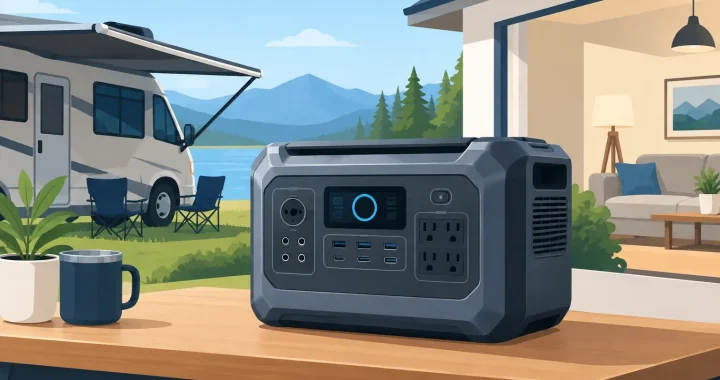
A power station earns its place during the first outage when it keeps the refrigerator cold, the phones charged, and the room quiet without a gas generator running outside. This Fossibot F2400 review looks at whether a 2,048Wh battery and 2,400W inverter are the right level of backup for households, RV travelers, and anyone who wants practical power readiness.
The short answer is that the F2400 is built for users who have moved beyond charging small electronics. Its capacity and output are substantial enough for real appliance support, while its LiFePO4 battery chemistry, solar capability, and fast AC charging make it a capable all-around power station. It is not a whole-home battery replacement, and buyers should still plan their loads carefully. But for targeted backup and mobile power, it covers a useful middle ground.
Fossibot F2400 Review: The Core Numbers That Matter
The F2400 pairs a 2,048Wh LiFePO4 battery with a 2,400W pure sine wave inverter. In plain terms, watt-hours tell you how much stored energy is available, while watts tell you how much equipment the station can run at one time. Both numbers matter during an outage.
A 2,400W inverter gives the F2400 enough headroom for many kitchen appliances, power tools, RV equipment, televisions, networking gear, CPAP machines, and many full-size refrigerators. Pure sine wave output is also the right choice for sensitive electronics and appliances with motors. It delivers cleaner, more consistent AC power than modified sine wave designs.
The 2,048Wh battery capacity is meaningful, but it should not be confused with 2,048Wh of usable wall-outlet power. Every power station uses some energy during conversion, and runtime changes with temperature, load, and the equipment connected. A practical planning estimate is to assume less than the stated battery capacity is available through AC outlets.
That still leaves plenty of energy for essentials. A 60W television, 15W modem and router, several LED lights, and phone charging can run for many hours. A refrigerator may cycle on and off for a substantial portion of a day, depending on its compressor draw, room temperature, and how often the door is opened. A 1,500W space heater, hair dryer, or electric kettle is a very different use case: the F2400 can handle loads in that range, but high-wattage heat appliances consume stored power quickly.
Who the F2400 Is Best For
The strongest case for the F2400 is targeted resilience. It is a practical choice for a family that wants to protect food, communications, lighting, and selected comfort items during a blackout without managing gasoline, exhaust, or generator noise.
It also fits RV and camping use well. With enough inverter capacity for common appliances and enough battery storage to avoid constant recharging, it can support a more comfortable setup than a small power station. Travelers can run electronics, lights, fans, a coffee maker, and selected cooking appliances, provided they understand which loads can run together.
For jobsite use, the F2400 makes sense for charging cordless tool batteries, operating moderate-duty tools, and keeping laptops or communications equipment online. The quiet operation is especially useful where a fuel generator would be disruptive. However, contractors using large saws, air compressors, welders, or sustained high-draw equipment should check startup and running wattage before relying on any battery station.
It can also be a sensible backup for critical devices. A CPAP user, for example, may value the low-noise operation and indoor-safe battery power. For medical equipment, always verify the device’s wattage, operating requirements, and backup plan with the equipment provider. A portable power station should be part of a preparedness plan, not the only layer of protection for a critical need.
Charging Flexibility Is a Major Advantage
A backup battery is only as useful as the plan to recharge it. The F2400 supports AC charging and solar charging, giving owners options before, during, and after an outage. Fast AC charging is valuable because it lets you replenish the station quickly while utility power is available. That is especially helpful when severe weather is forecast and you want the battery topped off before conditions deteriorate.
Solar charging changes the equation during an extended outage or off-grid trip. With compatible portable solar panels and sufficient sunlight, you can replace a portion of the energy used each day instead of drawing the battery down once and waiting for grid power to return. Actual solar production depends on panel wattage, weather, panel angle, shade, season, and the station’s solar input limit. A panel’s advertised rating is a best-case figure, not a guarantee of daily output.
For RV owners, solar is most useful when paired with disciplined energy use. Charge laptops and power stations during daylight, then reserve stored energy for evening lighting, refrigeration support, device charging, and overnight essentials. This approach gives the battery a better chance of carrying you through multiple days.
What It Can Run, and What Requires Caution
The F2400’s 2,400W rating is high enough to make it tempting to plug in everything at once. That is where planning matters. Add up the running watts of connected equipment, then account for startup surges from refrigerators, pumps, and other motor-driven loads. A power station can have enough continuous output for an appliance but still encounter a problem if several motors start at the same time.
For outage backup, prioritize loads that protect safety, food, communication, and basic comfort. A refrigerator, internet equipment, lamps, phone chargers, a television, and a fan are usually a better use of stored energy than continuous electric heating or cooking. If you need to power a window air conditioner, check both its running watts and startup demand. Smaller efficient units may be workable, but runtime will vary sharply with outdoor temperature, insulation, and thermostat settings.
The same principle applies to RV use. An air conditioner can be one of the largest loads in the vehicle. The F2400 may support certain units under appropriate conditions, but air conditioning is not a set-it-and-forget-it battery load. It requires a realistic runtime calculation and, ideally, a solar or vehicle-charging plan to replenish the battery.
LiFePO4 Is the Right Chemistry for Readiness
The F2400 uses lithium iron phosphate, commonly called LiFePO4. This battery chemistry is well suited to preparedness and frequent-use applications because it offers a long cycle life compared with older lithium-ion battery types. For a household that wants to charge the station, use it periodically, and keep it ready year after year, that matters.
LiFePO4 also supports the practical ownership experience people expect from modern backup power: no fuel storage, no oil changes, no pull-start mechanism, and no fumes. It does not eliminate the need for care. Store the unit in a dry location, avoid extreme temperatures when possible, follow the manufacturer’s charging guidance, and test it before storm season instead of discovering an issue during an emergency.
The trade-off is weight. A power station with this much battery capacity is not something most people will casually carry long distances. It is portable in the sense that it can move from a closet to a kitchen, RV, tailgate, or campsite without installation. It is not lightweight. Plan where it will be used, and consider whether one person can safely position it when needed.
Is the Fossibot F2400 Worth Buying?
The F2400 is worth considering if you need more than a compact electronics charger but do not need a permanent whole-home energy system. Its 2,048Wh capacity provides a useful reserve, and the 2,400W pure sine wave inverter gives it enough output for many everyday appliances and tools. Fast recharging and solar support further strengthen its value for preparedness-minded buyers.
It is less suitable for someone whose main goal is to run electric heat, central air conditioning, or multiple large appliances for days without recharging. Those applications require much larger battery banks, substantial solar arrays, a conventional generator, or a combination of systems. The right choice depends on the loads you refuse to go without, not just the largest wattage number on the box.
Before buying, write down the devices you want to protect and their approximate wattage. Then decide which ones must run at the same time and which can wait. That simple exercise turns a power station from an impressive specification into a dependable plan for the next outage, road trip, or off-grid weekend.
