
A power outage turns watt-hours from a product specification into a practical question: Will the refrigerator last through the night? Can a CPAP run until morning? How long can you keep a fan, router, or window AC operating? Knowing how to calculate appliance runtime gives you a realistic backup plan before weather, travel, or an off-grid stay puts that plan to the test.
The basic math is straightforward, but accurate planning requires more than dividing one number by another. Appliances do not always draw their labeled wattage, portable power stations lose a small amount of energy during conversion, and motors can demand a brief surge when they start. Account for those variables and you can choose capacity with far more confidence.
How to Calculate Appliance Runtime
Start with this formula:
Runtime in hours = usable battery watt-hours ÷ appliance watts
A watt-hour, shown as Wh, is a measure of stored energy. Watts, shown as W, measure how quickly an appliance uses that energy. A 1,000Wh power station theoretically has enough energy to run a 100W load for 10 hours.
In actual use, use the power station’s usable watt-hours rather than its advertised battery capacity whenever that figure is available. If usable capacity is not listed, a practical planning estimate for AC-powered appliances is about 85% to 90% of the rated capacity. This accounts for inverter conversion losses, battery management, cable losses, and operating conditions.
For example, consider a 1,000Wh portable power station running a 100W television through an AC outlet. Using an 85% planning factor:
1,000Wh × 0.85 = 850Wh usable energy
850Wh ÷ 100W = 8.5 hours of estimated runtime
That estimate is more useful than saying the unit will run the TV for 10 hours. It gives you a buffer for real conditions, which matters when replacement power may not be available.
Find the appliance’s actual power draw
The wattage label on an appliance is the best place to begin. Look on the back, bottom, power brick, or manufacturer label for a value marked W. Many devices also list volts and amps instead. In that case, multiply volts by amps to estimate watts.
Watts = volts × amps
A device rated at 120V and 1.5A uses up to 180W. This calculation is generally useful for simple resistive loads such as lamps, coffee makers, and space heaters. For appliances with motors, compressors, variable-speed controls, or electronic power supplies, the label may represent a maximum rather than a constant draw.
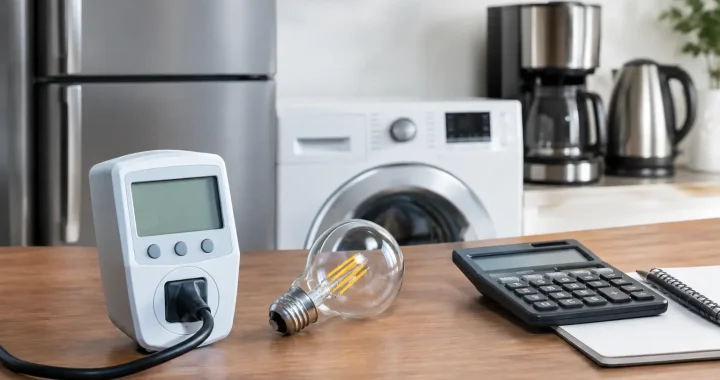
A plug-in watt meter provides the most dependable answer for household AC devices. Connect the meter between the wall outlet and appliance, then observe its running wattage over a normal cycle. For a refrigerator, this means measuring long enough to capture compressor starts and stops. For a CPAP, measure it with any humidifier or heated tube settings you plan to use.
Use average watts for appliances that cycle
Many essential appliances do not run continuously. Refrigerators, freezers, sump pumps, furnaces, portable air conditioners, and CPAP machines cycle on and off. Their real runtime depends on average energy use over time, not only the wattage when active.
Suppose a refrigerator draws 150W while its compressor runs, but the compressor runs only about one-third of the time during stable conditions. Its average load is roughly 50W:
150W × 0.33 = about 50W average
An 850Wh usable battery capacity could then provide:
850Wh ÷ 50W = about 17 hours
That number can change sharply with room temperature, how often the door opens, food temperature, and the age of the appliance. During a hot outage, a refrigerator may run much more often than it does on an ordinary day. Plan conservatively, keep doors closed, and avoid treating calculated runtime as a guarantee.
Account for Efficiency and Power Station Limits
Battery capacity alone does not determine whether an appliance will run. The power station’s inverter must also support the appliance’s running watts and its startup surge.
A refrigerator that uses 150W while running may briefly require 600W, 1,000W, or more when the compressor starts. A sump pump, power tool, or window air conditioner can behave similarly. If a power station has enough watt-hours but cannot meet that momentary demand, it may shut down or refuse to start the appliance.
Check two separate specifications before relying on a station for motor-driven equipment: continuous AC output and surge or peak output. Continuous output must exceed the appliance’s normal running demand. Surge capacity must cover its startup requirement. Pure sine wave output is also the appropriate choice for sensitive electronics and many motor-driven appliances.
Efficiency differs by connection type. A device powered from a USB-C, 12V, or other DC output often avoids some of the conversion loss associated with the AC inverter. A laptop that needs 60W may run longer through a compatible USB-C PD output than through its AC charging brick. The difference may be modest for one device, but it matters over several days of outage use.
Low-power loads deserve the same attention. A 10W router may appear easy to run, but a station’s own AC inverter consumes power while active. If the router can operate from a regulated DC output, that can extend available runtime. When every watt-hour counts, turn off unused AC outlets, lights, and accessories.
Calculate Runtime for More Than One Appliance
When several devices run at once, add their average wattage first. Then divide usable battery capacity by that total.
Imagine you need to power a 60W internet setup, a 35W fan, a 10W LED light, and a refrigerator averaging 50W. The combined average load is 155W. With 1,700Wh of usable energy:
1,700Wh ÷ 155W = about 11 hours
This is also where priorities matter. A power station that keeps a refrigerator, communication equipment, lights, and medical devices operating may not have enough capacity for high-draw comfort loads at the same time. Space heaters, electric kettles, toaster ovens, hair dryers, and portable air conditioners can drain stored power quickly because they often draw 1,000W to 1,800W or more.
For a 1,500W space heater, even 1,700Wh of usable capacity provides only a little over an hour of operation. That does not make the power station inadequate. It means resistance heating is usually a poor match for battery backup unless you have a very large battery bank and a specific short-term need.
Build a Runtime Plan Around Your Situation
Start with the devices that protect health, food, communication, and basic comfort. For an outage plan, that could mean medical equipment, a refrigerator, phones, a modem and router, LED lights, and a fan. For an RV or campsite, it may include a cooler, water pump, laptop, lighting, and charging gear. A jobsite plan may center on tool wattage, charging schedules, and whether a high-surge motor will start.
Write down each device’s watts, whether it runs continuously or cycles, and how many hours you actually need it each day. A daily energy estimate is often more valuable than a single runtime number:
Daily watt-hours needed = average watts × hours used per day
If your essential loads total 900Wh per day, a 1,000Wh unit may cover one day only under favorable conditions. A larger portable power station, an expansion battery, or solar recharging can provide the margin that turns a short backup window into a workable resilience plan.
Solar changes the equation, but output depends on panel size, sun angle, cloud cover, temperature, shading, and charging limits. Treat solar input as a helpful replenishment source, not a fixed promise. If you need critical overnight power, size the battery to make it through the night before counting on the next day’s sun.
Test Before You Need Backup Power
The best runtime calculation is confirmed at home, not during an emergency. Fully charge your station, connect the loads you expect to use, and monitor the input or output display for several hours. Note the actual wattage, battery percentage change, appliance behavior, and whether any startup surge triggers an overload warning.
A test also reveals practical details the math cannot show. You may find that a refrigerator needs a different extension cord location, a CPAP setting uses more power than expected, or a router takes several minutes to restart after an interruption. Thundervolt Power customers often choose expandable battery systems for this reason: real preparedness needs room for changing loads and longer outages.
Calculate with a conservative efficiency factor, confirm the inverter can handle startup demand, and reserve capacity for the devices that matter most. When the grid is unstable, a realistic runtime plan gives your stored power a clear job – keeping your home, travel setup, or worksite operating when you need it most.
