
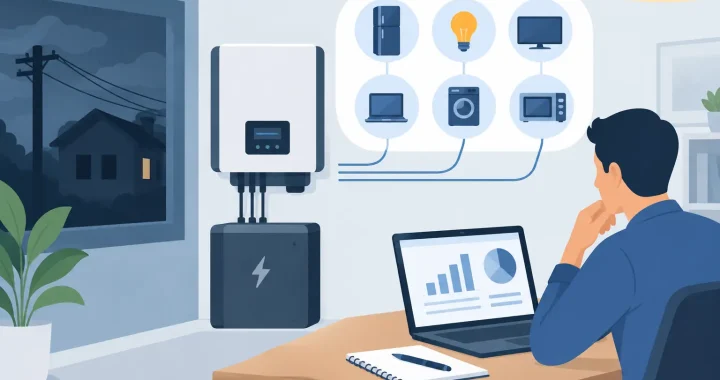
A backup power system only helps when it can carry the equipment you need most. Knowing how to calculate inverter load lets you avoid two costly problems: buying a unit that shuts down under demand or overspending on capacity you will never use. The calculation is straightforward once you separate running watts, startup watts, and battery runtime.
For a home outage, RV trip, jobsite, or off-grid campsite, begin with the devices that matter when regular power is unavailable. That may be a refrigerator, CPAP machine, Wi-Fi router, phones, lights, a sump pump, or a window air conditioner. Build your power plan around those priorities first.
What inverter load means
An inverter changes battery power from DC electricity into the AC electricity used by standard household outlets. Its load is the total wattage of every device drawing power from it at a given time.
If a portable power station has a 2,000W AC inverter, the combined running demand of connected equipment should stay below 2,000 watts. That rating is not the same as battery capacity. Inverter wattage determines what the system can run at once. Battery capacity, measured in watt-hours or kilowatt-hours, determines how long it can run it.
A unit may have enough stored energy to run a refrigerator for many hours, for example, but still be unable to start it if the inverter cannot handle the compressor’s momentary startup demand. Both numbers matter.
How to calculate inverter load in four steps
1. List what will run at the same time
Do not total every electrical item in your home. Focus on realistic simultaneous use. During an outage, you might run a refrigerator, modem, several LED lights, phone chargers, and a CPAP machine. You probably would not run the microwave, hair dryer, space heater, and air conditioner at the same time unless your system was specifically sized for that demand.
Write down each essential device and its running wattage. You can usually find this on the appliance label, power brick, owner’s manual, or manufacturer specifications. If the label provides amps and volts instead of watts, use this formula:
Watts = Volts × Amps
For standard US household equipment, voltage is typically 120V. A device rated at 2 amps uses approximately 240 watts. This estimate works well for many simple loads, though motors and electronic equipment can vary during operation.
2. Add the running watts
Add the wattage of everything expected to operate at once. Here is a practical outage setup:
| Device | Estimated running watts | | — | —: | | Refrigerator | 180W | | Wi-Fi router and modem | 25W | | CPAP machine | 60W | | Four LED lights | 40W | | Two phone chargers | 30W | | Laptop | 65W | | Total running load | 400W |
This setup needs at least 400 watts of continuous inverter output. But 400 watts should not be your purchase target. You still need room for surge power, normal variation, and additional charging needs.
3. Account for startup or surge watts
Some equipment draws a brief but much higher burst of power when it starts. Refrigerators, freezers, pumps, power tools, air conditioners, and other motor-driven appliances are the common examples. This is called startup wattage, surge wattage, or inrush current.
A refrigerator that runs at 180 watts may need 800 to 1,200 watts for a fraction of a second when its compressor turns on. A small sump pump may run at 800 watts but need substantially more to start. The actual demand depends on the appliance, its age, and its motor design.
You do not add every appliance’s surge rating together unless they are likely to start at the exact same moment. Instead, add your total running load to the highest expected surge. In the example above, a 400W running load plus a 1,000W refrigerator startup surge produces an estimated peak of 1,400W.
That means a 1,500W inverter might work, but it leaves little margin. A 2,000W pure sine wave inverter is a more dependable choice for this load, provided its surge rating supports the refrigerator’s starting demand.
4. Leave operating headroom
For dependable backup power, do not plan to operate an inverter at its maximum continuous rating for long periods. A practical target is to keep normal demand at roughly 70% to 80% of the inverter’s rated output. This leaves capacity for startup surges and avoids nuisance overload alarms.
If your expected continuous load is 1,200 watts, look for at least a 1,500W inverter and consider 2,000W if you expect motor loads or want flexibility. If you plan to run a 1,500W space heater, understand that it consumes most of a 2,000W inverter by itself. Adding a coffee maker or microwave may overload the system immediately.
Inverter size and battery size are different calculations
Choosing the right inverter is only half the job. Once you know the load, calculate how much battery capacity you need for the desired runtime.
Use this planning formula:
Runtime in hours = Battery watt-hours × usable efficiency ÷ load watts
Portable power stations lose some energy when converting battery power to AC output. Using an efficiency factor of 0.85 is a realistic planning estimate for many AC-powered loads.
For example, a 2,048Wh power station supporting a 400W average AC load may provide:
2,048Wh × 0.85 ÷ 400W = about 4.3 hours
Actual runtime can be longer or shorter. A refrigerator cycles on and off, so its average draw over several hours is often lower than its running wattage. A space heater runs continuously and will drain the same battery much faster. Cold temperatures, battery age, and device settings also affect results.
For longer outages, expansion batteries and solar recharging can turn a short-term backup into a more durable power plan. Solar production changes with weather, season, panel position, and available daylight, so treat it as a recharge source rather than a guaranteed fixed output.
Common load calculation mistakes
The most common error is confusing watts with watt-hours. Watts tell you whether the inverter can power a device now. Watt-hours tell you how long the battery can sustain it. A 1,000Wh battery does not mean it can power a 1,000W appliance for a full hour after conversion losses.
Another mistake is using only an appliance’s average consumption and ignoring startup demand. This is especially risky with refrigerators, pumps, and air conditioners. Check the inverter’s continuous rating and its surge specification before relying on it for motor-driven equipment.
Also consider how equipment behaves during an outage. A refrigerator may be manageable alone but difficult if a sump pump starts while a microwave is running. Stagger high-draw appliances whenever possible. Turn off nonessential loads before running a coffee maker, toaster oven, heat tool, or portable heater.
Finally, avoid using a modified sine wave inverter for sensitive electronics or equipment with motors unless the manufacturer specifically approves it. Pure sine wave output is the better fit for laptops, medical devices, modern appliances, and variable-speed motors because it closely matches utility power.
Quick examples for real-world power planning
A basic communications setup – router, modem, phones, laptop, and LED lighting – often stays below 250 watts. A compact portable power station can handle this easily, and battery capacity becomes the larger consideration.
A refrigerator backup setup typically needs more than its listed running watts suggest because of compressor startup. Pair it with a pure sine wave inverter that has enough surge capacity and avoid adding high-heat appliances at the same time.
For an RV or camping setup, calculate the loads you truly intend to use together. A 12V cooler, lights, fan, device charging, and laptop create a modest load. Adding an induction cooktop, microwave, or air conditioner changes the inverter requirement quickly.
For a jobsite, check every tool’s rated wattage and startup requirement. A circular saw, air compressor, or shop vacuum can demand far more from an inverter than phone charging or battery-tool charging. If two people may use tools at once, size for that real working condition rather than the best-case scenario.
Choose for the loads you cannot afford to lose
The right system is not necessarily the largest one. It is the one that supports your priority equipment with enough inverter headroom and enough battery capacity for the outage or trip you are planning for. Thundervolt Power customers often get the best results by starting with essential loads, then expanding capacity for comfort items as their needs grow.
Before bad weather arrives or you leave for your next trip, make a simple device list, check the labels, and test your plan. A few minutes of load calculation now can mean stable, quiet power when the grid is not stable.
