
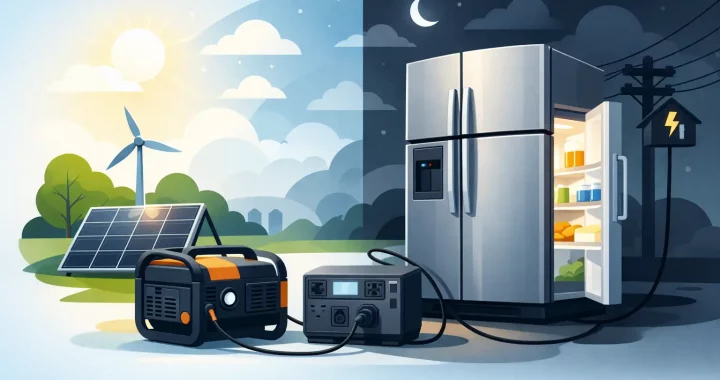
When the power drops, the refrigerator becomes one of the first appliances that matters. Food safety starts ticking almost immediately, and if you are storing medication, baby formula, or a week’s worth of groceries, knowing how to power a refrigerator during outage conditions is not optional – it is part of basic home readiness.
A refrigerator is not the hardest appliance to back up, but it does require planning. The main mistake people make is assuming any battery or generator will handle it. In reality, you need enough starting power for the compressor, enough battery capacity to keep it running, and a setup that fits the length of the outage.
How to power a refrigerator during outage conditions
There are three realistic ways to keep a refrigerator running during an outage: a portable power station, a gas generator, or a solar generator setup that combines a power station with solar panels. For most households, the right choice depends on how long the outage lasts, how much noise you can tolerate, whether you want to store fuel, and how many other appliances you need to support at the same time.
If your goal is quiet, indoor-safe backup power, a portable power station is usually the simplest answer. These systems use lithium batteries and built-in inverters to provide AC power through standard outlets. You charge the unit ahead of time, then plug the refrigerator into it when the grid goes down. Many homeowners prefer this option because it starts instantly, requires no gasoline, and does not produce fumes.
A gas generator can also run a refrigerator, and for long outages it may provide more runtime as long as fuel is available. The trade-off is noise, maintenance, outdoor-only use, and the safety risk that comes with fuel storage and carbon monoxide. A solar generator setup sits in the middle. It gives you the convenience of battery power and the ability to recharge during extended outages if sunlight is available.
Start with your refrigerator’s actual power needs
Before you choose any backup system, check the refrigerator label or manual. Most full-size refrigerators use somewhere around 100 to 800 running watts, but that range is wide for a reason. Size, age, compressor design, ambient temperature, and defrost cycles all affect real-world consumption.
The bigger issue is startup surge. Refrigerators use compressors, and compressors need extra power when they kick on. A unit that runs at 150 watts may briefly require 600 to 1200 watts at startup. Some larger or older models can surge even higher. That means the inverter in your backup power source must handle both the running load and the surge load.
If you cannot find a clear label, a plug-in watt meter can help you measure usage under normal conditions. That gives you a much more useful estimate than guessing. If you are shopping for backup power, this step can save you from undersizing your system.
Running watts vs. surge watts
Running watts are what the refrigerator uses once it is operating normally. Surge watts are the short burst required when the compressor starts. Your backup unit must meet both numbers. If it only covers running watts, the refrigerator may fail to start even though the numbers look close on paper.
This is why pure sine wave inverters matter. Refrigerators and other compressor-based appliances tend to run more reliably on clean, stable output. It is not just about turning the appliance on. It is about reducing stress on motors and electronics over repeated cycles.
How much battery capacity do you need?
Power output tells you whether a backup unit can run the refrigerator. Battery capacity tells you how long it can run it. Capacity is usually listed in watt-hours, or Wh.
A simple estimate is to multiply the refrigerator’s average hourly use by the number of hours you want coverage. If a refrigerator averages 80 watts over time, that is about 1,920 watt-hours per day. In practice, refrigerators cycle on and off, so the average is often lower than the peak number printed on the label.
Still, you should leave room for inverter losses, warm weather, frequent door openings, and the fact that outages rarely happen under ideal conditions. If you want overnight coverage, a higher-capacity portable power station can be enough. If you want all-day support, or you also need to run a freezer, router, lights, and phone chargers, you may need an expandable battery system instead of a smaller all-in-one unit.
A compact power station might keep an efficient refrigerator going for several hours. A large-capacity unit with expansion batteries can support it much longer. The right answer depends on your refrigerator and your outage plan, not just the headline battery number.
The best backup options for most homes
For short outages, a portable power station is often the most practical choice. It is quiet, easy to store, and ready with minimal setup. If your local outages are usually measured in hours instead of days, this can be the cleanest solution.
For longer outages, a higher-capacity power station paired with solar panels gives you more resilience. You can run the refrigerator from the battery and recharge during daylight. Weather matters here. Solar helps most when the outage lasts beyond one charge cycle and conditions are good enough for useful panel output.
For rural properties or multi-day blackouts where fuel is easy to store and noise is less of a concern, a gas generator still has a place. It can be effective, but it requires more attention and comes with more compromises. Many homeowners now prefer lithium backup systems because they are quieter, safer indoors, and easier to use in a stressful moment.
If you are comparing systems, look beyond raw wattage. Battery chemistry, recharge speed, output options, and expandability all affect real-world value. LiFePO4-based systems are especially attractive for emergency backup because they offer long cycle life and stable performance for repeated use.
How to set up your refrigerator backup safely
Once you have the right equipment, setup is straightforward. Charge the power station fully before storm season or any known grid event. Place it in a dry, ventilated indoor location and connect the refrigerator directly to an AC outlet on the unit. Avoid using thin or low-quality extension cords.
Keep the refrigerator door closed as much as possible. That reduces compressor cycling and stretches runtime. A refrigerator can hold a safe temperature for a limited time when unopened, but once you are relying on backup power, every unnecessary door opening costs energy.
Do not plug too many extra loads into the same backup system unless you have already calculated them. A refrigerator may not draw much power continuously, but startup surges can overlap with other appliances. That is where overload trips happen.
If you are using a gas generator, never run it in a garage, near doors, or close to windows. It must stay outdoors and far enough away to avoid carbon monoxide entering the home. Let the generator stabilize before connecting the refrigerator, and use cords rated for the load.
Common mistakes that shorten runtime or cause failures
The most common mistake is buying for running watts only and ignoring compressor surge. The second is underestimating battery capacity. People often see a refrigerator labeled at a modest wattage and assume a small battery will carry it all day. Real conditions are less forgiving.
Another mistake is trying to power too much at once. During an outage, priorities matter. If preserving food is the goal, build around the refrigerator first. Add other loads only after you know how much headroom you have.
It also helps to test your setup before an emergency. Run the refrigerator from backup power on a normal day and see how the system behaves. That one trial run tells you more than specs alone.
Choosing the right system for your outage pattern
If your outages are occasional and short, a mid-size portable power station may be enough. If storms regularly knock power out for a day or more, look at larger systems with higher inverter ratings and optional expansion batteries. If you want renewable recharging, pair the unit with portable solar panels sized to make a meaningful difference.
This is where a specialist retailer can help you match appliance loads to battery capacity instead of guessing. At Thundervolt Power, the focus is on practical backup systems that support real home and mobile power needs, including refrigerators and other essential appliances.
Preparedness is not about buying the biggest unit you can find. It is about choosing a system that starts your refrigerator reliably, runs long enough for your situation, and fits the way you actually live when the grid goes down. A little planning now is what keeps a short outage from turning into spoiled food, stress, and avoidable loss later.
