
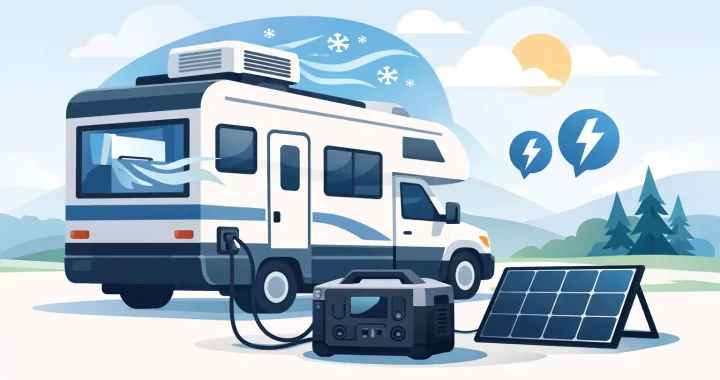
If your RV air conditioner is the one appliance you cannot afford to guess on, sizing power correctly matters from the start. A portable power station for RV air conditioner use can work well, but only when the battery capacity, inverter output, and AC startup demand are matched to the real load instead of the label alone.
Can a portable power station run an RV air conditioner?
Yes, but this is where many buyers get tripped up. The short answer is that some portable power stations can run some RV air conditioners for some amount of time. The key variables are the air conditioner’s running wattage, its startup surge, the outside temperature, and how long you expect cooling to last.
A small fan or CPAP machine is simple to plan for. An RV air conditioner is not. Even efficient units can pull a meaningful amount of power once running, and many demand a much higher burst when the compressor kicks on. That startup surge is often the deciding factor between a system that works reliably and one that shuts off the moment cooling begins.
For most RV owners, the best fit is a high-capacity lithium power station with a pure sine wave inverter and enough surge headroom to handle compressor startup. If you are trying to power a rooftop AC, capacity and inverter strength matter far more than the number of ports on the front panel.
What size portable power station for RV air conditioner operation?
This is the buying question that matters most. A portable power station for RV air conditioner performance should be evaluated in two separate numbers: inverter watts and battery watt-hours.
Inverter watts determine whether the unit can start and run the AC. Battery watt-hours determine how long it can keep doing that.
Many RV air conditioners land somewhere around 1,000 to 1,800 running watts, with startup surge significantly higher. A soft start device can reduce that startup spike and make battery power much more practical. Without one, some AC units require a very large inverter just to get through compressor startup.
As a practical baseline, many buyers should look at power stations in the 2,000W to 3,600W inverter class with substantial surge capacity if the goal is to run an RV air conditioner. On battery size, 2,000Wh may run an efficient unit briefly, but if you want meaningful cooling time, especially in hot weather, larger capacity or expansion batteries make a major difference.
That is the trade-off. If your goal is short cooling cycles, overnight help in mild weather, or backup use during stops, a portable system may be enough. If your goal is all-day air conditioning in peak summer heat, you will need much more stored energy, regular recharging, or both.
Why the AC label does not tell the whole story
The sticker on your air conditioner gives a starting point, not the whole answer. Compressor-based appliances cycle on and off, and actual draw changes with temperature, fan setting, insulation, sun exposure, and how hard the unit has to work.
An RV parked in full sun on a 95-degree day will force the AC to run longer and cycle more aggressively than the same RV in partial shade at 78 degrees. Runtime estimates that look comfortable on paper can shrink quickly in real conditions.
Battery capacity and real-world runtime
If an air conditioner averages 1,200 watts while running, a 2,000Wh power station will not deliver 2,000Wh of usable AC runtime. Inverter losses and operating conditions reduce real output. That means your actual cooling time may be noticeably shorter than a simple divide-the-numbers estimate suggests.
This is why higher-capacity LiFePO4 systems stand out for RV use. They offer longer service life, better stability, and a stronger foundation for expansion batteries and solar charging. For serious RV cooling, battery capacity is not a luxury feature. It is the difference between a short test run and a workable power plan.
What to look for in a portable power station for RV air conditioner use
Start with pure sine wave output. That is the standard for sensitive electronics and motor-driven appliances, and it is especially relevant when you are dealing with compressor equipment.
Next, check continuous AC output and surge rating. A unit may look strong on paper, but if it cannot handle startup demand, it will not run your AC consistently. Expandable battery support is also worth serious attention. RV owners rarely regret having more capacity once they begin using electric cooling, especially if they also need to power lights, a fridge, devices, or a microwave.
Fast recharging is another practical advantage. If you are topping back up from shore power, a campground hookup, a generator, or portable solar, recharge speed affects how quickly you are ready for the next cooling cycle. Multiple recharge options matter because RV travel rarely follows one perfect power scenario.
Durability and battery chemistry should stay high on the list. LiFePO4 systems are well suited for preparedness, travel, and repeated use because they are built for long cycle life and dependable performance. That fits the needs of RV owners who want quiet power without fuel storage, fumes, or constant maintenance.
Solar charging and RV air conditioning
Solar helps, but expectations need to stay realistic. Portable solar panels can extend runtime, support battery recovery, and reduce dependence on shore power. They are valuable in an RV setup. But running an air conditioner directly from solar during peak heat usually requires a substantial array and strong charging conditions.
That means solar is often best treated as part of the system rather than the full answer. It can offset daytime consumption, help recharge between AC cycles, and improve energy independence over a multi-day trip. It is less reliable as a stand-alone solution for heavy air conditioning unless your setup is sized well beyond the basics.
For RV travelers focused on resilience, a balanced system usually works best: a large portable power station, optional expansion battery capacity, and solar input to stretch usable time. This gives you quiet operation at camp and more flexibility when hookups are limited.
When a portable power station makes sense for RV cooling
This setup makes the most sense for RV owners who value quiet power, campground-friendly operation, and fuel-free backup. It is especially useful for overnight cooling support, travel stops, short boondocking windows, and emergency use when shore power drops out.
It also makes sense for buyers who want one system that can do more than run an air conditioner. A properly sized unit can support lights, charging, small kitchen appliances, communication devices, and other daily essentials from the same battery platform.
Where it becomes less practical is continuous heavy cooling for long stretches without a recharge plan. If your RV lifestyle includes extreme heat, full-day AC dependence, and minimal charging access, you may need a larger expandable setup than you first expected.
Common mistakes buyers make
The biggest mistake is shopping by battery size alone. A large battery with an undersized inverter still may not start the air conditioner.
The second is ignoring startup surge. Running watts matter, but compressor startup is where many systems fail. A soft start can improve your options, but you still need adequate inverter capacity.
The third is overestimating runtime. Real-world conditions are less forgiving than simple calculations. Heat, inverter losses, and extra appliance use all reduce available cooling time.
The fourth is treating all RV AC units as equal. A small, efficient unit is very different from a larger rooftop model in demanding summer conditions.
Choosing a system with confidence
The right purchase starts with your exact air conditioner model, not a generic assumption. Check the running wattage, understand the startup profile, and be honest about how long you need cooling to last. Then choose a power station with enough inverter headroom, enough battery capacity, and a realistic charging plan.
For many buyers, that means looking beyond entry-level portable units and into higher-output, expandable systems built for serious appliance loads. That is where curated product lines from retailers like Thundervolt Power become useful. Instead of sorting through underpowered options, you can focus on systems designed for dependable backup, RV travel, and real appliance support.
If your RV air conditioner is part of your comfort plan, your power system should be part of your readiness plan too. Buy for the heat you expect, not the mild day you hope for.
