
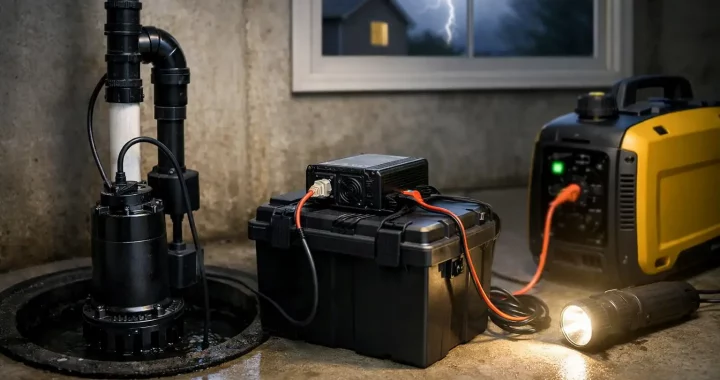
A sump pump failure usually becomes urgent at the worst possible moment – during a storm, in the middle of the night, or after the grid has already gone down. If you are figuring out how to power sump pump protection during an outage, the goal is simple: keep water moving out before your basement becomes the problem.
Why sump pump power planning matters
A sump pump is not a high-tech luxury. It is a damage-control device. When heavy rain hits or groundwater rises, your pump may need to cycle on and off for hours. If utility power fails, that protection can disappear fast.
That is why backup power needs to be sized for real conditions, not best-case assumptions. A sump pump might run only a few seconds at a time in one home and almost continuously in another. The right setup depends on the pump size, how often it runs, and how long outages tend to last where you live.
How to power sump pump systems: your main options
There is more than one way to keep a sump pump running, and each approach has trade-offs.
Battery backup sump pump systems
Some homes use a dedicated battery backup sump pump. This is usually a secondary DC pump installed alongside the main pump. When AC power fails, the backup unit takes over from its own battery system.
This can work well, especially for shorter outages. The advantage is that it is purpose-built for basement water protection. The downside is capacity. Many battery backup pump systems are designed for emergency use, not long multi-day outages with heavy water inflow. They also require maintenance, and battery performance can drop over time.
Portable power stations with inverter output
A portable power station can run many sump pumps, provided the unit has enough continuous wattage and enough surge capacity to handle motor startup. This is often the most practical clean-power option for homeowners who want quiet backup without fuel storage, fumes, or engine maintenance.
The key is matching the inverter and battery capacity to the pump. Sump pumps use electric motors, and motors pull more power at startup than during normal operation. If the power station cannot handle that surge, the pump may not start even if the listed running wattage looks acceptable.
Gas generators
Gas generators are still common for sump pump backup because they can run a pump for long periods as long as fuel is available. They also tend to handle motor surges well.
But there are trade-offs. They are noisy, require fuel storage, need outdoor placement, and can never be operated indoors or in enclosed spaces. During severe weather, refueling and setup may not be as convenient as people expect. For some homeowners, especially those looking for quieter and lower-maintenance backup, a battery-based system is a better fit.
Start with your sump pump’s actual power needs
If you want to know how to power sump pump equipment correctly, start with the pump label or owner’s manual. Look for voltage, amps, and horsepower.
Many residential sump pumps are 1/3 HP, 1/2 HP, or 3/4 HP. As a rough guide, a 1/3 HP sump pump may run in the 600 to 800 watt range, while startup surge can climb much higher. A 1/2 HP model may need around 800 to 1,050 running watts, with surge demands that can briefly double that. Actual numbers vary by model, age, plumbing resistance, and whether the discharge line is pushing water a long distance.
If the label lists amps instead of watts, multiply amps by voltage to estimate wattage. For example, 8 amps at 120 volts is about 960 watts. That gives you a baseline, but it still does not fully capture startup surge.
If you are unsure, it is smarter to size up rather than cut it close. Pumps are mission-critical loads. This is not the place for guesswork.
Inverter size matters as much as battery size
A common mistake is shopping by battery capacity alone. Watt-hours matter for runtime, but inverter output determines whether the pump can actually start and run.
For most sump pump applications, you want a pure sine wave inverter. That gives motor-driven equipment cleaner, more stable power. Modified sine wave systems may work with some pumps, but they can run hotter, less efficiently, or not at all depending on the motor design.
Look at two specs: continuous output and surge output. Continuous output is what the power station can deliver steadily while the pump is running. Surge output is the brief burst available when the motor starts. Both numbers need to clear the pump’s demands with some margin.
For many homes, that means choosing a backup unit that is larger than expected. A compact unit that handles phones, lights, and Wi-Fi may not be enough for a basement pump.
Estimating runtime without fooling yourself
Runtime depends on battery capacity and pump duty cycle. That second part matters more than many people realize.
If a sump pump runs for 10 seconds every minute, it uses far less energy than a pump that runs for 30 seconds every minute. During severe storms, cycling can increase dramatically. That means a setup that looks sufficient on paper may deliver much less real-world protection.
Here is a simple way to estimate. Take the usable battery watt-hours of your backup system and divide by the pump’s average watt draw over time, not just its active running wattage. If your pump uses 900 watts while active but only runs 25 percent of the time, the average load is closer to 225 watts. A 2,000Wh power station might then offer around 8 hours before inverter losses and real-world conditions are factored in.
That said, heavy water conditions can erase that margin fast. If your basement typically sees hard inflow during storms, plan for more capacity than the math suggests. Expandable battery systems can make a real difference here.
Solar charging can help, but timing matters
Solar charging sounds like the obvious answer, and in some cases it is useful. If an outage lasts through daylight hours, solar panels can help recharge a portable power station and extend protection.
But there is a practical limit. Many sump pump emergencies happen during dark, cloudy, storm-heavy conditions when solar input is weak. Solar should be viewed as a support option, not the only plan for basement flood protection. If you use it, pair it with enough stored battery capacity to get through the hours when charging is poor or unavailable.
A safer and more reliable setup
When choosing backup power for a sump pump, the best setup is usually the one that works automatically or with minimal intervention. During a storm, speed matters.
If you use a portable power station, test the system before you need it. Plug in the pump, confirm startup, and simulate operation. Make sure extension cords, if used, are rated properly for the load and kept as short as practical. Keep the power unit charged and stored in a dry, accessible place.
If your flood risk is high, think beyond minimum survival. A larger-capacity power station with pure sine wave output and room for expansion gives you more than backup power. It gives you time. That matters when roads are flooded, stores are closed, and the outage lasts longer than forecast. For homeowners comparing clean backup solutions, this is where systems from a specialist like Thundervolt Power make practical sense.
When a dedicated backup pump is the better choice
Some homes benefit from a layered approach. If your primary concern is basement flooding and nothing else, a dedicated battery backup sump pump can be the simplest answer. If you also want to run lights, routers, chargers, or a refrigerator during an outage, a portable power station becomes more flexible.
It really depends on your priority. Dedicated systems are focused. Portable energy storage is versatile. In homes with repeated storm issues, some owners use both – a secondary backup sump pump for automatic protection and a larger battery power system for broader outage coverage.
What to avoid
Do not assume horsepower alone tells you everything. Do not buy backup power based only on running watts. Do not wait until a weather alert is active to test your setup. And do not use indoor battery systems carelessly around water exposure, damaged cords, or overloaded adapters.
Just as important, do not treat a sump pump like an occasional convenience load. If your basement has flooded before, backup power is part of home protection, not an accessory.
The right answer depends on your basement, not just the product spec
Learning how to power sump pump equipment comes down to matching real pump demand with enough inverter headroom and enough battery capacity for the kind of outage you actually face. A small backup may be enough for light seepage and short interruptions. A high-water basement in storm season needs a more serious plan.
If you prepare before the next outage, you are not just keeping a pump alive. You are protecting floors, walls, storage, and the time and cost that come with water damage. The best backup power setup is the one you trust before the rain starts.
