
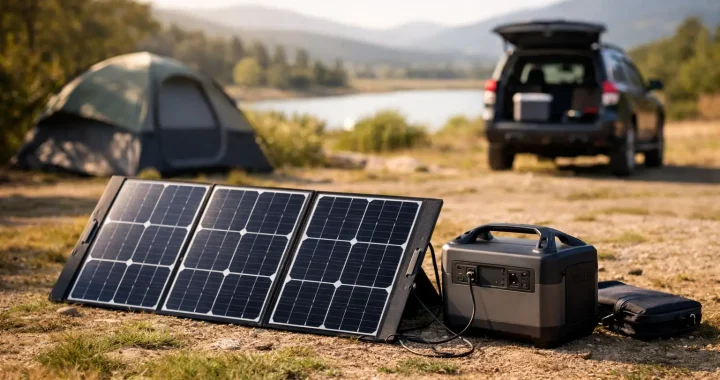
A portable solar panel is most useful when the grid is down, your campsite is far from an outlet, or your RV battery needs support before evening. This portable solar panel setup guide explains how to build a system that delivers dependable charging instead of disappointing results. The goal is simple: collect sunlight safely, match it to the right battery system, and have power ready when you need it.
Portable solar is not a replacement for every backup-power need. Cloud cover, short winter days, heavy appliance loads, and shaded campsites all affect production. But when panels, battery capacity, and power needs are matched correctly, solar charging can extend your runtime without fuel, noise, or repeated trips to a charging station.
Start With What You Need to Power
Before choosing panel wattage, identify the devices that matter most. During an outage, that may be phones, lights, a router, a CPAP machine, a refrigerator, or medical equipment. For travel, it may be a cooler, camera batteries, laptops, fans, and an RV’s essential DC loads. At a jobsite, it may be tool batteries, lights, and communications equipment.
Two numbers determine whether your system is practical: watts and watt-hours. Watts measure how much power a device needs at one time. Watt-hours measure how much energy it uses over time. A 60-watt laptop charger running for two hours uses roughly 120 watt-hours. A 500-watt appliance running for one hour uses about 500 watt-hours.
Your portable power station must supply enough continuous watts for the device you want to run. Its battery must also store enough watt-hours for the length of time you expect to operate it. Solar panels then help replace some of that used energy during daylight.
For example, a 1,000Wh power station may support a 60-watt router, a few LED lights, phone charging, and a laptop for a meaningful stretch of time. It will not run a 1,500-watt space heater for long, even with solar connected. High-draw heating appliances, coffee makers, hair dryers, and air conditioners drain batteries quickly. Prepare around essential loads first, then add convenience loads if capacity allows.
Match Solar Panel Output to Your Battery System
A panel’s advertised wattage is its maximum rating under ideal test conditions. A 200-watt portable panel rarely produces 200 watts all day. Heat, haze, panel angle, dirty surfaces, cable loss, and imperfect sun exposure reduce output. In favorable direct sun, planning around roughly 60 to 80 percent of a panel’s rated output is more realistic for many portable setups.
A 200-watt panel may therefore produce roughly 120 to 160 watts for part of the day. Over five hours of productive sunlight, that could return around 600 to 800Wh before conversion losses. Actual results can be lower in winter, during storms, or when the panel cannot be aimed well.
Check your power station’s solar input specifications before connecting anything. Look for these limits:
- Maximum solar input watts
- Acceptable input voltage range
- Maximum input current
- Required connector type
- Whether the unit has a built-in MPPT charge controller
Most modern portable power stations use a built-in MPPT controller to optimize solar charging. In that case, connect compatible portable panels directly to the station’s solar input using the correct cable or adapter. Do not connect a solar panel directly to a standalone battery unless that battery system has an appropriate charge controller between the panel and battery.
Voltage is especially important when combining panels. Two panels wired in series increase voltage. Panels wired in parallel increase current while keeping voltage near the same level. Either arrangement can be useful, but only if it stays within your power station’s input limits. Exceeding the maximum voltage can damage equipment. When specifications are unclear, use the manufacturer-approved configuration rather than guessing.
Choose a Panel Size That Fits the Situation
Smaller panels are easier to carry, store, and reposition. Larger panels collect more energy and reduce the time needed to recharge a power station. The right choice depends on how much power you use and how mobile you need to be.
A 60- to 100-watt panel can be a practical supplement for phones, lights, small electronics, and modest battery maintenance. A 100- to 200-watt panel is a strong starting point for camping, road trips, and keeping a medium-size power station charged. Systems in the 200- to 400-watt range make more sense for extended outages, off-grid use, larger battery banks, and households trying to preserve essential power over multiple days.
Consider recharge time, not just panel size. If your 1,000Wh power station is half depleted, it needs roughly 500Wh back, plus charging losses. A 200-watt panel in excellent conditions may handle that in several productive daylight hours. A 100-watt panel may need most of a day. If you expect bad weather or partial shade, additional battery capacity can be just as valuable as additional panel wattage.
Set Up Panels Where the Sun Can Reach Them
Solar panels need direct sunlight. A bright location is not always enough. Shade from a tree branch, roof vent, vehicle antenna, or even a narrow pole can cut output dramatically, particularly on panels with cells wired in series.
Set folding panels on stable, level ground where they will not be stepped on or blown over. Face them generally toward the sun and adjust their kickstands as the sun moves. In much of the United States, panels perform best when facing south during the middle of the day, but the practical priority is unobstructed direct sun. When camping or parked near trees, a longer compatible extension cable may let you place the panels in sunlight while keeping the power station in a shaded, protected location.
Do not leave a power station in direct sun just because the panels are outside. Heat can reduce battery performance and may cause charging to slow or stop. Keep the station dry, ventilated, and out of standing water. If rain is expected, verify the weather rating of every component. Many portable panels tolerate light exposure better than the power station and connection points do.
Connect the System in the Right Order
Begin with the power station turned off or with its solar input inactive if the manufacturer instructs you to do so. Inspect the panel, cables, and connectors for cracks, bent pins, moisture, or debris. Confirm that the connector and adapter are rated for solar use and fit securely.
Place the panels first, connect the solar cable to the panels, then connect the cable to the power station’s solar input. Once connected, check the display or app for incoming wattage. If the reading is very low in clear sun, inspect for shade, confirm the panel angle, and make sure every connection is fully seated.
Avoid running cables across walkways, under vehicle tires, or through places where a door can pinch them. Keep connectors off wet ground. If you need more cable length, use an extension designed for the voltage and current of your solar setup. A thin, undersized extension can create voltage drop and waste valuable charging power.
When disconnecting, follow the manufacturer’s instructions. As a practical rule, turn off or unplug large loads from the power station before moving the system, then disconnect the solar input and pack the panels after they have cooled.
Manage Loads While Solar Is Charging
Solar charging works best when you treat stored energy as a resource, not an unlimited utility connection. Use DC or USB outputs for compatible devices when possible, since converting battery power to AC and back can waste energy. Charge phones, tablets, lights, and tool batteries during peak daylight so the panels carry more of that demand directly.
For essential appliances, check both startup surge and running watts. Refrigerators and pumps may draw a brief surge when the compressor or motor starts. A pure sine wave inverter and sufficient surge capacity help portable power stations run sensitive electronics and motor-driven loads more reliably, but the station still needs enough available battery power.
During a prolonged outage, create a simple rhythm: charge during the best sun hours, run necessary loads, and avoid draining the battery deeply before nightfall. A fully charged station at sunset provides more security than one that has been used for nonessential daytime loads.
Common Setup Problems and Practical Fixes
If charging is slow, the cause is usually sunlight, angle, temperature, or a mismatch between the panel array and the power station’s input limits. Reposition the panel before buying more equipment. Moving it a few feet out of shade can make a bigger difference than adding another panel.
If a panel appears connected but the power station shows zero input, check the input port selection, adapter compatibility, connector seating, and voltage requirements. Some power stations will not begin charging if the panel voltage is below their minimum input threshold. This can happen early or late in the day, under dense cloud cover, or with an unsuitable series or parallel arrangement.
If the battery is not lasting as expected, measure actual appliance use. A device labeled at 100 watts may consume less or more depending on its operating cycle, while an AC inverter also uses power. Use the power station display to observe real-time draw and adjust your plan around the numbers.
Build Readiness Before the Weather Changes
A portable solar system is most dependable when it is tested before an emergency. Charge the power station, unfold the panels, confirm the cables fit, and run your essential devices for an afternoon. That test reveals whether you need more panel wattage, more battery capacity, an extension cable, or a simpler load plan.
Thundervolt Power customers often choose expandable LiFePO4-based power systems because preparedness is not a one-size-fits-all need. A weekend camping setup may only need compact panels and a small station, while a household preparing for multi-day outages may need larger solar input and expansion batteries.
Set up your system on a clear day, learn what normal charging looks like, and store every cable with the equipment. When power is not stable, that preparation turns sunlight into a practical source of quiet, dependable backup power.
