
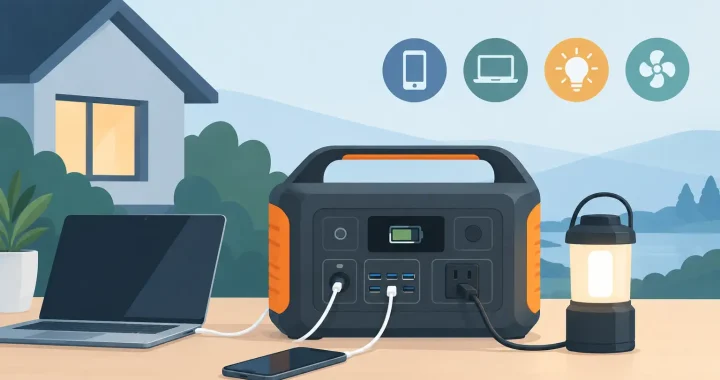
When the grid goes down, a portable power output guide helps answer the question that matters first: what can this power station actually run? A battery may have plenty of stored energy, but its output rating determines whether it can start and operate the equipment your household, campsite, RV, or jobsite depends on.
The right system is not simply the largest one available. It is the one with enough continuous wattage, enough surge capacity, the right outlets, and enough battery capacity for your real priorities. Understanding how those specifications work together turns portable power from a convenient accessory into a dependable backup plan.
Portable Power Output Guide: Start With Watts
Output is measured in watts, and it describes how much electricity a portable power station can deliver at one time. This is different from battery capacity, which is measured in watt-hours and tells you how much energy is stored for use over time.
For example, a power station with a 2,000W AC output can support connected devices drawing up to 2,000 watts continuously. A 2,000Wh battery can theoretically provide 2,000 watts for about one hour, 1,000 watts for about two hours, or 200 watts for roughly 10 hours. Actual runtime will be lower because inverters and electronics use some energy during conversion.
Think of output as the width of a bridge and watt-hours as the amount of fuel in the tank. A large battery with low output may run phones, lights, and a small refrigerator for a long time, but it may not be able to start a microwave, circular saw, sump pump, or window air conditioner. High output gives you more flexibility, but it does not eliminate the need to plan for runtime.
Continuous Output vs. Surge Output
Many appliances use a brief burst of extra power when they start. Refrigerators, freezers, pumps, air compressors, power tools, and air conditioners are common examples. Their running wattage may be manageable, while their startup demand can be two to three times higher for a few seconds.
Continuous output is the power a station can provide steadily. Surge output is the short-term capacity available to handle those startup spikes. Both numbers matter. A refrigerator that uses 150 running watts may need 800 watts or more at startup, depending on its compressor. If the station cannot cover that surge, it may shut down even though the running wattage looks well within range.
Pure sine wave AC output is another practical consideration. It delivers electricity similar to standard household wall outlets, helping sensitive electronics, chargers, appliances, and motor-driven equipment operate properly. For home backup and higher-value gear, it is a feature worth prioritizing.
Calculate Your Real Power Demand
Start by identifying the devices you truly need during an outage or away from the grid. Read the label on each appliance or charger for watts, amps, or volts. If a label lists amps, use this simple calculation:
Watts = volts × amps
At a typical 120V household outlet, an appliance drawing 5 amps uses about 600 watts. Labels can be helpful, but they do not always reflect startup demand. Motors and compressors deserve additional headroom.
Add together the running watts for devices you plan to operate at the same time. Then compare that total against the power station’s continuous AC output. For appliances with motors, choose a system with surge capacity comfortably above the likely startup requirement.
A basic outage setup might include a refrigerator, Wi-Fi router, several LED lights, phone chargers, and a laptop. That load may stay below 500 watts most of the time, though the refrigerator compressor can raise it briefly. A more demanding setup with a microwave, coffee maker, sump pump, space heater, or portable air conditioner can quickly move into the 1,500W to 3,000W range or higher.
Avoid planning around every appliance in the house running at once. Portable power is most effective when it supports a prioritized load. Keep food cold, communication online, lights available, and critical equipment operating. Then add comfort appliances only when the output and stored energy allow it.
Match Outputs to the Equipment You Use
The number of ports on a power station matters, but the type and rating of each port matter more. AC outlets are used for household appliances, laptop chargers, power tools, and many medical devices. USB-A and USB-C ports are useful for phones, tablets, cameras, and modern laptops. A high-watt USB-C PD port can charge many laptops directly without using an AC adapter.
DC outputs can be valuable for 12V equipment, including some coolers, routers, lighting, and vehicle accessories. Using DC power where possible can improve efficiency because it avoids converting battery power to AC and back to DC inside a charger.
Do not assume that every outlet can provide the station’s full rated output on its own. The AC outlets generally share one combined inverter limit. USB ports and DC ports may have separate limits, too. Check the specifications before connecting multiple fast chargers, a 12V cooler, and an AC appliance at the same time.
For RV use, confirm whether you need a standard 120V outlet, a 30A RV connection, or another specific connection type. For jobsites, consider both the startup demand of tools and the reality that a table saw, compressor, or heavy-duty grinder can have a much higher draw than handheld electronics.
Battery Capacity Determines How Long Power Lasts
Once you know your output requirement, use watt-hours to estimate runtime. Divide the battery’s rated watt-hours by the load in watts, then reduce the result by roughly 10% to 20% to account for conversion losses and normal operating conditions.
A 1,000Wh power station running a steady 100W load may provide around eight to nine hours of usable runtime. That same unit powering a 1,000W appliance may last less than one hour. Intermittent appliances are different: a refrigerator cycles on and off, so its average energy use can be much lower than its momentary running draw.
For multi-day outages, capacity is only part of the answer. Recharging options are equally important. Solar panels can extend operation when weather and sunlight cooperate. Vehicle charging helps while traveling. Fast AC charging can restore a larger station quickly when grid power is available or when you have access to a compatible generator.
Expansion batteries are especially useful for homeowners and RV users who want more runtime without replacing the main power station. They make sense when your required output is already adequate but your backup plan needs more stored energy for overnight use or extended outages.
Plan for Critical Loads First
A power station can be a major source of stability during severe weather, but it should be used deliberately. Build your plan around equipment with the highest practical value: refrigeration for food and medication, phones, radios, internet equipment, lighting, CPAP machines, and other approved critical devices.
Medical equipment requires extra care. Check the device’s operating and surge requirements with its manufacturer, and test your setup before an emergency. Do not wait for an outage to find out that a particular device, charger, or power setting is incompatible with your backup system.
High-heat appliances need special attention. Space heaters, hair dryers, electric kettles, toaster ovens, and many hot plates can draw 1,000 to 1,800 watts or more continuously. They can drain a battery quickly even when the station can handle the output. In a prolonged outage, those loads are often better reserved for short, necessary use.
Test Before You Need It
The most dependable backup plan is the one you have already practiced. Charge the power station, connect your priority devices, and confirm how the load behaves when a refrigerator compressor cycles on or a tool starts. Make sure extension cords are rated for the intended load and keep power equipment dry, ventilated, and clear of flammable materials.
A portable power station cannot replace every household circuit or run every appliance indefinitely. But when its output, surge rating, battery capacity, and recharge plan match your priorities, it provides quiet, fuel-free power when reliable electricity is hardest to find. Choose for the equipment you cannot afford to lose, then keep the system charged and ready before the forecast turns serious.
