
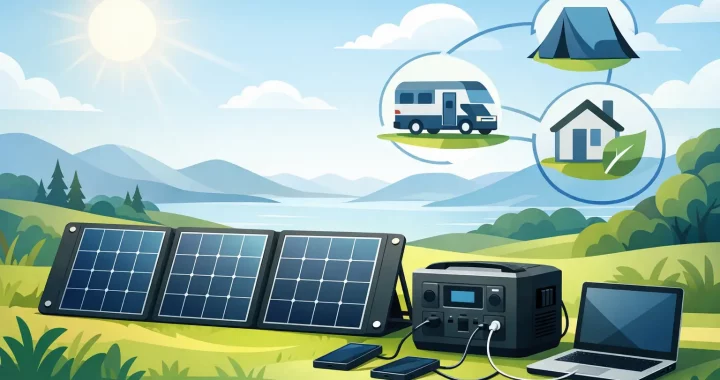
A portable solar panel can turn a power station from a limited battery into a practical backup system that recharges while the grid is down. This portable solar panel review focuses on what matters when you need dependable power for an outage, an RV trip, a remote jobsite, or a weekend away from hookups: real output, setup speed, durability, and the right match for your battery capacity.
The best panel is not automatically the one with the biggest wattage printed on the box. A large panel can collect more energy, but it also takes more space, weighs more, and may be less practical to move into direct sunlight several times a day. The right choice depends on what you need to keep running and how quickly you need your portable power station ready again.
Portable Solar Panel Review: What to Evaluate First
Start with rated wattage. This is the maximum power a panel can produce under controlled test conditions with ideal sunlight, panel temperature, and angle. A 200W portable solar panel is capable of collecting more energy than a 100W panel, but actual results outdoors are often lower. Cloud cover, haze, tree shade, dirty surfaces, panel angle, cable loss, and high heat all reduce production.
For planning purposes, treat rated wattage as the ceiling, not a promise. A quality 200W folding panel in good, direct sun may produce useful charging power for much of the day, but the output will rise and fall with weather and the sun’s position. That is normal. A reliable solar setup is built with enough capacity to account for those changing conditions.
The next number is your power station’s battery capacity, measured in watt-hours, or Wh. A 1,000Wh power station stores roughly one kilowatt-hour of energy. If your panel averages 150W of usable solar input, restoring that battery from low charge may take most of a sunny day. If you are powering devices while charging, the recharge time extends because incoming solar energy is serving both the active load and the battery.
This is why panel and battery sizing should be considered together. A small panel attached to a large expandable power station may be useful for maintaining phones, lights, and small electronics, but it may not restore enough energy for serious outage use. Conversely, an oversized panel array can be unnecessary if you only need to recharge a compact station for camping.
The Solar Panel Size That Fits the Job
For light-duty use, a 60W to 100W portable panel can be a practical choice. It is easier to carry, easier to position, and well suited to topping up a small power station used for phones, tablets, lights, cameras, fans, and laptops. It is also a sensible second panel for travel when cargo space is limited.
A 120W to 200W panel is often the stronger all-around option for campers, RV users, and households preparing for short outages. This range can provide meaningful daytime charging for medium-capacity power stations, especially when paired with efficient devices and a realistic power plan. It gives you more room to run communication equipment, a refrigerator intermittently, a CPAP machine, lighting, or work equipment without relying entirely on stored battery power.
Panels rated at 300W or more are built for users who need faster solar recovery or who operate larger power stations. They make sense for extended outages, off-grid work, or RV setups with higher daily energy use. The trade-off is simple: more solar collection usually means a larger folded package, more weight, and more care needed when placing the panel in windy conditions.
Before choosing a size, check the maximum solar input of your power station. Its solar charging limit may be lower than the panel’s rated output. Also check the permitted input voltage and connector type. A panel that physically connects is not necessarily a panel that operates within the station’s safe charging range.
Real-World Charging Conditions Matter More Than Marketing Photos
Portable panels perform best in full, direct sunlight with the panel facing the sun as closely as practical. Laying a foldable panel flat on the ground is quick, but an adjustable kickstand can improve output by allowing a better angle. Repositioning the panel every few hours may seem minor, yet it can make a noticeable difference over a full day of charging.
Shade is especially disruptive. Even partial shade from a branch, vehicle, antenna, or lawn chair can reduce output sharply. Set the panel in a clear area and keep the surface free of leaves, dust, snow, and standing water. Do not assume a bright day equals strong solar charging. Overcast conditions still produce energy, but often at a much lower rate than direct sun.
Heat is another factor. Panels need sunlight, but extreme surface temperatures can reduce efficiency. This is not a reason to avoid sunny locations. It is a reason to expect variable output and avoid making emergency plans that depend on perfect production every hour.
A good portable solar system gives you options. Store enough battery energy to carry overnight loads, then use solar to replenish during daylight. For critical needs such as medical devices, refrigerated medication, communications, or essential lighting, keep a larger energy reserve than your daily estimate suggests. Solar extends runtime, but weather can change without notice.
Portability Is More Than Folded Dimensions
A portable solar panel should be easy to deploy when conditions are not ideal. During an outage, that means you can carry it outside, unfold it, connect it correctly, and move it as the sun changes. On a campsite, it means the panel fits your vehicle, does not monopolize your usable space, and can be secured from wind.
Look closely at panel weight, folded size, handle placement, kickstand design, cable length, and connector storage. A panel that is technically portable but awkward for one person to carry may sit unused. Lighter panels are easier to reposition, while heavier high-wattage models may be worth the effort when charging speed is the priority.
Durability also matters. Portable panels live a harder life than roof-mounted systems. They are packed, unpacked, set on uneven ground, exposed to dust, and occasionally caught in changing weather. Weather-resistant materials, reinforced corners, stable kickstands, protected ports, and a sturdy carrying design are practical features, not cosmetic upgrades.
That said, weather resistance does not mean a panel should be left outside indefinitely. Bring it in during severe weather, secure it before wind picks up, and keep connectors dry and clean. Careful storage will protect both the panel and the charging cable when you need them most.
Build a System, Not Just a Solar Purchase
A solar panel is only one part of dependable portable power. The power station determines how much energy you can store, what appliances you can run, and how many devices you can connect at once. Pure sine wave AC output, battery chemistry, surge capability, charging speed, and expansion options all influence whether a system can support your actual needs.
For example, a family may use solar to keep a power station charged for phones, Wi-Fi equipment, lights, fans, and a refrigerator during a weather-related outage. An RV traveler may prioritize a panel that can recharge the station between driving days. A contractor may need enough solar input to support tool batteries and mobile devices without running a loud gas generator. Each use case calls for a different balance of panel size, stored capacity, and portability.
This is also where compatible accessories matter. Verify whether your power station supports parallel solar connections, what adapter is required, and whether its built-in charge controller accepts the panel voltage. Using manufacturer-approved or properly specified cables helps prevent setup problems and protects your equipment.
At Thundervolt Power, the practical goal is simple: choose a portable power system that provides useful energy under the conditions you are likely to face, not just ideal conditions on a clear day.
A Better Way to Choose
Estimate your daily energy use before selecting a panel. Add up the wattage of the devices you expect to run and multiply each by the number of hours you expect to use it. This gives a working estimate in watt-hours. Then consider how many days you may need power, how much battery capacity you have, and whether clear sunlight is likely where you will use the system.
If you need dependable backup rather than occasional convenience, favor extra capacity. A larger panel or a second compatible panel can help restore energy faster when sunlight is available. More battery capacity gives you a larger margin overnight and during poor weather. The right answer is rarely the smallest system that works on paper. It is the system that still supports your priorities when the forecast, location, and schedule are less than perfect.
Set up and test your panel before the emergency. Learn how it connects, observe its output in your yard or campsite, and practice placing it in direct sun. When the power goes out or the road takes you beyond the nearest outlet, that preparation turns solar from a promising feature into power you can count on.
