
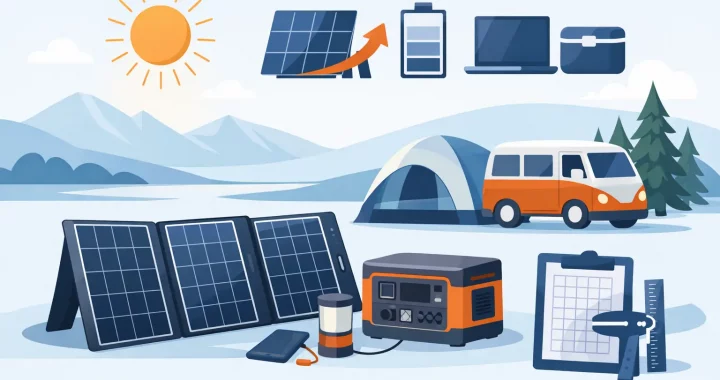
A portable solar panel sizing guide matters most when the weather turns, the grid goes down, or you are too far from an outlet to guess your way through charging. If your panel is too small, your power station recovers too slowly. If it is too large, you may spend more than you need and still run into charging limits set by the battery itself. Good sizing is not about buying the biggest panel. It is about matching solar input to how you actually use power.
What portable solar panel sizing really means
Panel sizing is the process of choosing enough solar wattage to recharge your portable power station or run small DC loads within a realistic amount of time. The key word is realistic. A 200W solar panel does not produce 200 watts all day. Output changes with sun angle, cloud cover, temperature, shading, season, and panel orientation.
That is why sizing starts with your energy demand, not the label on the panel. You need to know how much electricity you use in a day, how much battery capacity you are trying to refill, and how quickly you want that recharge to happen. Once those three pieces are clear, the right panel size is easier to identify.
Start with the battery, not the panel
Most buyers shop panels first because they are visible and easy to compare. In practice, the battery or portable power station should set the rules. Look at three numbers: battery capacity in watt-hours, maximum solar input in watts, and the allowed input voltage and current range.
If your power station stores 1,000Wh and accepts up to 400W of solar input, pairing it with an 80W panel will work, but recharge times will be long. Pairing it with 600W of panels may not help much either if the unit can only accept 400W. The excess panel capacity is not always wasted, because real-world conditions reduce output, but there is still a practical ceiling.
As a simple baseline, many people get good results by choosing total panel wattage equal to about 25% to 50% of battery capacity in watt-hours for general use. That means a 1,000Wh power station often pairs well with 200W to 400W of solar. If fast recharge is a priority for outage backup or daily off-grid use, lean toward the higher end. If your use is occasional weekend charging, the lower end may be enough.
How to calculate your daily energy needs
The most accurate portable solar panel sizing guide always begins with what you plan to run. Add up the wattage of each device and multiply by the hours you expect to use it each day. That gives you watt-hours.
A phone charger drawing 10W for 3 hours uses 30Wh. A laptop drawing 60W for 4 hours uses 240Wh. A portable fridge averaging 50W over 10 hours uses 500Wh. If your daily total is 770Wh, your solar setup should aim to replace at least that much energy during a good solar day.
This is where people often underestimate. Appliances with compressors, heating elements, or variable draw can use more than expected. A CPAP machine, router, lights, fans, and device charging can add up quickly in an overnight outage. For preparedness, it makes sense to leave margin instead of sizing to the exact number.
Estimate solar production the practical way
Portable panels are rated under ideal lab conditions. Real output is lower. For planning, a useful rule is to assume about 70% to 80% of rated wattage in solid sun, and then multiply that by your peak sun hours.
Peak sun hours are not the same as daylight hours. In much of the US, a reasonable planning range is 3 to 5 peak sun hours per day depending on season and location. A 200W panel producing at an effective 75% output gives you around 150W in good conditions. Over 4 peak sun hours, that is about 600Wh per day.
That makes the math more grounded. If you need roughly 800Wh per day, one 200W panel may fall short. Two 200W panels, under the same conditions, could produce around 1,200Wh and give you a healthier buffer for weather or imperfect placement.
Match the panel to your use case
Outage backup at home
For home backup, speed matters. During an outage, you may need to recharge a power station between storms or during short windows of sun. If you are supporting communications, lights, a fridge, medical gear, or internet equipment, undersizing can leave you rationing power by day two.
In this case, choose as much panel wattage as your power station can efficiently accept, especially if the unit is 1,000Wh or larger. A larger solar array gives you a better chance of meaningful recharge even in mixed conditions. It also reduces dependence on wall charging when the grid is unstable.
RV travel and camping
For RV users and campers, sizing depends on whether solar is topping off the battery or serving as your primary daily recharge source. Weekend users charging phones, lights, and a small cooler may be fine with 100W to 200W. Multi-day trips with a portable fridge, laptops, fans, and regular device charging often justify 200W to 400W or more.
Portability matters here. Larger folding panels charge faster, but they also take more space, weigh more, and require more setup effort. If you move camp often, a slightly smaller panel that you actually deploy every day can be more useful than a large panel that stays packed.
Worksites and mobile business use
Contractors, remote crews, and mobile vendors should size around daily uptime, not emergency conservation. If your tools, tablets, lighting, or communications equipment must be ready every day, choose enough panel wattage to recover most of the battery during working hours. Consistency is worth more than theoretical max output.
Portable solar panel sizing guide by battery size
A quick reference helps, as long as you treat it as a starting point rather than a rule.
For power stations around 300Wh to 500Wh, a 100W panel can work for light use, while 200W gives noticeably better recharge flexibility. For 700Wh to 1,000Wh units, 200W to 400W is a practical range for most buyers. For 1,500Wh to 2,000Wh systems, 300W to 600W is often the range where solar starts feeling effective rather than supplemental. For even larger expandable systems, panel sizing should be based heavily on the unit’s maximum solar input and your expected daily load.
If your goal is one-day recharge in good sun, size more aggressively. If your goal is slow maintenance charging during trips or occasional backup, you can size lower.
Important trade-offs buyers miss
Bigger is not always better. Some portable power stations cap solar input at a level that makes oversized arrays less useful. Connector compatibility, open-circuit voltage, and charging controller limits all matter. The panel has to fit the electrical window of the power station, not just the general idea of solar charging.
Weather also changes the equation. If you live in a cloudy region or expect winter use, your panel should usually be larger than what summer math suggests. The opposite is true if you only camp in sunny conditions and your loads are modest.
Then there is the human factor. Portable solar only works when it is set up in direct sun and repositioned when needed. If convenience matters, fewer larger panels may be easier than managing several small ones. If flexibility matters, smaller panels can be easier to carry, angle, and store.
A simple sizing formula you can use
Take your daily energy use in watt-hours and divide by your expected peak sun hours. Then divide again by 0.75 to account for real-world losses. The result is the approximate panel wattage you need.
If you use 900Wh per day and expect 4 peak sun hours, 900 divided by 4 is 225. Then 225 divided by 0.75 gives 300W. That means a 300W array is a reasonable target in good conditions. If resilience matters more than minimum cost, step up to 400W for margin.
This same method works if your main goal is recharging a battery. If you want to refill a 1,024Wh power station in one good day of sun, 300W to 400W is usually a sensible planning range, assuming the unit accepts that much input.
When to size up
You should consider more solar wattage if you need faster recharge, expect frequent cloudy conditions, use power daily, or rely on critical devices. It also makes sense to size up if your battery system is expandable, since future capacity increases can make a once-adequate panel setup feel undersized.
For many buyers, this is where dependable equipment matters. A well-matched panel and power station setup gives you quiet, fuel-free charging that is practical enough to use before an emergency, not just during one.
The best system is not the one with the highest advertised numbers. It is the one that can reliably put enough energy back into your battery when you need it most. If your setup leaves room for weather, real usage, and the occasional bad charging day, you are sizing it the right way.
