
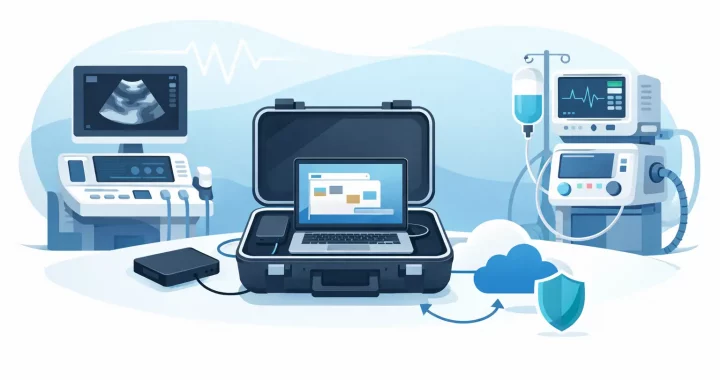
A power outage is never just inconvenient when someone depends on a CPAP, oxygen concentrator, suction machine, feeding pump, or other prescribed equipment. A portable backup for medical devices example starts with one practical question: how long must the device operate safely if utility power fails? The answer determines the battery capacity, inverter rating, charging plan, and whether a portable power station is the right part of your emergency setup.
Portable battery power can provide quiet, fuel-free backup during weather outages, travel, and temporary relocations. But medical equipment has no room for guesswork. Confirm the device’s power requirements with its manual, durable medical equipment provider, or clinician before relying on any backup source.
A Portable Backup for Medical Devices Example
Consider a household using a CPAP machine during overnight outages. The unit’s power adapter is rated for 90 watts, but actual consumption varies widely. A CPAP running basic airflow may use far less than its adapter rating, while a heated humidifier and heated tube can raise energy use substantially.
For a conservative planning example, assume the CPAP averages 60 watts for eight hours. That is 480 watt-hours of energy use:
60 watts x 8 hours = 480 watt-hours
A power station should not be sized at exactly 480Wh. Energy is lost through AC inversion, cable use, and normal operating variation. A 700Wh to 1,000Wh LiFePO4 power station provides a more realistic margin for one overnight CPAP setup, particularly when using AC power. If the device can use a compatible DC adapter, it may consume less battery energy because the station avoids some inverter loss.
That same station may support a phone, lamp, or tablet, but critical medical equipment should receive priority. Do not base medical runtime on a product’s maximum advertised output alone. The useful figure is usable battery energy after conversion losses, combined with the actual watts the device draws in its normal settings.
Start With the Device Label, Not the Battery
Every backup plan begins at the medical device. Look for the input voltage, rated watts or amps, AC or DC requirements, and any instructions from the manufacturer about backup operation. A label might show 120V AC, 60Hz, and a wattage value. Some devices list amps instead. For a simple estimate, multiply volts by amps.
For example, a device rated at 120V and 2 amps could draw up to 240 watts. That does not necessarily mean it uses 240 watts every minute, but it tells you the power station needs sufficient continuous AC output. Devices with motors, compressors, or heating elements can also have a higher startup demand than their steady running draw.
A watt meter is especially useful for household equipment that runs from a standard wall outlet. It can show actual usage over several hours under normal settings. That measurement gives a much better runtime estimate than relying only on the maximum rating printed on an adapter.
For medical equipment, always follow the manufacturer’s approved operating conditions. Some devices may require specific power quality, grounding, battery systems, or alarm behavior. A portable power station should support the equipment, not replace the instructions that came with it.
Calculate Capacity With a Safety Margin
Battery capacity is measured in watt-hours, while the inverter output is measured in watts. Both matter. Watt-hours tell you approximately how long a device can run. Watts tell you whether the station can run the device at all.
A quick planning formula is:
Estimated watt-hours needed = device watts x hours of operation
Then add a margin for conversion losses and unexpected use. For AC-powered medical devices, planning for 20% to 30% more capacity is a sensible starting point. Conditions vary, so a larger margin may be appropriate for essential equipment, long outages, cold environments, or devices with variable heat and motor loads.
Here is a second example. An oxygen concentrator may consume 350 watts while operating. For a four-hour outage:
350 watts x 4 hours = 1,400 watt-hours
After allowing for losses and a reserve, a 2,000Wh class power station may be more appropriate than a 1,500Wh unit. However, oxygen concentrators vary significantly by model, flow setting, and startup demand. Some may need more continuous inverter output than a smaller station provides. This is exactly why the device manual and supplier guidance come first.
For extended outage coverage, expansion batteries can add valuable capacity. Solar panels can also replenish a compatible power station during multi-day events, but solar production depends on weather, panel size, season, shade, and available daylight. Solar is a recharge strategy, not a reason to start with too little stored energy.
Choose the Right Output Type and Power Quality
A pure sine wave inverter is the preferred choice for sensitive electronics and many medical devices. It produces AC power that closely resembles standard household electricity, helping compatible equipment operate more consistently than it might on a modified sine wave source.
Check the power station’s continuous AC output, not only its surge rating. A station with 500W of continuous output may be suitable for a 90W CPAP, but it may not be suitable for a concentrator that requires 700W or has a substantial compressor startup load. Higher-capacity stations often provide more inverter headroom along with more battery storage, though that also means more weight and a higher purchase cost.
If a device has an approved DC power option, it can be worth considering. Direct DC operation can improve runtime and reduce dependence on the AC inverter. The adapter must be specifically compatible with the medical device. Do not improvise with a connector that merely appears to fit.
Understand the Difference Between Backup Power and a UPS
A portable power station can be an excellent outage solution, but it is not automatically the same as a medical-grade uninterruptible power supply. Some power stations offer pass-through charging or a UPS-style mode that keeps connected equipment running while the station is plugged into the wall. The key question is transfer time: how quickly the station switches to battery when grid power drops.
Some equipment can tolerate a brief transfer. Other equipment may alarm, reset, or require a specialized UPS with a particular switching performance. Do not assume a power station will prevent every interruption unless the device manufacturer and power station specifications confirm compatibility.
This distinction matters most for equipment where even a momentary loss of power creates a serious risk. In those cases, ask the care provider or equipment supplier about an approved battery backup system and maintain any prescribed emergency plan.
Build a Practical Outage Setup
Keep the power station indoors in a dry, ventilated location, placed where cords will not create a trip hazard. Charge it well before severe weather arrives. Avoid placing it in direct heat, freezing conditions, or enclosed spaces with poor airflow.
A dependable setup includes more than a fully charged battery. Keep the correct medical-device cord or approved DC adapter with the station, label the critical outlet, and test the equipment before an emergency. Run the device from battery power for a controlled period when practical, observing its display, alarms, and operating behavior. Testing reveals issues such as an insufficient inverter, a loose plug, an unexpected power draw, or a setting that cuts runtime more than expected.
For equipment that supports life or requires continuous operation, create layers of protection. That may include a primary portable power station, an expansion battery, a backup charging method, and a plan to relocate to a powered location if an outage exceeds your available runtime. Keep phone numbers for care providers, equipment suppliers, and local emergency services accessible without internet access.
Avoid Common Sizing Mistakes
The most common mistake is buying based on outlet count rather than capacity. Ten AC outlets do not provide ten times the energy. What matters is the station’s watt-hour rating, continuous output, and the total load connected to it.
Another mistake is calculating only the device’s lowest-power setting. A CPAP may run efficiently without heat, but a user who relies on humidification should plan for normal use unless a clinician says otherwise. Similarly, an oxygen concentrator’s power needs may change with flow settings. Emergency conditions are not the time to find out that the battery estimate assumed a different setup.
Finally, do not connect nonessential loads during an outage. A refrigerator, space heater, coffee maker, or television can drain the reserve needed for medical equipment. Assign the station to its critical purpose first, then use remaining capacity only if the essential runtime is protected.
Portable power gives families more control when the grid is unstable, but the best setup is the one tested before the forecast turns severe. Size for real device use, keep a reserve, and make sure every caregiver in the home knows which battery, cable, and outlet keep essential equipment running.
