
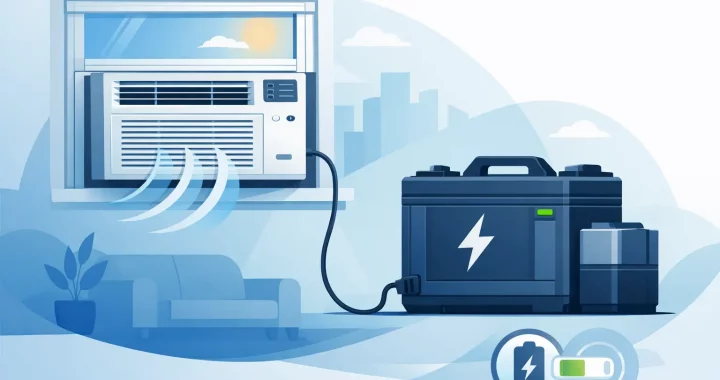
A hot room gets miserable fast when the power goes out. If you are searching for a window air conditioner battery solution, the real question is not whether a battery can run your AC at all. It is whether your battery system is sized correctly for the startup surge, the running load, and the number of hours you actually need.
That distinction matters. Plenty of people buy a portable power station based on a quick wattage estimate, only to find out their window AC trips the inverter at startup or drains the battery much sooner than expected. Reliable backup cooling takes a little planning, but it is absolutely possible with the right setup.
What a window air conditioner battery setup really means
Most window air conditioners do not have a built-in battery. In practice, a window air conditioner battery setup usually means a portable power station or external battery-backed system that can supply AC power to the unit when grid power is unavailable.
That setup includes three parts working together: the battery capacity, the inverter output, and the air conditioner itself. The battery stores energy in watt-hours. The inverter converts battery power into the 120V AC power your window unit expects. The air conditioner draws a steady amount of power while running, but it often needs a much higher burst for startup.
That startup demand is where many backup plans fail. A window AC listed at 500 or 700 running watts may briefly need far more than that when the compressor kicks on. If the inverter cannot handle that surge, the unit will not start even if the battery is full.
Can a battery run a window air conditioner?
Yes, but it depends on the size of the air conditioner and the size of the battery power system. Small window units are often realistic candidates for battery backup. Larger units can be much harder to run for meaningful periods unless you have a high-capacity power station, an expansion battery, or solar input to stretch runtime.
A compact 5,000 BTU window AC may run in the 400 to 600 watt range under typical conditions. A mid-size 8,000 to 10,000 BTU model might pull 700 to 1,200 watts. Some units start softly and behave well with inverter power. Others are more demanding, especially older models with less efficient compressor behavior.
This is why the model number and spec label matter more than general advice. Two window units with similar BTU ratings can have very different power demands.
How to size a window air conditioner battery system
Start with the data plate on the air conditioner. Look for running watts, amps, or input power. If the label shows amps at 120V, multiply amps by volts to estimate watts. For example, 5 amps at 120V is about 600 watts.
Next, account for startup surge. If the air conditioner does not list startup wattage, give yourself headroom. A power station with a pure sine wave inverter and solid surge capacity is the safer choice for compressor-based appliances.
Then calculate runtime. Battery capacity is usually listed in watt-hours. A 1,000Wh battery does not deliver the full 1,000Wh to your appliance because inverter losses reduce usable output. In real-world use, assume somewhat less than the rated capacity is available.
If your window AC uses 500 watts while running, a 1,000Wh power station may only run it for around 1.5 to 1.8 hours under favorable conditions. At 700 watts, runtime drops further. That is enough for short cooling relief, sleeping through the hottest part of a night with intermittent cycling, or bridging an outage while you manage indoor temperatures. It is not whole-day cooling unless you move into a much larger battery bank.
A simple runtime example
If your AC averages 600 watts and your battery system provides roughly 1,800Wh of usable energy, expect about 3 hours of continuous runtime. If the compressor cycles on and off because the room is insulated and already cool, you may get more time. If the room is hot, sunny, and poorly insulated, expect less.
The room itself changes the math. Cooling a shaded bedroom is a very different job than cooling a sun-facing living room in August.
Why inverter size matters as much as battery size
A lot of buyers focus only on watt-hours, but inverter output is just as important. A battery with plenty of stored energy still cannot run a window AC if the inverter is undersized.
For most small window units, you want enough continuous inverter capacity to comfortably exceed running load, plus enough surge handling for compressor startup. A unit that runs at 550 watts may behave better on a power station rated well above that, rather than one sitting right at the threshold.
This is one reason higher-quality portable power systems are worth considering for outage use. Stable inverter performance, battery management, and cleaner output all affect whether an appliance starts reliably and keeps running without nuisance shutdowns.
When a window air conditioner battery makes sense
Battery-powered cooling is most practical when you are trying to protect one room, not cool an entire house. That usually means a bedroom, nursery, home office, RV sleeping area, or a designated safe room during an outage.
It also makes sense when quiet operation matters. Gas generators still have a place in some backup plans, especially for long-duration high-load use, but they come with fuel storage, noise, exhaust, and placement constraints. A battery system is cleaner, quieter, and much easier to use indoors with appropriate ventilation around the air conditioner itself.
For overnight comfort, batteries can be especially useful if you pair them with smart habits. Pre-cool the room while grid power is available. Close blinds before peak sun. Seal air leaks around the window unit. Run only the AC and a few essentials, not every device in the room. Small efficiency gains translate directly into longer runtime.
When battery backup may not be the best fit
There are trade-offs. If you need to run a larger window AC all day through repeated outages, the battery capacity required can get expensive and heavy. If your area experiences multi-day outages during extreme heat, a battery-only plan may need solar charging, expansion batteries, or a layered backup strategy.
Older air conditioners can also be poor battery candidates. They often draw more power, start less efficiently, and waste energy compared with newer models. In some cases, upgrading the AC reduces the size and cost of the battery system needed to support it.
There is also a comfort trade-off. A battery system may keep one room livable, but it may not deliver the same whole-home experience as central air. For many households, that is still a very good outcome during a storm outage or grid interruption.
Solar charging and longer outage planning
If you want more than short-term runtime, solar becomes part of the conversation. A portable power station that accepts meaningful solar input can recharge during daylight hours and help extend your cooling plan.
This works best when expectations are realistic. Solar conditions change by weather, panel angle, season, and available sun hours. Window AC loads are heavy enough that solar may offset some consumption or recharge between cooling periods, but constant daytime AC operation still demands a substantial system.
Even so, solar can make the difference between a battery that is empty after one use and a system that recovers enough energy each day to keep a bedroom cool for key hours. For preparedness-minded households, that flexibility matters.
What to check before you buy
Before choosing a power station for a window air conditioner battery setup, verify five things: your AC’s running wattage, likely startup demand, the power station’s continuous inverter rating, surge capacity, and usable battery capacity. Fast recharging and expansion support are also valuable if this is part of a serious outage plan.
Battery chemistry matters too. LiFePO4 systems are especially attractive for backup use because they offer long cycle life, thermal stability, and dependable performance over repeated charge and discharge cycles. If your power system may be used for storms, travel, and emergency backup throughout the year, long-term durability is not a minor detail.
For many buyers, this is where a curated portable power option makes more sense than trying to piece together a system without checking compatibility. Thundervolt Power focuses on practical backup systems built for real appliance loads, which is exactly what matters when cooling is part of your emergency plan.
A practical way to think about it
A window air conditioner battery is not a magic box that makes any AC portable. It is a backup power strategy, and the strategy works best when it is built around actual numbers instead of rough guesses. Match the battery to the unit, leave room for startup surge, and be honest about how long you need cooling to last.
If your goal is to keep one space safe, sleepable, and manageable during an outage, a properly sized battery system can be a strong answer. Start with the room that matters most, and build from there.
