
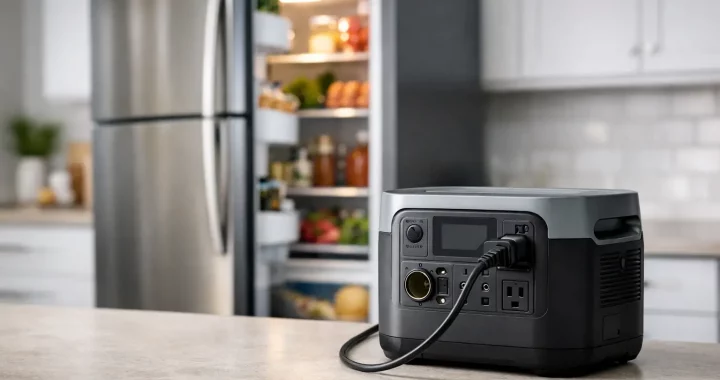
If the power goes out at 2 a.m., your refrigerator becomes the appliance you care about fast. Food safety has a short clock, and choosing the wrong backup unit can leave you with a battery that looks good on paper but shuts down the moment the compressor kicks on. That is why the real question is not just what size power station for refrigerator use, but what size will start it reliably and keep it running long enough to matter.
What size power station for refrigerator backup?
For most full-size home refrigerators, a portable power station with at least a 1,000W pure sine wave inverter and roughly 1,000Wh to 2,000Wh of battery capacity is the practical starting point. That covers the two numbers that matter most: the running wattage and the startup surge.
A typical refrigerator may only run at around 100W to 250W once it is operating, but the compressor usually needs a much higher burst of power at startup. In many cases, that surge lands between 600W and 1,200W. Some larger units, older refrigerators, and garage-ready models can spike even higher.
This is where buyers get tripped up. They see a low running watt number and assume a small power station will work. Then the fridge tries to start, the inverter overloads, and the backup fails. If you want dependable performance during an outage, surge handling matters just as much as battery size.
The two numbers you need before you buy
When deciding what size power station for refrigerator support makes sense, start with the inverter rating in watts and the battery capacity in watt-hours.
The inverter rating tells you whether the power station can run the refrigerator at all. It must cover both the fridge’s normal draw and its startup surge. For most households, 1,000W is a safer minimum than 500W, even if the refrigerator’s average consumption seems low.
Battery capacity tells you how long it can keep the refrigerator going. That number is measured in watt-hours, or Wh. The higher the Wh rating, the longer your runtime.
Think of it this way: watts are about capability, while watt-hours are about endurance.
How much power does a refrigerator actually use?
Most modern refrigerators do not run continuously. The compressor cycles on and off throughout the day, which means actual power use is lower than the startup number suggests. A common residential refrigerator might average 1 to 2 kWh per day, though some compact models use less and some larger side-by-side units use more.
That daily number is helpful, but outage planning works better when you think in shorter windows. If your refrigerator averages 60Wh to 100Wh per hour over time, a 1,000Wh power station will not give you a perfect 10 to 16 hours in real-world use. Inverter losses, ambient temperature, door openings, and compressor cycling all affect actual runtime.
A safer expectation is that a 1,000Wh unit may keep an efficient refrigerator powered for several hours, while a 2,000Wh class system can often handle overnight backup or longer, depending on conditions.
A practical sizing rule
If you want a simple buying framework, use this:
Choose a power station with an inverter rated at least 2 to 3 times your refrigerator’s running wattage, and enough battery capacity to match how long you need protection.
For example, if your refrigerator runs at 150W and surges to 900W, a 1,000W inverter is the minimum realistic target. If you want 8 to 12 hours of meaningful backup, 1,500Wh to 2,000Wh is a stronger fit than 500Wh or 700Wh.
That is why many shoppers preparing for storms or grid instability move beyond entry-level units quickly. Small power stations are great for phones, lights, laptops, and routers. Refrigerators usually need a mid-size or high-capacity system.
Small fridge, full-size fridge, or garage freezer
Not every cold-storage appliance needs the same setup.
A mini fridge is the easiest load. Many compact units can run on a smaller power station, sometimes in the 300W to 600W inverter range, with 300Wh to 700Wh of battery capacity depending on how long you need it to last.
A standard kitchen refrigerator is where most buyers should focus on 1,000W+ inverter output and at least 1,000Wh of battery. If reliability is the goal, especially during weather events, 1,500Wh to 2,000Wh gives you more breathing room.
A large refrigerator, upright freezer, or older garage fridge usually deserves even more margin. These appliances often face hotter environments, longer compressor cycles, and stronger startup surges. In that case, a higher-capacity portable power station or an expandable backup system is the better call.
Why pure sine wave matters
For refrigerator backup, pure sine wave output is not optional if you want stable operation. Compressors and motors run better on clean, utility-like power. Modified sine wave systems can create performance problems, noise, overheating, or startup issues.
Most quality lithium power stations built for appliance backup use pure sine wave inverters. That is the standard to look for if your goal is dependable home emergency power rather than basic gadget charging.
Runtime is always conditional
The honest answer to refrigerator runtime is: it depends.
A refrigerator in a cool kitchen with the doors kept shut will use less power than one working hard in a hot garage. A newer Energy Star model will usually stretch battery capacity better than an older unit. If you are also plugging in a router, a few lights, or charging phones from the same power station, runtime drops further.
There is also a big difference between keeping food cold and running the refrigerator with normal family use. During an outage, every door opening forces the appliance to work harder. If your goal is to preserve food as long as possible, keep it closed and let the battery focus on cooling instead of recovery.
When a larger power station is the smarter buy
If your refrigerator is part of an outage plan, not just a convenience item, sizing up usually pays off. A larger unit gives you better surge coverage, longer runtime, and more flexibility to support essentials beyond the fridge.
That may include a freezer, internet equipment, a CPAP machine, phones, fans, or a few lights. Once you start planning for real resilience, not just emergency improvisation, battery expansion and solar recharging become more valuable than shaving a few dollars off the upfront price.
This is where high-capacity lithium systems with LiFePO4 batteries stand out. They are built for longer cycle life, stable performance, and repeat use. For buyers who expect weather outages, RV travel, or backup duty several times a year, that matters.
How to check your refrigerator before you choose
The best way to size correctly is to verify your fridge’s actual demand. Start by checking the appliance label for watts or amps. If it only lists amps, multiply amps by 120V to estimate wattage.
That gives you a useful baseline, but startup surge may still be higher than the label suggests. If you want more confidence, use a plug-in watt meter to measure real consumption during normal operation. For refrigerators with uncertain startup behavior, it is smart to build in extra inverter headroom rather than sizing too tightly.
If your refrigerator is older, larger than average, or paired with an ice maker and extra features, be conservative. Backup power is one of those purchases where a little margin is usually cheaper than a failed outage plan.
A realistic recommendation for most households
For most US homes, the sweet spot is a portable power station with a 1,000W to 2,000W pure sine wave inverter and around 1,000Wh to 2,000Wh of battery capacity. That range gives many standard refrigerators a solid chance of starting cleanly and running through a meaningful outage window.
If you only need short-term backup for a modern efficient fridge, the lower end may work. If you want overnight runtime, room for extra devices, or stronger preparedness for storms, move up in capacity. Expandable systems are especially useful if refrigerator backup is part of a broader emergency setup.
At Thundervolt Power, this is the practical line between a power station that can technically run a refrigerator and one that can support your home when the grid is not stable.
The right size is the one that starts your fridge without hesitation, gives you useful runtime instead of wishful math, and leaves enough margin for the kind of outage you are actually preparing for.
