
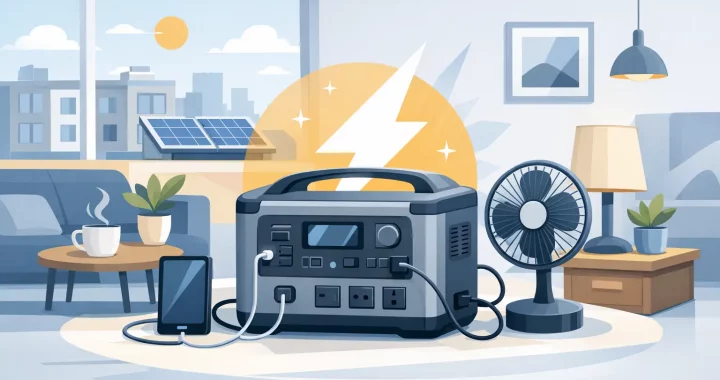
A power outage in an apartment creates a different kind of problem than one in a house. You may not have a garage for a loud generator, outdoor storage for fuel, or permission to run cords through common areas. What you can have is quiet, indoor-ready backup power for the devices that keep your household connected, informed, and comfortable. The best battery station for apartments is not necessarily the biggest model available. It is the one that matches your essential loads, fits your space, and can recharge reliably before the next outage.
Start With What You Need to Keep Running
Apartment backup power is usually about protecting essentials, not running every outlet at once. A portable power station can keep phones, tablets, laptops, Wi-Fi equipment, lamps, fans, medical devices, and small kitchen appliances available when the grid goes down. Larger units can also support a compact refrigerator, CPAP machine, television, or certain window air conditioners, depending on their running wattage and startup demand.
Begin by separating your needs into two categories: must-run devices and nice-to-have devices. A phone, modem, light, medication cooler, and CPAP machine may belong in the first group. A gaming setup, coffee maker, hair dryer, and microwave can wait. That distinction prevents a common mistake: buying a station based on the largest appliance in the apartment instead of the equipment that truly matters during an outage.
Check the label or manual for each device’s wattage. If it shows amps instead, multiply amps by volts to get an approximate wattage. A 120-volt device drawing 2 amps uses roughly 240 watts. Add the watts of devices you expect to operate at the same time, then choose an inverter with enough room above that number.
Capacity Matters More Than Outlet Count
A power station may have many ports, but its battery capacity determines how long it can actually keep devices running. Capacity is measured in watt-hours, written as Wh. In plain terms, a 1,000Wh battery holds about one kilowatt-hour of stored energy before conversion losses.
For apartment residents, these ranges are often practical starting points:
- 300Wh to 600Wh: Best for phones, tablets, a laptop, lights, a modem, and short CPAP use. These compact stations are easy to store in a closet and carry between rooms.
- 700Wh to 1,200Wh: A stronger choice for overnight essentials, including Wi-Fi equipment, multiple personal devices, lighting, fans, and some medical equipment.
- 1,500Wh to 2,500Wh: Better for longer outages and higher-demand needs, such as a refrigerator, workstation, CPAP, or a small appliance used occasionally.
- 2,500Wh and above: A serious apartment backup option for households that need extended runtime, higher inverter output, or future expansion capacity.
Real-world runtime will always be lower than a simple watt-hour calculation suggests because the inverter and electronics use some energy. As a quick planning example, a 1,000Wh unit may run a 50-watt modem, 10 watts of lighting, and a 60-watt fan for several hours, but it will not run a 1,500-watt space heater for long. Resistive heating appliances, including space heaters, electric kettles, toaster ovens, and hair dryers, drain batteries quickly.
Choose an Inverter That Can Handle Startup Surges
Battery capacity is only half the decision. The inverter rating, measured in watts, tells you how much power the station can deliver at one time. A station with a 1,000W inverter can support devices drawing up to 1,000 watts continuously, assuming the battery has sufficient charge.
Motors and compressors complicate the picture. Refrigerators, portable air conditioners, and some medical devices can require a brief surge of power when they start. A unit may draw 100 to 200 watts while running but need substantially more for a few seconds at startup. Look for a power station with a pure sine wave inverter and a surge rating appropriate for the appliance you plan to use.
Pure sine wave output is especially valuable for sensitive electronics, modern appliances, and medical equipment. It delivers power similar to standard household electricity and helps avoid the buzzing, heat, or poor performance that can occur with lower-quality modified sine wave output.
A Note on Air Conditioners and Space Heaters
Apartment residents often ask whether a portable power station can run air conditioning. The honest answer is: sometimes, but it depends on the unit. A small, efficient window air conditioner may be workable with a large-capacity station and high-output inverter. A portable floor AC or central HVAC system is usually a much larger demand and may not be practical without an extensive expandable battery system.
Space heaters are generally a poor use of stored battery power. They commonly draw 1,500 watts and can empty even a large station quickly. During an outage, prioritize layered clothing, blankets, safe indoor warmth strategies, and power for communication over trying to heat the entire apartment electrically.
Best Battery Station for Apartments: Features That Matter
Apartment living makes a few features more valuable than they might be in a garage or RV. LiFePO4 battery chemistry should be high on the list. It is known for long cycle life, thermal stability, and dependable performance over years of regular use. For a backup system you may keep charged and ready for storm season, that durability matters.
Fast AC recharging is another major advantage. If your power returns for a short period, a station that can recharge in one to two hours can be more useful than one that needs most of the day. Review the manufacturer’s stated AC charging time and check whether fast charging requires a dedicated wall outlet.
A clear display is equally practical. You should be able to see remaining battery percentage, input watts, output watts, and estimated runtime without guessing. Consider models with an app only if remote monitoring adds real value to your routine. A display you can read during an outage is more essential than an app you may never open.
For apartments, physical details count too. Measure your storage space and consider weight before choosing a large station. A 2,000Wh model can offer meaningful backup, but it may be heavy enough that moving it alone is difficult. Wheels, sturdy handles, and a manageable footprint can make the difference between a system you use confidently and one that stays tucked away.
Recharge Options in a Rental Setting
Wall charging is the main recharge method for most apartment households. Keep the station topped up according to the manufacturer’s storage guidance, especially during hurricane season, winter storm season, or periods of unreliable local service. Many units also offer car charging, which can be useful during travel or after an evacuation.
Solar charging can add resilience, but apartment feasibility depends on your building. A portable solar panel may work on a private balcony, patio, or rooftop area where building rules permit it and where panels receive direct sun. It is not a reliable plan if the balcony is heavily shaded, faces north, or is restricted by a lease or homeowners association.
Never place panels, cords, or equipment where they block walkways, fire exits, or shared access areas. Confirm lease terms and building policies before setting up solar equipment outdoors. Solar is valuable as a recharge option, but it should complement a fully charged battery station rather than replace your outage plan.
Use It Safely Indoors
One of the strongest reasons to choose a battery power station in an apartment is that it produces no engine exhaust. Unlike gasoline generators, it can be used indoors when operated according to manufacturer instructions. That said, indoor use still requires basic care.
Set the station on a stable, dry surface with open space around its vents. Do not cover it with blankets, store it in a sealed cabinet while operating, or place it near a stove, radiator, bathtub, or sink. Use the supplied charging cable or a properly rated replacement, and avoid overloaded power strips. If you are powering a critical medical device, test the setup in advance and keep the device manufacturer’s backup guidance available.
Do not assume a station will power an entire apartment through a wall outlet. Portable power stations are designed to power devices directly from their own AC outlets, USB ports, or DC outputs. Connecting one to household wiring without appropriate transfer equipment and qualified electrical work can create a serious safety hazard.
Build for the Outage You Are Most Likely to Face
A short city outage calls for a different setup than a multiday weather emergency. If your typical concern is a two- to six-hour interruption, a compact 500Wh to 1,000Wh station may cover communications, lighting, and personal devices comfortably. If storms have left your area without power for a day or more, a 1,500Wh-plus model with fast recharge capability becomes more compelling.
Expandable battery systems deserve consideration if you expect your needs to grow. You might begin with enough capacity for a modem, refrigerator, and CPAP, then add battery capacity later instead of replacing the whole system. This approach can make sense for renters who want meaningful backup now but may move into a larger home later.
The right choice is not about buying maximum capacity for its own sake. It is about being ready to keep your essential devices operating without fuel, noise, or last-minute decisions. A carefully sized portable power station gives apartment residents a practical reserve of electricity when the building is dark, the elevators are stopped, and dependable power matters most.
