
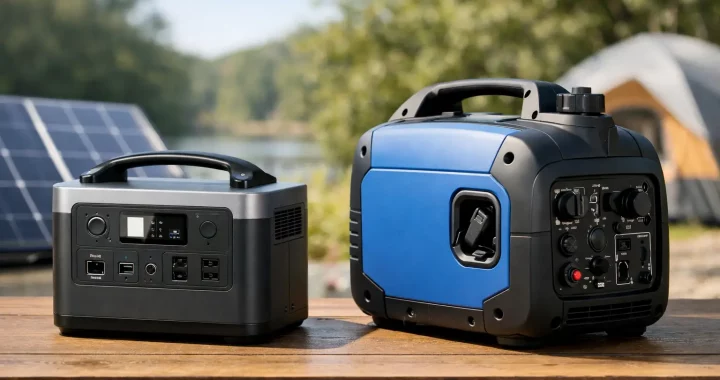
When the lights go out at home or you need dependable power away from an outlet, the portable battery versus inverter generator question gets real fast. This is not a small lifestyle choice. It affects how much noise you make, what devices you can run, how long you can stay powered, and how much setup you are willing to deal with when time matters.
For many buyers, the right answer comes down to one thing: what must stay on, and for how long? A family keeping a CPAP machine, router, phones, and a refrigerator running through a short outage has very different needs than a contractor powering tools all day or an RV owner trying to run air conditioning off-grid.
Portable battery versus inverter generator: the core difference
A portable battery power station stores electricity and delivers it through AC outlets, USB ports, and DC outputs. You recharge it from the wall, a vehicle, solar panels, or in some cases another generator. It runs quietly, produces no exhaust, and usually needs very little hands-on maintenance.
An inverter generator creates electricity from fuel, usually gasoline, propane, or dual-fuel combinations. The inverter design helps deliver cleaner, more stable power than a conventional generator, which makes it safer for electronics. It can often run much longer than a battery system as long as you have fuel on hand.
That difference shapes everything else. Portable batteries are about convenience, quiet use, and clean indoor-safe operation. Inverter generators are about longer runtime, higher sustained output in many cases, and fuel-based resilience when charging is limited.
Where a portable battery makes more sense
If your priority is quiet, instant power, a portable battery is usually the better fit. You press a button, plug in your gear, and you are running. There is no refueling, no pull cord, no engine vibration, and no concern about carbon monoxide.
That matters at home during overnight outages. It matters in an apartment where gas equipment is not practical. It matters in an RV park, at a campsite, or during tailgating where noise can ruin the experience. It also matters for people supporting sensitive devices like laptops, routers, cameras, or medical equipment.
A good lithium power station also gives you more flexibility than many people expect. Larger units with pure sine wave inverters can run refrigerators, freezers, microwaves, TVs, and even some window AC units depending on startup surge and total load. Systems with LiFePO4 batteries are especially attractive for preparedness because they are built for long cycle life and repeated use.
Another major advantage is expandability. Some battery systems let you add extra battery capacity as your needs grow. That is useful if you want to start with basic outage protection and later scale up for longer backup windows or more demanding appliances.
The trade-off is runtime. A battery has a fixed amount of stored energy. Once it is depleted, you need time and a charging source to refill it. If the grid is down for days and solar conditions are poor, that limitation becomes important.
Where an inverter generator has the edge
An inverter generator is still hard to beat when you need extended runtime and steady output for many hours or days. If you have fuel, you can keep going. That makes it a practical fit for long outages, job sites, outdoor events, and off-grid situations where large loads need to stay active.
It is often the stronger choice for power-hungry equipment. Space heaters, full-size air conditioners, power tools, sump pumps, and multiple kitchen appliances can push battery systems hard. A properly sized inverter generator may handle those loads more comfortably, especially if they need to run for long periods.
There is also a cost-per-runtime argument. For buyers focused mainly on long-duration emergency backup, a fuel-powered unit can provide a lot of operational time without requiring a very large battery bank. That can make sense in regions where outages are frequent and prolonged.
But the trade-offs are real. Inverter generators still make noise. They still require fuel storage and regular maintenance. They must be used outdoors with safe clearance, which complicates use during storms. And while they produce cleaner power than traditional generators, they are not as effortless to live with as a battery system.
Noise, safety, and day-to-day usability
This is where many buyers stop comparing specs and start thinking about real life. A portable battery is dramatically easier to live with. It is quiet enough for indoor use, overnight operation, and shared spaces. You can keep it ready in a closet, charge it periodically, and move it where needed.
An inverter generator asks more from you. You need to wheel it outside, manage extension cords or transfer connections, monitor fuel, and shut it down for refueling. During severe weather, that process is not always convenient. During the night, the sound alone can become a problem.
Safety is also a major dividing line. Portable batteries are designed for indoor use. Inverter generators are not. Carbon monoxide risk is serious, and safe placement is non-negotiable. For households that want the simplest backup option for immediate use, batteries have a clear advantage.
Portable battery versus inverter generator for outages
For short outages, a portable battery often feels like the smarter solution. If your goal is to keep communication devices charged, preserve food for several hours, power lights, and run a few essentials, a battery system is fast, quiet, and low stress.
For longer outages, the answer depends on your load plan. If you are disciplined about what stays plugged in and you have solar recharging available, a larger battery setup can still be highly effective. If you need to run high-wattage appliances around the clock or expect multiple days without meaningful recharge opportunities, an inverter generator may be the safer bet.
Many prepared households end up seeing this as a layered strategy rather than a winner-take-all decision. The battery handles quiet indoor essentials and overnight power. The generator covers heavy loads and long-duration backup when fuel is available.
Cost is not just the sticker price
A lot of comparisons go wrong here. Buyers look at the upfront cost and stop. But portable batteries and inverter generators carry very different ongoing costs.
A battery system has a higher initial price at larger capacities, especially if you choose premium battery chemistry, fast charging, or expansion options. After that, operating costs are low. There is no gasoline to buy, no oil changes, and less routine maintenance.
An inverter generator may look more affordable upfront for the amount of wattage offered. Over time, fuel, maintenance, stabilizers, replacement parts, and storage requirements add up. The real value depends on how often you use it and how much runtime you need.
If you use backup power regularly for camping, road trips, work, and emergencies, a battery may deliver more daily value. If your main concern is surviving a rare but multi-day outage with major appliances in play, a generator may justify itself quickly.
How to choose the right one for your situation
Start with your must-run devices, not the machine itself. Write down what absolutely needs power: refrigerator, CPAP, router, phones, lights, microwave, TV, sump pump, or air conditioner. Then estimate how many watts those devices require and how long they need to operate.
If most of your essentials are low to moderate draw and you want indoor-safe, quiet operation, a portable battery is likely the better fit. Look for enough watt-hours to cover your realistic usage, not your wish list. Features like pure sine wave output, fast AC charging, solar input, and expandable batteries can make a major difference.
If your list includes long runtimes on high-draw equipment, or you need all-day performance in places where recharging is unreliable, an inverter generator deserves strong consideration. Focus on running watts, surge capacity, fuel efficiency, and noise level.
Also be honest about how you will actually use it. A backup system that is technically powerful but annoying to operate often sits unused until an emergency exposes the gap. The best choice is the one you can deploy confidently when power is not stable.
For many customers shopping with a preparedness mindset, that is why portable battery systems keep gaining ground. They are easier to store, easier to use, and easier to trust in the moment. Brands and retailers like Thundervolt Power have leaned into that shift by offering high-capacity lithium systems designed for real backup use, not just charging phones on a weekend trip.
The better question is not which option wins on paper. It is which one matches your load, your environment, and your tolerance for noise, maintenance, and fuel dependence. If you buy with that level of clarity, you are far more likely to end up with power you can count on when it matters most.
