
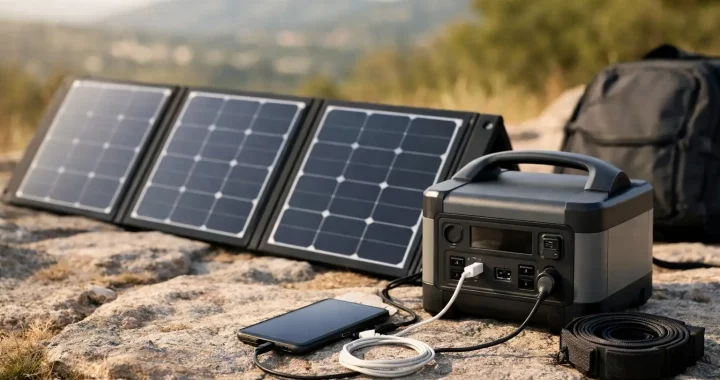
A portable solar charging kit is most valuable before an outage, not after your phone reaches 2% and the weather forecast turns worse. The right setup gives you a quiet way to recharge essential devices from sunlight, whether you are preparing your home, parked at a campsite, working from an RV, or operating beyond the reach of utility power.
The term can describe anything from a compact panel with USB outputs to a high-capacity portable power station paired with folding solar panels. Those systems serve very different needs. Choosing well starts with a realistic picture of what you need to keep running and how long you may need to rely on stored power.
What a Portable Solar Charging Kit Includes
At its most practical, a portable solar charging kit combines a solar panel, the necessary charging cable or adapter, and a battery system or device that accepts solar input. The panel collects energy; the battery stores it for use after clouds roll in or the sun goes down.
For phones, headlamps, small radios, and similar low-draw devices, a compact solar panel with direct USB charging may be enough for recreational use. It is not usually the best emergency solution. Direct charging can be inconsistent in changing light, and it leaves you without stored energy when you need power at night.
For preparedness, RV travel, and off-grid work, the more capable setup is a portable power station and compatible solar panels. The power station stores solar energy in a lithium battery and provides AC outlets, USB ports, and often 12V DC outputs. That lets one system support communications, lighting, laptops, CPAP machines, fans, refrigerators, and selected small appliances within its rated capacity.
A kit is only as useful as its components work together. Confirm that the panel connector is compatible with the power station, that the panel voltage falls within the station’s solar input range, and that the included cable supports the connection. An adapter can solve some fit issues, but it cannot make an incompatible voltage range safe.
Start With the Loads You Need to Protect
Solar panel wattage gets attention, but your power needs should lead the decision. Make a short list of the equipment that matters during an outage or away from shore power. Include the watts each device uses and the number of hours you expect to operate it daily.
Watt-hours are the most useful planning number. A 60W laptop used for four hours needs about 240Wh. A 10W LED light used for eight hours needs 80Wh. A refrigerator may run at a modest average draw but require a much larger startup surge when its compressor turns on. Add your expected use, then allow room for charging losses and changing conditions.
This is where a portable power station earns its place in the kit. Battery capacity is generally stated in watt-hours. A 500Wh unit can be a strong fit for personal electronics, lighting, a modem, and limited small-device use. A 1,000Wh to 2,000Wh system provides more practical margin for longer outages, refrigerated food, medical devices, or mobile work. Larger expandable systems may be appropriate when keeping more household essentials available is the goal.
Do not confuse battery capacity with inverter output. Capacity tells you how much energy is stored. Inverter output, measured in watts, tells you what the station can run at one time. A station may have enough stored energy for several hours of use but still be unable to start an appliance if its inverter cannot handle the running watts and startup surge.
Match Solar Input to Your Recovery Plan
The panel’s rated wattage affects how quickly you can restore the battery under favorable conditions. A 100W panel can be useful for maintaining small loads and slowly replenishing a compact power station. A 200W or 400W solar array has a better chance of recovering meaningful energy during a day of good sun, especially with a larger battery.
Rated output is not a promise of constant production. Panel angle, season, shade, cloud cover, heat, and cable losses all affect actual output. A 200W panel may produce considerably less than 200W at many points during the day. Plan with that reality in mind rather than assuming a panel will deliver its nameplate rating hour after hour.
A practical emergency setup should make progress even when conditions are imperfect. If you rely on a 1,000Wh power station for essential loads, a solar input that can replace a substantial portion of your daily use is more useful than a small panel that only offsets phone charging. For weekend camping, slow replenishment may be perfectly acceptable. For multiday storm outages, recovery speed matters much more.
Solar charging controllers also matter. Many quality power stations use maximum power point tracking, commonly called MPPT, to draw available power from panels more efficiently as sunlight changes. It is a worthwhile feature, particularly when investing in higher-wattage folding panels.
Choose Panels Built for How You Travel
Portable solar panels are designed to be moved, but portability comes with trade-offs. Folding panels are easy to store in an SUV, RV, or garage and can be deployed quickly when the sun appears. Their stands let you adjust the angle, although they need to be secured in wind and kept clear of shade.
Rigid panels can be a better long-term choice for a roof-mounted RV or fixed off-grid installation, but they are less flexible for home backup. A portable panel can be placed where the sun is strongest, even when the power station remains under cover near the equipment it serves.
Pay attention to physical details. Panel weight affects whether one person can safely reposition it. Cable length determines how far the power station can sit from the sun. Weather resistance helps, but no portable electrical system should be left exposed to standing water, severe wind, or conditions outside its manufacturer guidance.
For most households, two manageable panels are often more practical than one oversized panel. They can be carried separately, positioned around partial shade, and packed more easily. The best answer depends on available storage, lifting ability, vehicle space, and the solar input limits of the power station.
Battery Chemistry and Outputs Affect Daily Use
A portable solar charging kit should support more than a single ideal scenario. LiFePO4 battery chemistry is a popular choice for backup power because it offers long cycle life, stable performance, and a strong fit for equipment that may be charged and used repeatedly over years. It is particularly appealing for families building a preparedness plan rather than buying a one-season camping accessory.
Output selection matters just as much. Pure sine wave AC power is the preferred choice for sensitive electronics and motor-driven devices. Multiple USB ports make it easier to charge phones, tablets, and battery banks without tying up AC outlets. A regulated 12V output can be useful for vehicle-style accessories, compressors, and certain travel equipment.
Fast AC recharging is another feature worth considering. Solar gives you independence when utility power is unavailable, while rapid wall charging helps you restore the system quickly when power returns or before leaving for a trip. A good kit gives you both options instead of forcing you to choose between convenience and resilience.
Build for the Situation, Not the Spec Sheet
A camper who wants lights, a phone, and a small cooler has different needs than a homeowner protecting a CPAP machine, refrigerator, router, and medical-device charging. A contractor may prioritize high inverter output for tools, while an RV traveler may value solar recovery and DC connectivity. Bigger is not automatically better if the system is too heavy to move, too slow to recharge with your available panels, or far beyond the loads you actually need.
For home readiness, keep the kit charged, store its cables and adapters together, and test it before storm season. Run a real charging session in your driveway or yard. Connect the devices you expect to use, watch the power draw, and see how panel placement changes input. That simple practice reveals weak points while you still have time to correct them.
Thundervolt Power focuses on practical systems that pair lithium-based portable power stations with solar charging options for real backup, travel, and off-grid needs. The goal is not to replace every circuit in a house with a small box. It is to keep the equipment that protects comfort, communication, work, and safety available when normal power is not.
A Readiness Check Before You Buy
Before selecting a kit, verify four numbers: your expected daily watt-hour use, the highest wattage appliance you may run, the station’s usable solar input range, and the realistic solar hours available where you will use it. Then consider whether expansion batteries could be valuable later. A system that starts at the right size and can grow may offer better long-term value than replacing an undersized unit after the first serious outage.
Sunlight is a powerful resource, but it is variable. Pairing it with enough stored battery capacity, compatible panels, and a clear load plan turns it into dependable power. Set up your kit while the grid is stable, and it will be ready to do useful work when stability is no longer guaranteed.
