
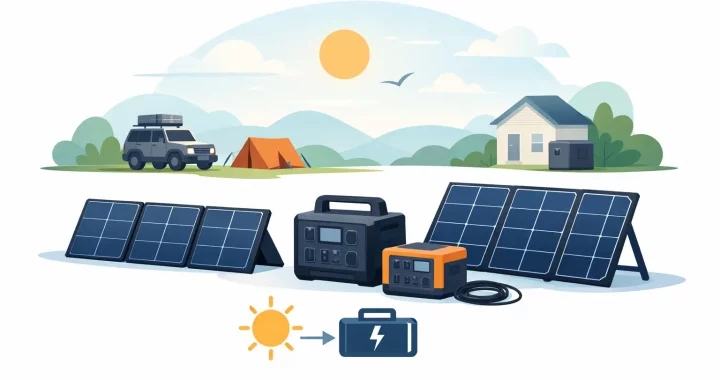
A portable power station can only keep working as long as it has energy to draw from. During a multi-day outage, on an extended RV trip, or at a remote jobsite, portable solar panels turn stored battery power into a renewable supply you can replenish without fuel, noise, or a trip to the gas station. Knowing how to choose portable solar panels starts with matching the panel to what you need to power, how quickly you need to recharge, and where you will use it.
The right setup is not always the panel with the highest wattage. A larger panel can recharge a power station faster, but it may be too heavy to move often or too large for a compact campsite. A smaller panel is easier to carry and position, but it may not replace a full day of power use. The goal is dependable solar charging that fits your real situation.
Start With Your Power Needs and Battery Capacity
Choose the power station first, or at least know its battery size and solar input limits before selecting panels. Battery capacity is measured in watt-hours, or Wh. A 1,000Wh power station stores roughly 1,000 watts of energy, though actual usable energy is lower after conversion losses.
Think about what the battery will run between charging sessions. Phones, lights, laptops, fans, CPAP machines, routers, and small coolers have very different energy needs. A compact panel may be enough to maintain light electronics, while a refrigerator, power tools, or portable air conditioner can require much more solar capacity and a larger battery bank.
As a practical starting point, a 100W portable solar panel can be useful for topping up small power stations and supporting modest daily use. A 200W to 400W panel setup is better suited to larger portable power stations, longer outages, RV use, and families who need to recharge more than phones and lights. If your station accepts expansion batteries, plan for the future capacity you may add rather than sizing solar only for the battery you own today.
How to Choose Portable Solar Panels by Wattage
Panel wattage tells you the maximum power a panel can produce under ideal laboratory conditions. It is a useful comparison point, but it is not a promise of constant output in the field. A 200W panel will not produce 200 watts every hour of every day.
Sun angle, cloud cover, temperature, shade, panel direction, and cable losses all affect production. In favorable direct sunlight, portable panels often deliver a meaningful portion of their rated output. In weak winter sunlight or partial shade, output can fall sharply.
For that reason, avoid sizing a system so tightly that it only works on a perfect sunny day. If you need to put 800Wh back into a power station daily, a single 100W panel is unlikely to meet that need consistently. A larger panel array provides more charging headroom and helps recover after cloudy weather.
Estimate Daily Solar Production Realistically
A simple planning estimate is panel wattage multiplied by peak sun hours, then reduced for real-world losses. For example, a 200W panel receiving five strong sun hours has a theoretical output of 1,000Wh. After accounting for heat, positioning, conversion, and changing light, the usable result may be closer to 700Wh to 850Wh.
Peak sun hours vary by season and location. Arizona summer conditions and a cloudy northern winter are not equivalent. For emergency preparedness, build around conservative expectations, especially if storms or winter outages are part of your concern.
Match the Panel to Your Power Station’s Solar Input
Compatibility matters as much as wattage. Every portable power station has limits for solar input wattage, voltage, current, and connector type. A panel setup that exceeds the station’s allowable voltage can cause damage or fail to charge. A setup with insufficient voltage may not start charging at all.
Check these specifications before you buy:
- Maximum solar input wattage, which sets the useful upper limit for panel capacity.
- Solar input voltage range, including the maximum open-circuit voltage, often listed as Voc.
- Maximum input current, particularly when connecting panels in parallel.
- Connector type and whether the correct adapter cable is included or required.
Many portable power stations use an integrated MPPT charge controller. MPPT controllers are valuable because they adjust to changing sunlight and help draw available power more efficiently than basic controllers. Still, the controller cannot make an incompatible panel setup safe. Confirm the electrical specifications, not just that the plugs appear to fit.
If you plan to connect multiple panels, understand the difference between series and parallel wiring. Series wiring increases voltage, while parallel wiring increases current. Which approach is correct depends entirely on the power station’s stated solar input range. When in doubt, follow the power station and panel manufacturer guidance for approved configurations.
Consider Portability, Setup Time, and Build Quality
Portable solar panels come in several forms. Foldable suitcase-style panels are a strong choice for emergency kits, RV travel, camping, and tailgating because they pack down for transport and can be positioned away from the vehicle or shelter. Rigid panels are generally more permanent and better for roof or fixed mounting applications. Flexible panels can help with certain curved or weight-sensitive surfaces, but they are not automatically the best choice for every portable setup.
Look beyond folded dimensions. Check the panel’s full deployed footprint, weight, handle design, leg stability, cable length, and storage case. A 400W folding panel may provide excellent charging power, but one person may find it awkward to carry and reposition. Two 200W panels can be easier to manage, and they let you use one panel when space or weather limits the full setup.
For preparedness, durability matters. Look for weather-resistant materials, protected connectors, reinforced corners, stable kickstands, and a surface that can handle regular outdoor use. Weather-resistant does not mean the panel, cables, and power station should be left exposed in heavy rain. Keep the power station dry and use the panel according to its rated environmental limits.
Plan for Shade, Season, and Panel Positioning
Solar panels need direct sun. Even a narrow shadow from a tree branch, antenna, or roof edge can significantly reduce output, especially on a panel with cells wired in series. This is one reason portable panels are valuable: you can move them into clear sun while keeping the power station in the shade or inside a dry protected area.
For best performance, face panels toward the sun and adjust their angle during the day when practical. In the Northern Hemisphere, panels generally produce best when facing south, but the sun’s path changes by season. Flat panels may be convenient, yet adjustable kickstands usually give you more control and better output.
Cable length is also a practical consideration. A longer cable can let you place the panel in sunlight while the battery remains closer to your RV, tent, work area, or home. Do not use undersized extension cables, and avoid creating trip hazards where people are moving around the site.
Choose for the Job You Actually Need to Do
Different situations call for different solar capacity. For occasional camping, a compact folding panel paired with a small power station may be all you need for phones, lanterns, a camera, and a laptop. For RV travel, larger panels can support longer stays off-grid, especially when you are running a cooler, fan, water pump, or work equipment.
For home outage readiness, focus on recharge speed and reliability. A larger solar array paired with a high-capacity LiFePO4 power station can help sustain essentials such as communications, lighting, refrigeration, and select medical devices. It is wise to calculate device wattage and daily runtime before assuming solar can support every appliance in the house.
For contractors and mobile work crews, portability may compete with charging speed. A panel system needs to be quick to deploy, durable enough for repeated use, and capable of recovering the battery after tool use. In this case, multiple manageable panels may be more practical than one oversized unit.
Do Not Overlook the Details That Affect Daily Use
A solar panel is part of a system, not a standalone answer. Verify what cables, adapters, parallel connectors, and carrying cases are included. Check whether your power station can accept solar and AC charging at the same time if fast recovery is a priority. Consider where panels will be stored, who will carry them, and whether every person in the household can set them up safely.
Finally, treat rated solar output as potential, not guaranteed production. A well-matched setup gives you enough panel capacity to recharge meaningfully in normal conditions, with margin for the days when weather is working against you. That margin is what turns portable solar from a convenience into dependable backup power when the grid is not stable.
