
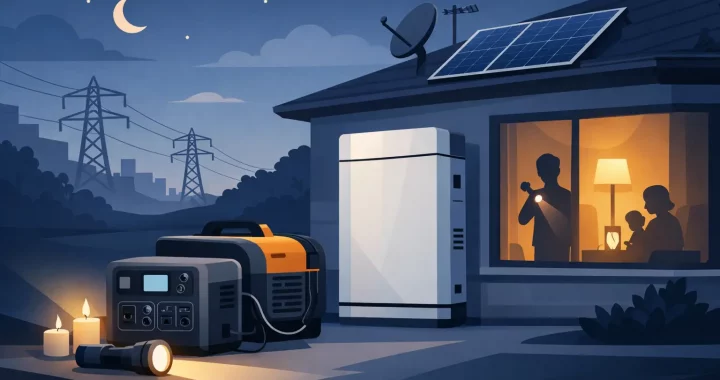
A blackout changes the priorities in a home fast. Refrigerated food, phones, internet, lights, sump pumps, and medical devices can all become immediate concerns. Knowing how to prepare blackout backup power before a storm, wildfire, heat wave, or grid failure gives you time to choose the right equipment instead of settling for whatever is available after shelves are empty.
A dependable plan does not mean powering every circuit in your house. It means keeping the devices that protect your household safe, connected, and comfortable for the amount of time an outage is likely to last. Portable battery power stations, expansion batteries, and solar panels can provide quiet, fuel-free backup power when they are sized and staged correctly.
Start With the Loads That Matter Most
The first question is not, “What is the biggest power station I can buy?” It is, “What must keep running?” Make a short, practical list of essential devices and separate them by priority.
Your first tier may include a CPAP machine, home medical equipment, a phone, essential lighting, a refrigerator, or a sump pump. The next tier might be a Wi-Fi router, laptop, fan, television, or coffee maker. High-draw comfort appliances such as portable air conditioners, space heaters, electric ranges, and clothes dryers require much more energy and may not be realistic for a compact backup system.
Look at each device label or power adapter for its running wattage. Watts measure how much power a device needs at one moment. A 10-watt LED lamp uses far less power than a 1,200-watt microwave. Some motor-driven appliances, including refrigerators, freezers, pumps, and certain power tools, also need a higher starting surge when they turn on. Your power station inverter must support both the appliance’s running watts and its surge demand.
For critical medical equipment, confirm the device’s power requirements with its manufacturer or care provider. Keep the prescribed backup plan in place and do not assume every portable power station is appropriate for every medical use.
Size Blackout Backup Power by Watt-Hours
Once you know what you need to run, estimate how long you need to run it. This is where watt-hours matter. Watt-hours, shown as Wh, measure stored battery capacity.
A simple estimate is:
Device watts x hours of use = watt-hours needed
For example, a 60-watt refrigerator that averages eight hours of actual compressor run time over a day may use roughly 480Wh. A 10-watt router running for 24 hours uses 240Wh. Four 8-watt lights used for five hours add 160Wh. Together, those essentials require about 880Wh before accounting for inverter losses and real-world variation.
Plan extra capacity rather than sizing to the exact total. Battery power is affected by appliance cycling, ambient temperature, conversion losses, and the fact that usage often increases during a long outage. A 1,000Wh power station can be a sensible starting point for communications, lighting, and selected small appliances. For refrigerator backup, pumps, multiple family devices, or overnight use, higher-capacity systems and expansion batteries provide a more practical margin.
Do not confuse a power station’s battery capacity with its AC output rating. A unit with a 2,000Wh battery may have a 2,000-watt inverter, but those specifications answer different questions. Capacity tells you approximately how long it can run equipment. Output tells you what it can operate at one time.
Choose Equipment That Fits the Outage Scenario
A portable power station is often the most straightforward blackout solution for apartment residents, homeowners, RV travelers, and anyone who needs clean indoor-safe power. Unlike a gas generator, a battery power station produces no exhaust and runs quietly. It can be used indoors as directed, making it useful for bedrooms, kitchens, workspaces, and sheltered areas during severe weather.
Look for a pure sine wave inverter for sensitive electronics and common household devices. Multiple AC outlets, USB-C ports, USB-A ports, and 12V outputs make it easier to run a mix of devices without a pile of adapters. LiFePO4 battery chemistry is also a strong fit for preparedness because it is designed for long cycle life and stable performance over repeated use.
For outages that may stretch beyond one night, expandability changes the equation. An expansion battery can increase stored energy without requiring a completely separate system. That can be especially useful for a household that begins with communications and refrigeration backup, then later adds capacity for a freezer, workstation, or portable air conditioner.
Solar charging adds another layer of resilience. A compatible portable solar panel can recharge a power station during daylight, extending your available runtime when utility power is still unavailable. Solar is not instant backup after dark, and output varies with weather, panel angle, shade, and season. Still, it can be the difference between rationing power on day two and maintaining essential loads for several more days.
Build a Realistic Charging Plan
Your battery is only as ready as its state of charge. Keep your primary power station charged according to the manufacturer’s storage guidance, and check it on a regular schedule. A monthly readiness check is a practical habit: confirm the charge level, inspect cables, test outlets, and make sure the unit is easy to access.
Plan more than one charging method when possible. AC wall charging is the normal starting point. Car charging can help during travel or evacuation, though it is generally slower. Solar charging provides an independent daytime option during extended grid outages. If your system supports fast AC charging, it can also be valuable when a storm warning gives you only a few hours to prepare.
Store solar panels where they can be deployed quickly, but protect them from damage and moisture. Before you need them, practice placing the panels in direct sun, connecting the correct cables, and checking charging input on the power station display. A solar setup that has never been tested is not yet part of your backup plan.
Prepare the Home, Not Just the Battery
Backup power works better when your household has already reduced unnecessary demand. Use LED lighting, charge phones and battery banks before bad weather arrives, and set refrigerators and freezers to colder settings when an outage is expected. Keep refrigerator doors closed as much as possible once the power goes out.
Place the power station in a dry, ventilated location with enough clearance around it. Avoid leaving it in direct rain, extreme heat, or a place where cords create a tripping hazard. Use properly rated extension cords for the equipment you intend to connect. Never attempt to power household wall outlets by plugging a power station into an outlet. That dangerous practice can backfeed electricity and requires a professionally installed transfer solution if whole-home circuits are the goal.
It also helps to organize a small outage kit beside your backup system. Include charging cables, a flashlight, spare batteries, a printed contact list, a weather radio, surge-protected power strips if appropriate, and clear instructions for other household members. Label the cords and outlets you use most often. During a nighttime outage, simple organization saves time.
Test Your Plan Before Weather Forces It
A blackout plan should be tested under normal conditions. Run your refrigerator from the power station for a few hours. Charge phones, operate lights, and verify that the router stays online. If you intend to run a sump pump, check its starting wattage and test it carefully when conditions are safe.
Testing reveals the details that product specifications alone cannot: whether a cord reaches, whether a device pulls more power than expected, whether your family knows what to unplug, and how quickly your battery capacity declines. It also helps you decide whether a larger station, an added battery, or solar input is worth adding.
Thundervolt Power focuses on practical, portable systems because readiness should not depend on fuel runs, noise, or last-minute guesswork. Start with the essential loads, give yourself capacity margin, and practice using the equipment while the grid is still on. When the lights go out, a prepared power plan gives your household a calmer next step.
