
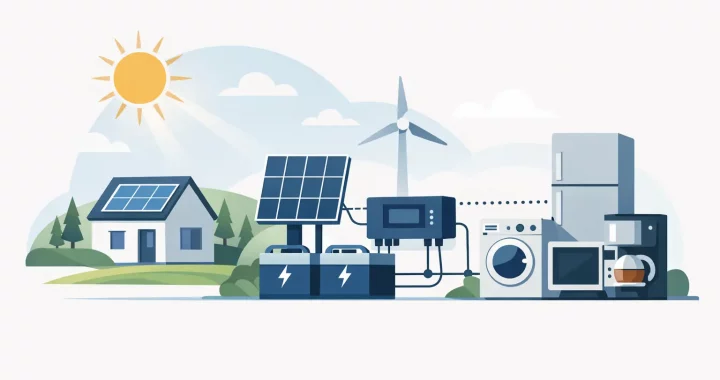
A refrigerator full of food, a CPAP machine beside the bed, or a window AC during a summer outage all create the same question: can your power system actually handle the load? Learning how to run appliances offgrid is less about buying the biggest battery you can find and more about matching appliance demand, battery capacity, inverter output, and charging speed.
A properly sized portable power station can deliver quiet, fuel-free electricity where a gas generator is inconvenient, unavailable, or unsafe to run. But appliances have very different power needs. A phone charger is forgiving. A coffee maker, microwave, refrigerator, or air conditioner requires real planning.
Start With Appliance Watts, Not Battery Size
Every off-grid power plan begins with watts. Watts measure the power an appliance needs while it is operating. You can usually find this number on the appliance label, in its manual, or listed as input power in the specifications.
If an appliance shows amps rather than watts, use this simple estimate:
Watts = volts x amps
For standard US household equipment, voltage is usually 120V. A device rated at 5 amps therefore uses roughly 600 watts. This is useful for estimating demand, but the label’s listed wattage is the better number when available.
There are two wattage figures to consider. Running watts are the ongoing power demand. Starting watts, also called surge watts, are the brief extra power some appliances need to start a motor or compressor. Refrigerators, freezers, sump pumps, power tools, and air conditioners commonly have a startup surge.
A refrigerator may run at 150 watts yet briefly need 1,000 watts or more when its compressor starts. If your inverter cannot meet that surge, the refrigerator may fail to start even when your battery has plenty of stored energy. Choose a power station with a pure sine wave inverter whose continuous output covers your expected load and whose surge rating can handle motor-driven appliances.
Calculate Battery Runtime in Watt-Hours
Battery capacity is measured in watt-hours, abbreviated Wh. This tells you how much energy the battery stores. A 1,000Wh power station can theoretically provide 1,000 watts for one hour, 100 watts for 10 hours, or 50 watts for 20 hours.
Real-world runtime is lower because inverter conversion, heat, and the appliance’s operating behavior use some energy. A practical planning formula is:
Estimated runtime = battery watt-hours x 0.85 ÷ appliance watts
The 0.85 factor allows for typical conversion losses. For example, a 2,000Wh battery running a steady 200-watt load would provide approximately 8.5 hours:
2,000Wh x 0.85 ÷ 200W = 8.5 hours
That calculation works best for a consistent load such as a fan, TV, or medical device. Refrigerators and air conditioners cycle on and off, so their average draw over several hours may be lower than their rated running wattage. On the other hand, hot weather, direct sun, frequent door openings, and a poorly insulated space can make them work harder.
When you plan for critical appliances, leave a margin. Do not build a system around a calculation that uses 95% of the battery on paper. A larger battery, expansion battery, or a recharge plan gives you more dependable power when conditions are less favorable than expected.
A quick example for a home outage
Suppose you need to run a 150-watt refrigerator, a 40-watt CPAP, two 10-watt lights, and a 60-watt internet modem and router. Their combined running load is 270 watts. A 2,000Wh power station could provide about 6.3 hours if everything ran continuously.
In practice, the refrigerator compressor cycles, and you may not need the lights all night. That can extend runtime. Still, if an outage may last more than a night, solar recharging, vehicle charging, or additional battery capacity becomes part of the plan.
Choose an Inverter That Can Carry the Load
The inverter converts battery power into the AC electricity used by standard wall outlets. Its continuous watt rating determines what it can run at one time. Its surge rating determines whether it can handle the momentary startup demand of motors and compressors.
Add the running watts of appliances you expect to operate at the same time. Then choose an inverter with room above that total. If your combined load is 1,200 watts, a 1,500-watt inverter may work, but a 2,000-watt unit gives you more breathing room for startup surges and changing needs.
Avoid treating every outlet as a separate power source. A power station may have several AC outlets, but all connected appliances still share the inverter’s total output. Plugging a microwave into one outlet and a space heater into another can overload a 2,000-watt inverter because those appliances together may draw more than 2,500 watts.
High-heat appliances are the fastest way to drain a battery. Space heaters, hair dryers, toaster ovens, electric kettles, coffee makers, induction cooktops, and microwaves often use 1,000 to 1,800 watts or more. They can be run off-grid with a sufficiently large system, but generally for short, deliberate use rather than all-day operation.
Build a Charging Plan for Longer Outages
Battery capacity gets you through the first hours. Recharging determines whether you can remain powered for days. Solar panels are often the most practical off-grid option because they produce energy without fuel, noise, or a trip to a gas station.
Solar output changes throughout the day. Panel ratings represent ideal laboratory conditions, not guaranteed daily production. Clouds, shade, panel angle, season, cable losses, and heat all reduce output. A 400-watt solar array may not deliver 400 watts continuously, so plan around a useful production window rather than a nameplate number.
As a rule, determine how many watt-hours you use per day, then size solar input to replace most of that energy during available sun. If your essential loads consume about 1,500Wh daily, a 400-watt solar setup receiving five productive sun hours could potentially produce around 1,400 to 1,700Wh under favorable conditions. Conditions vary, so conserving power remains part of the strategy.
Portable solar panels work best when they can be repositioned as the sun moves. Keep them free of shade, even partial shade from a roof vent or tree branch. A small shaded section can noticeably reduce output. Confirm that panel voltage and connector type are compatible with your power station’s solar input limits before connecting anything.
AC charging and vehicle charging are useful backups. Charge fully before a storm, camping trip, or remote work assignment. If utility power returns briefly, fast AC charging can restore a large battery bank before the next interruption. For travel, vehicle charging can help maintain smaller loads, though it is generally much slower than solar or wall charging.
Prioritize Appliances That Protect Comfort and Safety
Off-grid power works better when you separate essential loads from convenience loads. During an outage, protect refrigeration, medical equipment, communication, lighting, water access, and devices needed for work or weather alerts before using energy-intensive appliances.
A practical sequence is to power one major load at a time. Run the microwave for a few minutes, then turn it off before using a coffee maker. Charge phones and laptops while the refrigerator is between cooling cycles. If you need to operate a sump pump, avoid running other heavy appliances during its startup period.
For RV travel and remote campsites, the same principle applies. LED lights, phones, laptops, fans, a portable fridge, and cameras are usually manageable loads. Electric cooking and climate control require more capacity and more frequent charging. A window air conditioner can be possible with a high-output power station and adequate battery capacity, but runtime depends heavily on the unit’s wattage, thermostat setting, outdoor temperature, and solar conditions.
Use the Right Equipment Safely
Portable power stations are designed for convenient plug-in power, but they are not a substitute for permanent electrical work. Never connect a power station directly to a home’s electrical panel or wall outlet unless a qualified electrician has installed an approved transfer switch or interlock system. Backfeeding can endanger utility workers, damage equipment, and create a fire risk.
Operate equipment in a dry, ventilated location and keep cables protected from pinching, standing water, and foot traffic. Use appropriately rated extension cords for the appliance load. Do not chain multiple power strips or extension cords together, and do not cover a power station while it is operating or charging.
For medical devices, verify the manufacturer’s power requirements and test your setup before an emergency. Run the device from the power station for a normal use period, confirm estimated runtime, and establish a charging routine. Preparedness is far more reliable when the system has been tested under ordinary conditions rather than first used during a storm.
How to Run Appliances Offgrid With More Confidence
The most reliable system is sized around your actual priorities, not a single impressive specification. Start by listing the appliances you cannot reasonably go without, their running watts, likely surge watts, and the number of hours you need them each day. From there, select battery capacity, inverter output, and solar input that leave room for real conditions.
Thundervolt Power focuses on portable energy systems that make this planning more practical, from compact stations for essential electronics to expandable LiFePO4 setups for longer outages and heavier appliance loads. The right setup is the one you understand, can recharge, and can depend on when grid power is not stable.
Before you need it, plug in your essential appliances, watch the power draw, and record the results. That simple test turns an off-grid power plan from a guess into a dependable response.
