
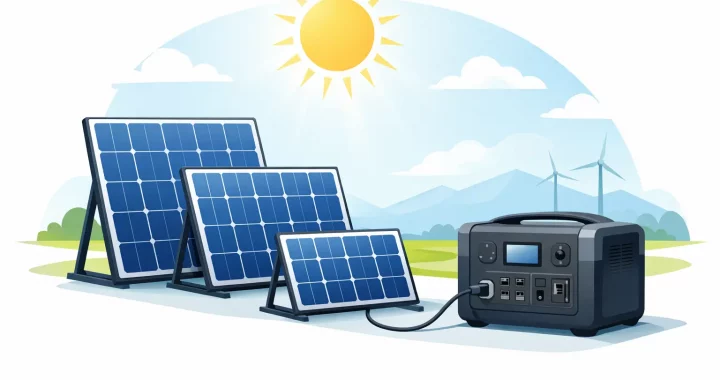
A solar panel that is too small can leave a power station charging all day without restoring enough energy for the night ahead. One that is too large may cost more than necessary, while exceeding the station’s voltage limit can create a compatibility problem. Knowing what size solar panel for power station charging starts with matching your battery, solar input, and real-world power needs.
For emergency backup, RV travel, camping, or off-grid work, the right setup is not about buying the largest panel available. It is about building a dependable charging system that can recover your power station fast enough to keep essential devices available when the grid is not.
What Size Solar Panel for a Power Station?
Start with the power station’s battery capacity, measured in watt-hours (Wh), and its maximum solar input, measured in watts (W). Battery capacity tells you how much energy the station can store. Solar input tells you how quickly it can accept energy from panels.
As a practical baseline, choose solar panels rated at roughly the same wattage as your power station’s maximum solar input. A power station with a 200W maximum solar input pairs well with a 200W panel setup. A station that accepts 500W can make good use of 400W to 500W of solar panels.
There is room for flexibility. Panels rarely produce their advertised rating for a full day. Heat, haze, panel angle, cable losses, and partial shade all reduce output. In many conditions, a 200W portable panel may deliver about 120W to 170W. This is why some owners use an array rated modestly above the station’s wattage limit, provided the panel voltage and current stay within the manufacturer’s approved input range.
The non-negotiable specification is voltage. Extra panel wattage is often simply limited, or clipped, by the power station. Excess voltage can damage the solar charging circuit. Always check the station’s stated solar input voltage range, maximum current, connector type, and permitted series or parallel configuration before connecting an array.
Begin With Battery Capacity
A 500Wh power station does not need the same solar setup as a 2,000Wh unit. Larger batteries provide more runtime, but they also require more energy to recharge. If your goal is to restore a station in one useful daylight window, panel size matters as much as battery size.
A simple estimate is:
Solar panel watts needed = battery watt-hours ÷ desired charging hours ÷ 0.7
The 0.7 factor accounts for typical real-world solar production. It is an estimate, not a guarantee. Bright, cool conditions with panels aimed directly at the sun can perform better. Cloud cover, flat-mounted RV panels, smoke, or a shaded campsite can perform much worse.
For example, a 1,000Wh power station charged from empty over about five hours of strong sun needs roughly 285W of rated solar capacity using that formula. A 300W array is a sensible target if the station can accept that much input. If its solar input is limited to 200W, it will charge more slowly regardless of how much additional panel wattage is connected.
Remember that power stations lose some energy during charging and conversion. A 1,000Wh battery may require more than 1,000Wh from the panels to reach a full charge. Planning for a margin is part of dependable backup power.
Common Panel Sizes and What They Fit
A 100W panel is a practical match for small power stations in the 200Wh to 500Wh range, especially for phones, lights, cameras, laptops, and light camping use. It can maintain a modest load or replenish a smaller station over a clear day, but it is not the fastest choice for outage recovery.
A 200W panel is one of the most versatile options for 500Wh to 1,000Wh stations. It offers meaningful charging speed while remaining portable enough for car camping, RV travel, and easy deployment around the home. For many households, 200W is a strong minimum for keeping communications, lighting, and small electronics supported through an extended outage.
A 300W to 400W setup suits 1,000Wh to 2,000Wh stations with compatible solar input. This range is better for people who need to replenish energy daily while operating a refrigerator intermittently, CPAP machine, multiple laptops, router, fan, or other essential loads.
A 500W to 800W array is appropriate for large expandable power stations, provided their input specifications support it. These systems are designed for more serious resilience: multi-day outages, off-grid work, RV living, or supporting larger appliances in rotation. They still have limits. A portable solar power station is not automatically a whole-home system, and high-draw equipment can consume stored energy faster than panels can replace it.
Match Charging Speed to Your Use Case
The right panel size depends on how quickly you need to recover after using the battery. A weekend camper may be comfortable with a 100W panel slowly refilling a compact station between uses. A family preparing for storm outages needs enough solar to replace a meaningful portion of daily consumption before sunset.
Consider a 1,024Wh station running a CPAP, several phones, a Wi-Fi router, LED lights, and a small fan. If those devices use 500Wh overnight, a 200W panel may replace much of that energy during a strong sunny day. If a cloudy forecast cuts production in half, the same setup may not fully recover. A 400W compatible array provides more charging headroom when sunlight is limited.
For refrigerators, portable coolers, and jobsite equipment, calculate the actual watt-hours used per day rather than relying only on an appliance’s running wattage. A refrigerator may run at a modest wattage but cycle throughout the day. A power tool may run briefly but draw a large surge at startup. Your power station’s pure sine wave inverter and surge rating matter, but so does having enough solar capacity to rebuild the battery after use.
Check the Power Station’s Solar Input Limits
Before selecting panels, locate four figures in the power station specifications: maximum solar input watts, input voltage range, maximum input current, and connector requirements. These determine what the station can safely use.
For instance, a station rated for 11V to 50V solar input and 10A maximum current needs a panel configuration that remains within both limits. Connecting panels in series raises voltage. Connecting them in parallel raises current while keeping voltage closer to that of one panel. Neither approach is automatically better. The correct choice depends on the station and the electrical specifications of each panel.
Do not assume that two identical panels can always be connected together. A pair of 200W panels may be electrically compatible with one station and unsuitable for another. Review open-circuit voltage, often labeled Voc, rather than relying solely on nominal panel wattage. Voc rises in cold temperatures, so leave a safety margin below the station’s maximum input voltage.
If the station includes an MPPT solar charge controller, it can adjust charging to make better use of changing sunlight conditions. MPPT improves efficiency, but it does not override voltage and current limits. Treat those limits as firm boundaries.
Rated Watts Are Not Everyday Output
Solar panels are tested under standardized laboratory conditions. Outside, their output changes hour by hour. A 400W array does not produce 400W from sunrise to sunset, and it may not reach 400W at all on a hot summer day with panels lying flat.
Portable panels are especially dependent on placement. Set them in full sun, keep them away from even narrow shadows, and adjust their angle as the sun moves. Shade across one section of a panel can reduce output far more than expected. Clean surfaces, short quality cables, and secure connections also help preserve charging performance.
For preparedness, plan your system around conservative output rather than ideal conditions. If you need 600Wh of solar energy each day to keep critical equipment running, do not build around a theoretical 600Wh solar harvest. Give yourself enough panel capacity to account for weather, seasonal sun angles, and unavoidable losses.
Portable Panels Versus Fixed Panels
Portable folding panels are easy to store, move, and aim at the sun. They are a practical choice for camping, tailgating, and emergency use at home, where you can set them outside after an outage. Their trade-off is that they require setup and supervision.
Fixed roof or ground-mounted panels offer more convenience for an RV or off-grid structure, but they may spend much of the day at a less-than-ideal angle. A fixed 400W array can produce less energy than a smaller portable setup that is properly aimed and repositioned. Choose based on how you will actually use the system, not just the nameplate rating.
A Dependable Sizing Approach
First, estimate how many watt-hours you expect to use in a day. Next, choose a power station with enough battery capacity to cover that demand plus a reserve. Then select enough solar panel wattage to replace the energy you use during the available sunlight hours, while staying inside the station’s input limits.
For a small emergency kit, a 500Wh station and 100W to 200W solar panel can keep communications and small devices available. For overnight essentials and daily recovery, a 1,000Wh to 2,000Wh station paired with 200W to 400W of compatible solar is often more realistic. For larger backup needs, expansion batteries and 500W or greater solar arrays can provide more stability, but only when the station is designed to accept that input.
A properly sized solar setup gives you more than a charging accessory. It gives your stored power a way to recover when outlets are unavailable. Build for the devices your household cannot afford to lose, leave room for imperfect weather, and verify compatibility before the next outage puts your plan to the test.
